


Want to attract and retain great talent? Start with wellbeing. Workplace wellbeing is no longer a trend — it’s a necessity. It not only boosts team productivity but also helps to attract and retain talent, reduce stress, and create a more human work environment.
Yet what to do and how to do it is still a challenge for many Irish employers.
A useful way to think about it is: good wellbeing initiatives reduce the “push” factors (stress, exhaustion, poor line-management) while improving the “pull” factors (culture, meaning, flexibility) that keep employees engaged and productive.
While pay is important, research and employer experience in Ireland show that satisfaction, wellbeing, and the everyday quality of working life are major drivers of whether people stay.
In this article, you’ll find practical tips, an overview of the latest trends, and a look at how we at E-Frontiers promote wellbeing in our day-to-day work.

What the Data shows:
Before diving into trends and recommendations, here are a few figures to highlight the importance of workplace wellbeing:
A 2024 TELUS Health report found that 42% of Irish workers report feeling at high risk of mental health issues — one of the highest levels in Europe.
According to the ESRI (Economic and Social Research Institute), one in three Irish employees experiences high levels of stress linked to work pressure and workload. HR Practices in Ireland 2025 | Report | CIPD
CSO data also show that sickness absence due to stress and burnout has risen steadily since 2021, with workload identified as a leading cause.
A 2025 CIPD Ireland report revealed that wellbeing and flexible working policies are now among the top three factors influencing employee retention in Irish companies.
Mental health challenges are a key factor in workplace absenteeism, with a significant portion of organisations reporting burnout and stress linked to workload, job changes, and insufficient managerial support. Many employers are responding by increasing investment in mental health initiatives and tackling long-hours cultures to support employee wellbeing and maintain productivity.
However, there is still a long road ahead for Irish employers it seems: only half the respondents in this CIPD survey said wellbeing was increasingly on their senior leaders’ agenda.
Trends and Research in Workplace Wellbeing
The world of work is evolving fast — and so is our understanding of wellbeing. Many companies are now taking active steps to support their employees’ mental and physical health. Here are some key trends shaping the workplace
Right to Disconnect
With the rise of remote work during the pandemic, the need to disconnect digitally after working hours became clear. More companies are now enforcing boundaries that protect employees from excessive workloads.
In Ireland, the “Right to Disconnect” Code of Practice was introduced in 2021, giving employees the right to switch off outside working hours and setting out employer obligations to respect work-life balance.
Irish companies that actively promote this culture — through clear communication and manager training — report noticeable improvements in staff satisfaction and retention.
Hybrid Work and Flexibility
Recent studies show that flexible work models increase job satisfaction — provided that communication and routines are clear. Irish research by Ibec and CIPD shows that 76% of employees value hybrid or flexible working as a key reason to stay with their employer.
Many Irish organisations have adopted hybrid setups that balance flexibility with collaboration, contributing to higher retention and wellbeing scores
Investment in Mental Health Programmes
Leading companies now see mental health support as a strategic investment, not an expense. Research shows that for every euro invested in wellbeing, organisations can achieve a fourfold return on productivity.
In Ireland, employers increasingly use initiatives such as Employee Assistance Programmes (EAPs), the HSE’s Minding Your Wellbeing resources, and mental health training for managers to support their teams.
Practical Tips to Improve Wellbeing at Work
Beyond the trends above, here are some simple, effective ideas that can be applied at a team level:
Active 5-minute breaks: Encourage short stretches or breathing exercises every 90 minutes to boost energy and focus.
Encourage digital downtime: Set specific times to check emails and messages – try the “no emails after 6 p.m.” guideline in line with Ireland’s Right to Disconnect.
Promote work-life balance through culture: Irish workplaces are becoming more supportive of flexible hours, family leave, and return-to-work programmes, recognising that caregiving responsibilities can impact stress levels.
Ergonomic workspace: Adjust chair height, screen level, and foot support to reduce strain and muscle pain.
Mindfulness at work: 10 minutes a day of mindfulness practice can improve stress management and mental clarity.
Wellbeing budget: Offer an annual allowance for physical or mental health services — physiotherapy, counselling, or gym membership — a benefit now increasingly common among Irish employers.
Home-office ergonomics budget: Support hybrid and remote employees with an allowance for ergonomic equipment such as chairs, monitors, or laptop stands.
Peer connection spaces: Create opportunities for team bonding — virtual coffee chats, team-building sessions, or casual meetups. This is especially important for remote and hybrid workers.
Variety in projects: Let employees join different initiatives — attending events, leading internal workshops, volunteering, or contributing to a wellbeing committee. These foster learning and belonging.
Some of the Wellbeing Activities We Do at E-Frontiers
Here’s a look at some of the ways we put workplace wellbeing into practice:
Dedicated Wellbeing Team:
A group within E-Frontiers organises team outings, wellbeing talks, and internal activities to stay connected. Social events like lunches, outings, or casual get-togethers are vital for fostering a sense of belonging.
Movement challenges:
Physical activity challenges encourage movement, whether walking, running, or simply getting outdoors at lunchtime.
Professional Growth:
Learning and development are a priority. We provide opportunities such as online courses, workshops, and certifications to help employees grow in their careers.
Recognition:
People thrive when they feel valued. Celebrating achievements through meetings, newsletters, or internal platforms helps us build a culture of recognition and engagement.
Involvement beyond recruitment:
Our team members also engage in community initiatives, industry events, employability workshops, and volunteering opportunities.
Wellbeing surveys and reviews:
We regularly measure how our teams are feeling and adapt our initiatives to their real needs.
.
Final Thoughts
At E-Frontiers, we genuinely believe workplace wellbeing isn’t just about perks — it’s about creating an environment where people can truly thrive.
For Irish employers, wellbeing is becoming a key retention and performance strategy — when your people feel supported, they stay longer, perform better, and contribute more.
When our people grow, we all grow.
For further reference:
https://healthyworkplace.ie/areas/wellbeing-areas/mental-health
https://healthyworkplace.ie/workplace-wellbeing-trends-2025
Nigel Bolger | Commercial Manager | E-Frontiers
Contact: nigel.bolger@e-frontiers.ie
The Return Home: Could now be the right time?
If you’re an Irish professional living abroad and thinking about moving home, you’re not alone.
More and more people are making the same decision — bringing back global experience, new perspectives, and a renewed desire to settle and grow their careers in Ireland.
Driven by family ties, better opportunities at home, and the rising cost of living overseas, thousands of Irish professionals are returning each year.
And with demand for skilled people higher than ever, the timing has never been better to make your move.

TOP STATS YOU SHOULD KNOW:
The Numbers Behind the Trend
The Returners
– Over 30,000 Irish nationals returned home in the year to April 2024 – a 17% year-on-year increase (CSO Ireland).
– Returners are typically in their 30s, bringing 10+ years of international experience across sectors like construction, engineering, tech, and finance.
– Economist John FitzGerald, Irish Times, notes a common pattern: “Many young Irish people emigrate in their twenties and return in their thirties. Returnees often bring with them valuable international experience, enhanced skill sets, and a strong desire to settle and progress their careers in Ireland” (Irish Times).
– Returners typically earn 10% more than those who never left, reflecting the value of international experience.
The Market
– Ireland is near full employment (CSO). Unemployment stands at just 4.0%, well below the EU average of 6.1%.
– Shortages are most acute in Construction, Nursing, Engineering, Accounting, and Software Development
(Labour Market Monitor Q2 2025).
– 13% of Irish job seeker interest came from abroad in 2024(Indeed). This is a record high. Applications for work permits also hit a record high last year, with 39,390 permits issued (+27% yoy). 6,500 of these permits were in the IT and Comms tech area.
SPOTLIGHT ON:
Finance & Accounting: A Global Edge at Home
In forecasting trends for 2025, the IFSC.ie expects a sustained influx of expats returning to Ireland.
In finance, returners bring a competitive edge through:
– Exposure to global regulatory environments (London, North America).
– Expertise in financial planning, audit, risk, compliance, and reporting.
– The ambition to join growing Irish firms and contribute long-term.
With mid-to-senior roles in high demand, your international background could allow you to step in quickly, minimise training time, and make an immediate impact.
Why Are People Coming Back?
From our conversations with candidates (and backed by market data), four motivators consistently come up:
1. Family & Lifestyle – raising children closer to extended family, enjoying a better balance at home.
2. Rising Costs Abroad – high housing and childcare costs in cities like London, Sydney, and San Francisco are driving decisions to return.
3. Improved Opportunities in Ireland – Ireland’s economy is strong, with competitive salaries and growing career prospects across sectors.
4. Remote & Hybrid Work – flexibility makes the transition easier and opens more doors for returners.
Construction: Skills Gaps Meet Global Experience
Ireland’s construction sector is facing a major shortage of skilled professionals. That means an opportunity for returners with global project experience.
We’re seeing strong demand for:
– Engineers and Quantity Surveyors returning from the UK, Australia, Canada, and the Middle East.
– Site Managers and Safety Officers with large-scale project expertise.
– Civil and Structural Engineers looking to return for family and quality-of-life reasons.
If you have international construction experience, your skills are highly valued. Employers are eager to hire professionals who can lead and deliver from day one.
Poll Results: Why Our Community Says They’re Returning
We asked our LinkedIn network: What’s the main reason you (or others you know) are choosing to return home to Ireland for work?
👨👩👧 Family & friends – 41%
💼 Career opportunities – 26%
🌍 Quality of life – 20%
💻 Remote/hybrid – 13%
These results reflect what we hear in conversations with candidates every week – that family comes first, but career prospects and lifestyle are also major factors in the decision. Interestingly, while only 13% said remote/hybrid was the main driver, it often acts as an enabler for those motivated by family or lifestyle, making the move feel more achievable and sustainable.
WHAT THE RETURNERS ARE SAYING:
Anca Antonica, Principal Consultant – IT:
“Family and quality of life are the biggest motivators, and remote work has made the move home more practical. Candidates bring back international experience and adaptability. Employers offering hybrid work, relocation support, and clear career progression are the ones standing out.”
Conor Hackett, Principal Consultant – Accounting & Finance:
“Family is the main driver, often starting families or wanting to be closer to home. Opportunities and pay in Ireland don’t always compare to London, but employers are beginning to adapt – offering flexibility and stronger branding. That’s what helps attract returners.”
Paula Coffey, Principal Consultant – Sales & Marketing:
“Many returners come from countries like Australia with excellent work-life balance. Employers here are learning that flexibility is key to making Ireland attractive again.”
Mark Kelly, Senior Consultant – Construction & Engineering
“We’ve seen more construction professionals returning to Ireland this year, drawn by a strong pipeline of housing, commercial, pharma, and tech-driven projects. Many are motivated by family, long-term stability, and the chance to contribute to Ireland’s growing infrastructure.
Returnees bring valuable international experience, having worked on complex builds abroad, exposure to high safety standards, and adaptability to diverse teams – skills that make them immediately effective in Irish projects. Hybrid work can help in roles like design or project management, but on-site work remains key.
If you’re considering a move back, look for employers who highlight clear project pipelines, structured onboarding, competitive packages, and short-term relocation or accommodation support. These factors can make your transition smoother and help you settle quickly into a rewarding career in Ireland’s construction sector.”
Next Steps
Ireland is at full employment, employers are actively looking for skills, and demand is especially strong in construction, finance, engineering, and IT. If you’ve been thinking about moving home, this is a great time to take the next step.
At E-Frontiers, we work every day with Irish professionals planning their return from London, Sydney, Toronto, New York, and beyond. We’d love to help make your move smoother and connect you with opportunities where your skills will be valued.
👉 Thinking of returning? Get in touch — your next career move could be waiting in Ireland.
Contact us today for advice – Alexandra Pop – Recruitment Operations Manager – alexandra.pop@e-frontiers.ie
Need help finding skilled returners for your business?
E-Frontiers is actively working with Irish candidates planning their move back home and has recruiters on the ground across the UK, EU, and the USA.
Looking to stay informed, inspired, and better connected?
We’ve rounded up some of the top professional events happening in Ireland from October to December 2025. Whether you’re focused on business, AI, cybersecurity, software, or innovation, these conferences and summits offer expert insights and networking opportunities.. Have a browse and see what fits your calendar.
October 2025
8/9 October – RIAI Conference 2025
📍 Location: Dublin – RDS
ℹ️ Why attend: This conference gathers national and international practitioners and thought leaders to discuss vital issues affecting the architectural landscape in Ireland, including the challenges of affordable housing, vacancy, dereliction, and climate change.
🔗 More info: RIAI Conference (Oct 2025), Dublin Ireland – Trade Show
9 October – CISO Ireland Summit 2025
📍 Location: Dublin – Aviva Stadium
ℹ️ Why attend: Join leading Chief Information Security Officers and cybersecurity experts from across the nation to explore the latest trends, challenges, and innovations in information security. Attendees can expect insightful keynote presentations, engaging panel discussions, and ample networking opportunities, all aimed at enhancing the security landscape within organisations. The summit serves as a vital platform for sharing knowledge, best practices, and strategic insights into how to effectively manage and mitigate cybersecurity risks in an ever-evolving digital environment.
🔗 More info: CISO Ireland Summit (Oct 2025), Dublin Ireland – Conference
9 October – CDO & AI Ireland Summit
📍 Location: Dublin
ℹ️ Why attend: This one-day event aims to explore the transformative power of artificial intelligence within organisations, with a deep dive into data strategy, governance, and the latest technological advancements. Attendees will have the opportunity to engage with thought leaders, participate in dynamic discussions, and network with peers who are at the forefront of data-driven decision-making.
🔗 More info: https://10times.com/e1xz-185h-r9rk
11 October – Construction Jobs Expo 2025
📍 Location: Dublin – RDS Main Arena
ℹ️ Why attend: this event aims to connect job seekers with employers in the construction industry, showcasing a variety of opportunities available across multiple regions, including Ireland, Kenya, and South Africa.
Attendees can expect to engage with numerous exhibitors who represent leading companies in the construction field, providing insights into current job openings and industry trends.
🔗 More info:Construction Jobs Expo (Oct 2025), Dublin Ireland – Trade Show
23 October – Digital Marketing Strategies for International Markets -An Enterprise Ireland event
📍 Location: Dublin
ℹ️ Why attend: clients to develop and enhance their online presence in a focused and meaningful way which will promote existing and new business opportunities in overseas markets
🔗 More info: Digital Marketing Strategies for International Markets, October 2025 – Enterprise Ireland

November 2025
6 November – AI Forum 2025
📍 Location: Croke Park, Dublin
ℹ️ Why attend: Brings together stakeholders from public and private sectors involved in AI, policy, delivery & tech adoption.
🔗 More info: https://aiforum.ie/
6/7 November – Data Protection Practical Compliance Conference 2025
📍 Location: Dublin
ℹ️ Why attend: Industry leaders, compliance professionals, and legal experts to explore the latest trends and challenges in data protection. With a focus on practical strategies and real-world applications, participants will gain invaluable knowledge to ensure their organizations meet compliance standards while safeguarding sensitive data.
13 November – Dublin Tech Connect
📍 Location: Dublin (HQ Dublin)
ℹ️ Why attend: Networking, company tech pitches, connecting professionals with tech firms in Dublin.
🔗 More info: https://www.eventbrite.pt/e/dublin-tech-connect-tickets-1135009155939
December 2025
Currently, no large-scale events are publicly listed. Keep an eye on tech and industry portals for late additions
Additional Events to Watch
27/28 May, 2026 – Dublin Tech Summit
📍 Location: Dublin -RDS
ℹ️ Why attend: Networking, company tech pitches, connecting professionals with tech firms in Dublin.
🔗 More info: Dublin Tech Summit (May 2026), Dublin Ireland – Conference
For more industry insights, please visit our website here
Visit our LinkedIn profile here, and please feel free to contact any of our team with any queries.
Looking to stay informed, inspired, and better connected in the tech world?
We’ve rounded up some of the top tech events happening in Dublin from July to September 2025. Whether you’re focused on AI, cybersecurity, software, or innovation, these conferences and summits offer expert insights, networking opportunities, and a chance to stay ahead in a fast-moving industry. Have a browse and see what fits your calendar.
Longevity Summit
When: Wed 2–Fri 4 July 2025
Where: Trinity College, Dublin
Why attend: Leading experts share the latest in longevity research, healthtech, and biotech innovations driving societal impact.
Sign‑up: via Eventbrite/Website. Email: info@theccd.ie
Future IP Europe
When: Tue 16th – Wed 17th September 2025
Where: Dublin
What: A key conference in collaboration with Enterprise Ireland, exploring innovation and IP strategy amid tech disruption and legal shifts. Featuring Irish and European insights, it covers AI, trademarks, copyright, and global IP trends.
Sign-up: via Eventbrite. Tickets
CISO Inspired Summit Ireland 2025
When: Tue 23rd September 2025
Where: Maynooth, Carton House
What: Brings together cybersecurity leaders to share innovative strategies and address emerging threats within the rapidly evolving digital landscape. Under the theme “Securing Tomorrow,” the summit serves as a unique platform for security professionals to collaborate, exchange insights, and pave the way towards a secure digital future.
Sign-up: via Eventbrite
Data Centres Ireland 2025
When: Wed – Thu 19th – 20th November, 2025
Where: RDS Main Arena, Dublin
What: Datacentres Ireland event will be the opportunity to hear the latest ideas, best practice, and case studies presented by leading industry experts and take part in facilitated discussions
Sign-up: Click on the link for tickets
ShipItCon
When: Fri 29th August 2025
Where: Dublin, Mansion House
What: Focused on software delivery and related topics, such as DevOps, continuous delivery, and continuous integration. The conference brings together industry experts, practitioners, and thought leaders to share their experiences, insights, and best practices for delivering software faster, more efficiently, and with higher quality.
Sign-up: via Website
Analytics Summit 2025
When: Thursday 9th October, 2025
Where: The Convention Centre, Dublin
What: Leaders and practitioners in data, analytics, and artificial intelligence. The summit will explore how organisations are leveraging data to address complex challenges, improve operational efficiency, and deliver business value.
Sign-up: via Eventbrite
Dublin Tech Connect
When: Thu 13th November, 2025 6.30 pm
Where: HQ, Dublin
What: Meet top tech companies and teams in Dublin and network with professionals.
Sign-up: Tickets via website
Need to scale fast? See how E-Frontiers delivered a compliant, high-performing engineering squad in just 14 days for a global fintech facing tight delivery deadlines.
Client Overview
A leading global fintech enterprise with over 25,000 employees worldwide launched a major greenfield initiative to enhance its European digital payments infrastructure.
The programme was centred in Ireland and required specialist engineering squads to be operational within tight delivery windows to meet Q2 development goals for a greenfield project.

The Challenge
The client needed to:
– Rapidly build a full squad of senior Java microservices engineers.
– Start onboarding within 10 business days from project kick-off.
– Ensure all contractors were compliant, reference-checked, and onboarded to enterprise security and tooling protocols.
Complicating the situation:
– The client’s internal recruitment was already at capacity.
– The technology stack was highly specific (Java, Spring Boot, AWS Lambda, Docker, Kubernetes, GitHub Actions).
– Project delays could cost up to €250k per sprint in lost development velocity.
Our Approach
We assigned a 3-person delivery team (1 Account Manager + 2 Principal Recruiters) who ran a structured sprint-based recruitment workflow:
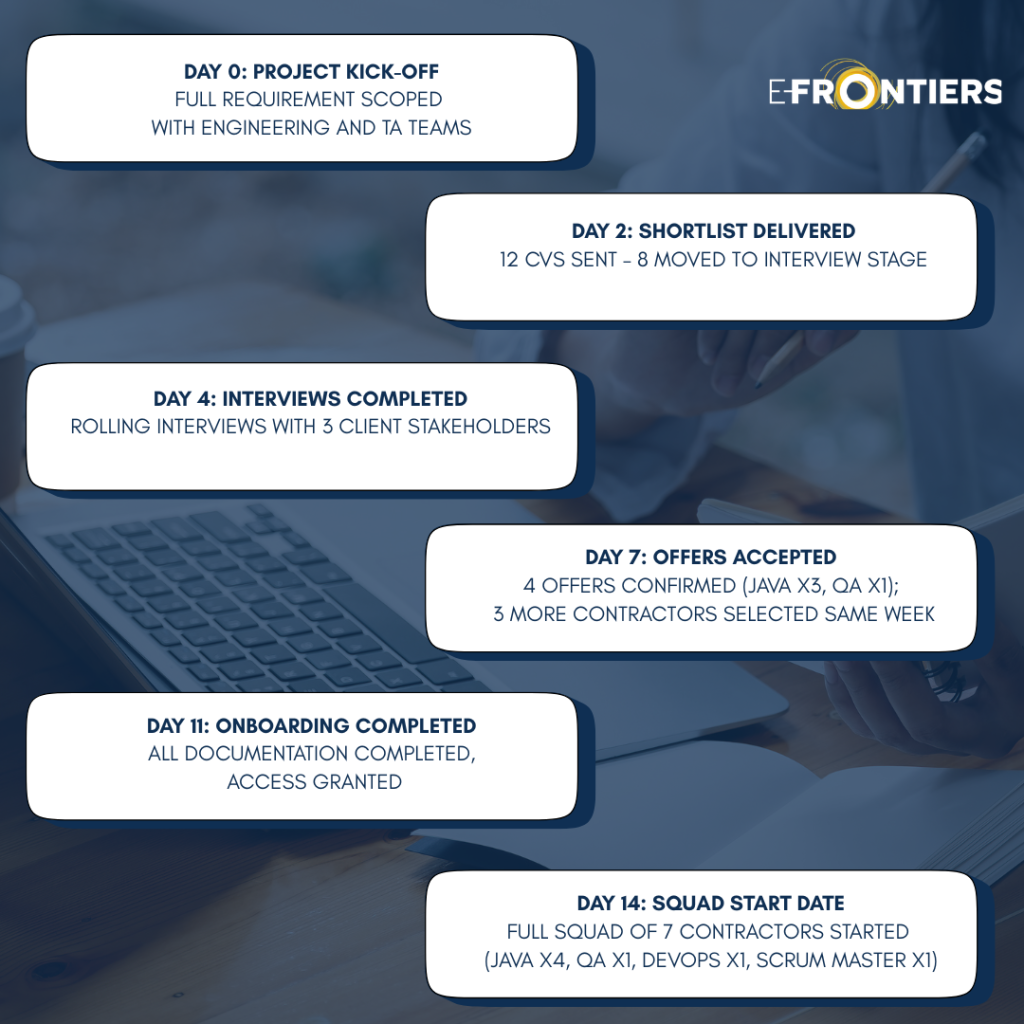
– Day 0 (Project Kick-off): Requirements gathered via live session with engineering leadership and TA partner.
– Day 1–2: Candidate pool activation via Contractor Database, network, contract market penetration.
– Day 3: 12 qualified CVs submitted.
– Day 4–6: Rolling interviews scheduled across 8 shortlisted candidates.
– Day 7: First 4 offers made and accepted.
– Day 8–9: Compliance + onboarding prep (ID verification, tax checks, background screening).
– Day 10: Equipment shipped / VPN access confirmed.
– Day 14: Full team started on-site and remote.
The Results
– 7 contractors onboarded in 14 calendar days — ahead of the client’s 3-week target.
– Zero offer rejections, 100% retention post first 3 sprints.
– Client sprint velocity achieved in week 1, contributing directly to a successful MVP delivery.
– Saved the client an estimated €80,000+ vs. typical agency time-to-hire lag (~30 days).
– Created a repeatable squad delivery model for future team builds in Q3 and Q4.
Key Takeaways
– A 14-day time-to-value is achievable with specialist contract delivery models.
– Structured shortlisting, automated outreach, and pre-qualified talent pools cut hiring timelines dramatically.
– When onboarding is managed by the recruitment partner, internal teams save dozens of hours.
Need to scale a team in weeks, not months?
Contact us to learn how our specialist contracting solutions can help you build and onboard technical squads with precision and speed.
This case study was written by Kenneth O’Connor, Head of Contracting for Ireland and the UK at E-Frontiers.
Considering Contracting in 2025? Here’s Your Essential Compliance Checklist for Ireland.
First things first: What is a contractor?
Independent contractors are professionals who offer their services or products to clients for payment but are not classified as employees. This distinction means they typically do not receive employee benefits like paid leave, sick days, or minimum wage protections. However, in exchange, contractors enjoy greater flexibility, allowing them to choose their projects, set their schedules, and work in a way that best suits their lifestyle.
Embarking on a contracting career in Ireland’s tech and project management sectors can be both exciting and rewarding. The flexibility, exposure to diverse projects, and potential for higher earnings are appealing. However, it’s crucial to stay compliant with Ireland’s regulatory and legal requirements to ensure a smooth and successful journey.
Here’s a comprehensive checklist to guide you:

1. Business Structure: Choose Wisely
Decide on the most suitable business structure for your contracting activities. This really depends on the type of person you are and your skillset. In Ireland, contractors typically choose one of the following options:
– Sole Trader: Register as self-employed, making you responsible for filing tax returns, managing pension contributions, and handling financial matters independently. This can be tricky for some and many opt to hire an accountant to assist with these responsibilities.
– Limited Company: Establishing a limited company can offer tax efficiencies and liability protection, but requires more administrative work.
– Umbrella Company: You pay an umbrella company to manage tax, pension contributions, and holiday entitlements. However, this convenience comes at a cost, often up to 15% of your salary in fees.
Each option has its implications for liability, taxation, and administrative responsibilities. Consulting with a financial advisor can help determine the best fit for you and your situation.
2. Tax Obligations: Stay Informed and Compliant
– Register with Revenue: Ensure you’re registered with the Irish Revenue Commissioners for all relevant taxes, including Income Tax, Corporation Tax (if applicable), and Value Added Tax (VAT). This is essential to avoid penalties.
– Understand Your Tax Liabilities: Familiarise yourself with the tax rates and allowable deductions for your business structure. Make sure to keep track of all legitimate business expenses so you can use these to lessen your tax burden.
– Timely Filings: Timing is very important here. You must adhere to all tax filing deadlines to avoid penalties. Hiring a professional accountant can be a huge help here.
3. Insurance: Protect Yourself and your Business
– Professional Indemnity Insurance: This covers claims arising from professional negligence or errors.
– Public Liability Insurance: Protects against claims for injury or property damage caused to third parties.
– Employer’s Liability Insurance: This one is necessary if you hire employees or subcontractors.
4. Contracts: Clarity is Key – Establish Clear Agreements
– Written Agreements: Always have a clear, written contract outlining the scope of work, payment terms, confidentiality clauses, and termination conditions. Clear agreements set expectations and work to protect both parties.
– Avoid Misclassification: ensure the client has classified you as an independent contractor and not an employee to prevent issues with Revenue.
– Review Terms Thoroughly: Understand all your contractual obligations. It is a good idea to seek legal advice if any terms are unclear.
5. Pension and Social Security: Plan for the future
– Contribute to a Pension Scheme: As a contractor, you’re responsible for your retirement planning. Setting up a personal pension plan to secure your future is crucial.
– Social Insurance (PRSI): PRSI payments are important as these are your gateway to state benefits. Ensure you’re making the appropriate Pay Related Social Insurance contributions, otherwise it may affect your entitlements.
6. Continuous Professional Development (CPD): Stay Competitive
– Invest in Learning: Stay updated with industry trends, technologies, and best practices. Regularly attending workshops, courses, and seminars can enhance your skill set and marketability.
7. Health and Safety Compliance: Prioritise Well-being
– Risk Assessments: Conduct regular risk assessments, especially if you’re working on-site or managing projects.
– Safety Statements: Prepare and maintain a safety statement as required by the Safety, Health and Welfare at Work Act.
– Training: Ensure you have the necessary health and safety training relevant to your work.
8. Data Protection: Keep Personal Information Safe
– Follow GDPR Regulations: If handling personal data, comply with GDPR rules by keeping data secure, obtaining necessary permissions, and understanding individuals’ rights regarding their information.
9. Networking: Build Your Professional Connections
– Join Professional Groups: Becoming a member of industry associations can help you meet the right people, stay updated, and enhance your credibility.
– Be Part of the Conversation: Get involved in online forums, go to industry events, and connect with others to stay in the loop and build valuable relationships.
.
Why Compliance Matters
Following the rules isn’t just about avoiding fines – it’s about setting yourself up for long-term success. Staying compliant helps you:
– Build Trust: Clients prefer to work with contractors who are professional and follow legal standards.
– Stay Financially Secure: Managing your taxes and finances properly helps you avoid surprises and ensures business stability.
– Keep Your Career on Track: Staying informed on industry regulations and best practices makes you a reliable and in-demand professional.
The Bright Side of Contracting
Once you’ve navigated the compliance landscape, contracting offers numerous benefits:
– Flexibility: Control over your schedule and choice of projects.
– Diverse Experience: Exposure to various industries, technologies, and methodologies.
– Potential for Higher Earnings: With the ability to set your rates and manage your workload, there’s potential for increased income compared to traditional employment.
By proactively addressing compliance requirements, you can pave the way for a rewarding and dynamic contracting career in Ireland’s tech and project management sectors.
For further reading and resources, consider exploring the following:
– Benefits of Contracting: Pros and Cons of Being a Contractor
– Current contract jobs – E-Frontiers
– Useful Contacts:
– E-Frontiers | Head of Contracting Ireland & UK Kenneth O’ Connor
– E-Frontiers | Contracts Manager Trish Lynch
Embarking on this path requires diligence and proactive management, but with the right approach, contracting can be a fulfilling and prosperous career choice.

We are now into our 13th year of sponsorship of Thurles Sarsfields GAA club. It is Tipperary’s oldest GAA club, and we are proud to be associated with such a legendary club that has produced many wonderful sporting heroes and moments.
E-Frontiers has a personal connection to Sarsfields. Our Managing Director, Brendan Carroll, proudly wore the blue of Thurles Sarsfields and has represented both club and county at all grades.
Our sponsorship is about supporting a club that has supported its community so well throughout its 138-year history. It is about giving back, supporting our communities, and all within them, where everyone matters. It’s about being part of where we live and what we do.
There have been many famous members of Thurles Sarsfields GAA club down through the years, and names like Semple, Doyle, Stakelum, Corbett, and Maher are synonymous with this great club.
E-Frontiers are delighted to sponsor all club teams in Hurling, Gaelic Football, Ladies Football, and Camogie across all age grades. It is a wonderful association that we are very proud of.
We look forward to the upcoming season with anticipation.
AI is no longer the future, it’s here, it’s now. And although you may not fully understand its origins or scope (learn more from Statista.com here) you are probably already a little fed up hearing about it.
Thanks to AI, we can now source, screen, and shortlist candidates faster than ever. From smart systems that scan CVs, to scheduling tools and chatbots that talk to candidates 24/7, it’s fair to say the game has changed. And that’s a good thing, mostly.
But while the machines are getting smarter, one thing hasn’t changed: the importance of the human touch. When it comes to finding the right hire, it still takes a recruiter with intuition, empathy, and a bit of gut instinct to get it right.
Finding the Balance
For those of us working across Tech, Construction, and Business Support here in Ireland, it’s now about striking the right balance – leveraging all the efficiency AI gives us, without losing sight of the relationships, conversations, and soft skills that make people thrive in a role.
The Power of AI in Modern Recruitment
AI has genuinely transformed how we work.
We use it to:
– Screen CVs in seconds
– Identify skills matches
– Predict offer acceptance
– Analyse talent trends with LinkedIn Talent Insights
– Run AI-powered coding and certification checks
– Use chatbots to streamline first-round screening
And It’s Working
The Irish recruitment market is showing cautious but steady growth (see more from Irish Jobs.ie here) – up 5% quarter on quarter for Q1, with standout areas like:
Sales: +28%
Healthcare: +16%
This means we need to be more efficient than ever with our time and tools. But as automation does more of the heavy lifting, it raises an important question:
What are we doing with the time we save?
AI Can’t Replace Empathy (and That’s a Good Thing)
For all its clever algorithms, AI still can’t read between the lines.
It doesn’t know when a gap in a CV reflects a personal challenge overcome.
It can’t sense passion, energy, or cultural fit from keywords alone. It might overlook a strong candidate who simply didn’t include the exact phrasing a machine is looking for.
In The Real World
The best developers aren’t always the flashiest on paper.
In Construction, leadership on-site can’t be measured by an algorithm.
And in a Business Support role, you need someone who can read a room, handle a tough call, or support a team when things get busy. AI can’t assess those moments—but we can.
A brilliant software developer may not shine in a video screening but would thrive in a real-world, collaborative team. AI might miss that.
A project manager’s calm under pressure doesn’t show on a CV scan.
As recruiters, we know when to lean in, ask the right questions, and spot those gems that a machine might miss.
Why Soft Skills Matter More Than Ever
In today’s job market, soft skills aren’t just nice to have – they’re critical.
Read more insights on this in a recent article from Silcon Republic here.
Traits like:
– Communication
– Emotional intelligence
– Teamwork
– Resilience
– Adaptability
These are the traits that help people navigate change, manage relationships, and ultimately stay and succeed in a role long term.
That’s where skills-based hiring comes into play. More and more companies are moving away from just hiring based on job titles or education history, and instead asking:
“What can this person actually do?”
According to LinkedIn’s research in their report on ‘The Future of Recruiting 2025’:
– 93% of talent acquisition professionals believe accurately assessing a candidate’s skills is key to making quality hires.
– Companies using more skills-based searches are 12% more likely to land the right person.
Of course, really getting to know someone’s skillset – especially their soft skills – takes time. But this is where AI has started helping in a meaningful way.
Recruiters who’ve adopted GAI tools say the time saved often goes back into better candidate assessment:
– 35% of recruiters using GAI tools say the time saved goes into screening candidates more thoroughly
– 26% use it specifically to evaluate soft skills
– 70% expect hiring efficiency to improve
– 33% expect quality of hire to increase
AI helps us do the technical work faster – so we can spend more time understanding the person behind the profile.
The Recruiter’s Role in the Age of AI
So where do recruiters fit in now?
Right where we’ve always been – in the middle, connecting the dots.
AI might show us who’s available, but it takes human insight to know who’s right. That takes instinct, experience, and conversations that build trust.
At E-Frontiers, we use AI and automation to support our process – but we don’t outsource our judgment. Whether it’s a Systems Architect, a Safety Officer, or a Customer Support Lead, it’s our job to look beyond the data and understand the bigger picture.
Because recruitment isn’t just about filling roles.
It is always about the people. It’s about potential. And that’s something no machine can fully grasp.
Conclusion: Embracing AI, Keeping It Human
The future of recruitment is clearly tech-enabled, and that’s something to be welcomed.
AI is helping us work smarter, move faster, and deliver better results for our clients and candidates.
But let’s not forget that recruitment is still a people business.
Here in Ireland, especially, where hiring is often about relationships, referrals, and long-term cultural fit, soft skills will always matter.
AI can find the right CV. But it’s still up to us to find the right person.
If you would like help in your search for the right hire, please get in touch with us today.
Nigel Bolger Commercial Manager
+353 86 3888147
Nigel.bolger@e-frontiers.ie
.

Our Online Event
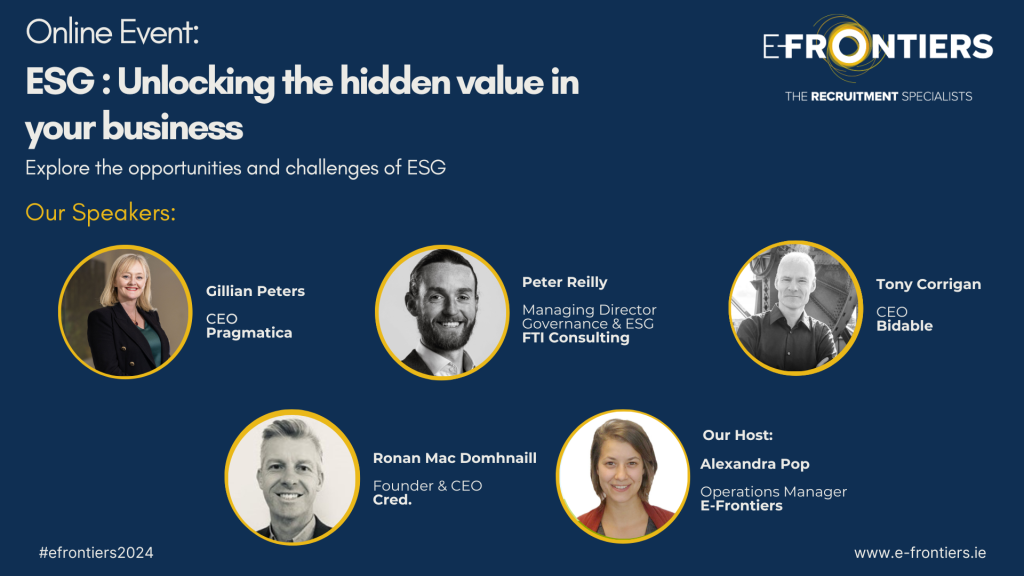
On October 24th we had the pleasure of hosting a roundtable event on ESG. This event was designed for business leaders, sustainability professionals, and anyone looking to explore how ESG is transforming business practices.
In this event, we brought together a panel of industry experts to share their perspectives on the trends, challenges, and opportunities that ESG presents. Alexandra Pop, Operations Manager @ E-Frontiers moderated and guided this conversation which addressed a wide range of topics.
Gillian Peters’ career has spanned various roles, primarily in marketing and business development within financial services. As Business Development Director at CPA Ireland, she earned her MBS in Business Practice and developed a deep interest in sustainability in business.
In February 2023, she transitioned to CEO of Pragmatica, where her mission is to create tailored roadmaps and innovative solutions that guide companies on their sustainability journeys.
Tony Corrigan With over a decade of experience in government bidding, Tony Corrigan has focused on helping SMEs succeed in public contracts. He founded TenderScout in 2014 to guide SMEs through the tendering process, equipping them with effective tools and strategies.
In 2023, Tony launched Bidable.ai, an AI-driven platform that enhances bids with precise insights, showing businesses their expected scores and ways to improve. This platform, built on Tony’s expertise, is a critical resource for SMEs aiming to win in the competitive tendering arena. His dedication to SME success remains the core of Bidable’s mission.
Peter Reilly Managing Director of Governance and ESG at FTI Consulting , advises major global companies on corporate governance, focusing on reporting, stakeholder engagement, remuneration, and ESG strategy development to meet institutional and regulatory standards. With deep expertise, Peter has led activist defense programs across the US and Europe, enhanced governance frameworks for boards, and conducted proxy support strategies.
Previously, he served as Lead Analyst for Northern Europe at Glass Lewis, overseeing ESG research and recommendations. He holds a BA in Economics, Politics, and Law from Dublin City University and an LLM from Trinity College Dublin.
Ronan Mac Domhnaill is the founder of Cred, a Sydney-based Education and Technology company.
Cred’s focus is on the “Social” side of ESG.
Cred helps organisations:
– Engage, retain, and attract top talent.
– Create the right culture – balancing profit, people and purpose.
– Bridge the generational leadership gap
– Identify future leaders
– Use ESG as a competitive advantage
So that they can increase their bottom line sustainably.
Our experts addressed topics such as:
Understanding ESG: Beyond Recycling
-Definition and scope of ESG (Environmental, Social, Governance) and how it differs from traditional sustainability practices.
-Discussion on why businesses are increasingly considering ESG, especially in B2B vs. B2C contexts.
External and Internal Factors Influencing ESG Strategy
-External factors: capital accessibility, supply chain, customer demands, and reporting obligations.
-Internal factors: workforce capabilities, talent competition, and aligning governance structures to support sustainability goals.
Navigating ESG Reporting and Social Responsibilities
-Overview of CSRD thresholds and VSME voluntary reporting for SMEs.
-Considerations for businesses when evaluating the social aspects, such as supply chain transparency, staff policies, and community engagement.
Our discussion helps to define ESG’s scope beyond traditional sustainability and explores the internal and external factors driving ESG strategies. Our expert panel sheds light on key issues shaping this evolving landscape and offers practical takeaways on ESG reporting and the importance of aligning social responsibilities with business goals.
If you missed it, reach out to our team today to learn how ESG can benefit your organisation.

Why put DEI on your agenda?
It is important that the diversity efforts of organisations are intentional and visible and drive meaningful change. Efforts must be visible both internally and externally, demonstrating the organisation’s commitment to diversity, equality, and inclusion and fostering trust among employees, customers, and other stakeholders.
Poll Results
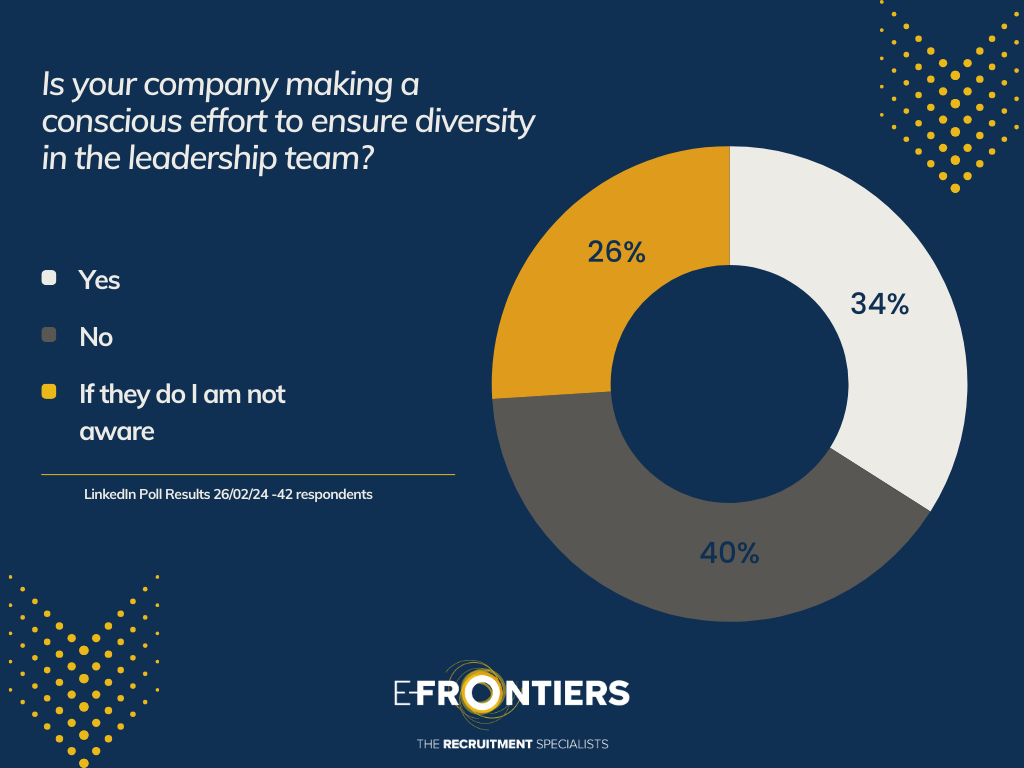
We recently asked our followers -‘Is your company making a conscious effort to ensure diversity in the leadership team?’ LinkedIn Poll 26/2/24
- 34% responded with Yes
- 40% responded with No
- 26% responded with ‘If they do, I am not aware’
It is food for thought that 66% felt that their company was not doing enough in terms of diversity and/or any efforts they were making were not visible, even to staff and team members.
Employers often require support and specialist external help in developing and amplifying the visibility of their Diversity, Equality, and Inclusion (DEI) initiatives, and could benefit from assistance with narratives and communication strategies. Coordinating a DEI plan requires guidance and planning to ensure alignment with organisational goals and foster a culture of genuine inclusion.
Diversity Live Event
We recently hosted a live panel discussion event on Diversity, Equality and Inclusion. This was held on International Women’s Day and featured four incredible speakers who shared invaluable perspectives on fostering DEI within the workplace. Our E-Frontiers team members Alexandra Pop, Recruitment Operations Manager, and Kenneth O Connor, Head of Contract Recruitment UK & Ireland, facilitated the engaging conversations that delved into a wide range of topics.
Our Speakers
Jeanne Mc Donagh : CEO : Open Doors Initiative Jeanne has over 30 years’ experience in DEI, politics, campaigning, mental health and LGBTQ+ issues and board work
Sandra Healy : CEO & Founder : Inclusio : Sandra is an Engineer, an Organisational Psychologist and NLP Master Practitioner. She has championed and driven diversity and inclusion practice across industry for over 18 years.
Garima Walia : Talent Acquisition Manager : Uniphar : Garima possesses a rich and extensive background in recruitment and talent acquisition, accumulating over 15 years of invaluable experience spanning diverse industries.
Gary Lawson : Director of Talent Acquisition : Mastercard :Gary has over 20 years of experience as a recruitment specialist and is responsible for talent attraction, strategy & branding at Mastercard’s technology and innovation hub in Dublin.
Our speakers touched on areas such as:
- How to bring organisations on board with DEI
- Gaining leadership buy-in
- Cultivating a culture of inclusive leadership
- Addressing the gender gap
- Implementing metrics and tracking progress
- Offering advice for startups embarking on their DEI journey
- How organisations can be more visible with their DEI efforts
- Lessons they have learned along the way
Conclusion
The wealth of information shared during the event provides a roadmap for businesses and clients aiming to enhance diversity and inclusion. Whether you’re a seasoned company looking to add to your DEI efforts or a startup seeking to lay a strong foundation, our speakers offered invaluable insights to support your efforts and ambitions.
You can catch up with the full event here:
Let’s continue to learn, grow, and create more inclusive workplaces together!
Contact us to find out more about our commitment to DEI policies in our workplace and in our recruitment practices

