


Salaries, Benefits and Opportunities Across Europe
By Mark Kelly | E-Frontiers Recruitment | Data Centre Construction Recruitment
If you work in data centre construction, have you ever wondered whether your salary reflects your experience and the value you bring to a project?
With complex builds, tight deadlines, and growing demand for specialist skills, experienced construction professionals are essential to delivering the next generation of data centres.
As we look towards 2027, understanding your market value and exploring opportunities beyond Ireland could open new doors for your career and finances.
At E-Frontiers, we connect experienced data centre construction professionals with opportunities across Ireland and Europe.
Europe: Opportunities to grow your career and savings
Ireland has an established data centre market, but opportunities extend across Germany, the Netherlands, the Nordics, Spain and other European locations.
For professionals in project management, quantity surveying, construction management, mechanical and electrical engineering, or commissioning, these markets offer the chance to work on major projects, develop specialist expertise, and gain valuable international experience.
But the benefits can go beyond career development
Working in Europe can also be a great opportunity to save more of your salary, as many employers provide accommodation or contribute to living and travel expenses. This may allow you to put a greater proportion of your earnings towards savings, paying off a mortgage, or building your financial future.
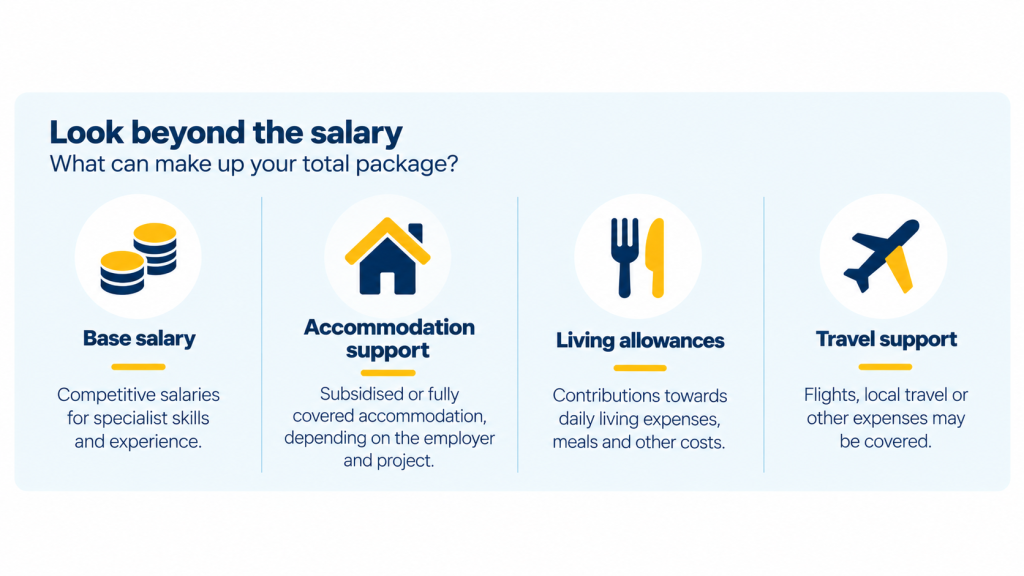
Of course, every package is different. Tax, travel arrangements, contract terms, and the precise benefits offered all need to be considered. Looking at the total value of an employment package, rather than salary alone, could reveal opportunities you might otherwise overlook.
There is also the lifestyle benefit. Spending a year or two working in Germany, the Netherlands or the Nordics will allow you to experience a new culture, meet international teams and strengthen your CV while working on major infrastructure projects.
For some professionals, staying in Ireland will be the right choice. For others, working abroad could offer the opportunity to earn, save and develop their careers at the same time.
Ireland remains a strong foundation for international opportunities
Ireland’s data centre construction sector has given many professionals experience in complex, mission-critical environments across civil, structural, mechanical and electrical disciplines.
That experience can be valuable when exploring roles elsewhere in Europe. Employers look beyond job titles to understand the projects you have delivered, the technical challenges you have managed and the level of responsibility you can take on.
Whether you specialise in M&E, commissioning, project management, construction management or quantity surveying, your experience may be transferable across markets.
Experience gained in pharmaceutical construction, industrial projects and other mission-critical environments may also be relevant to data centre employers.
The key is understanding where your skills are most in demand and which opportunities align with your career ambitions.
What affects your salary in data centre construction?
There is no single salary benchmark that applies to every professional in the sector. Your overall package will depend on several factors.
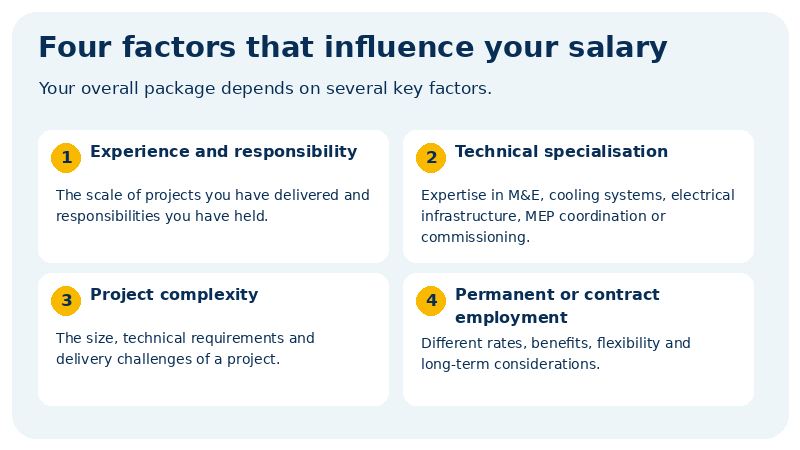
Your experience, technical knowledge, and the responsibilities you take on can all influence your market value. Before comparing opportunities, make sure you understand what each role involves and what is included in the package.
Contract roles may offer flexibility and attractive rates, while permanent positions can provide continuity, pension contributions, paid leave and other benefits. It’s worth comparing the complete package, including expenses, holidays, gaps between contracts and tax considerations, before deciding which option suits you best.
What should you consider before accepting an offer?
Salary is important, but the right opportunity should make sense financially, professionally, and personally.
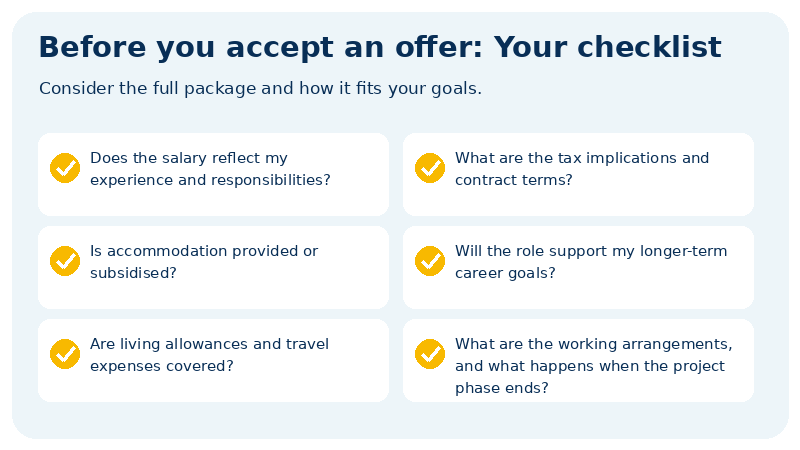
This checklist of questions is particularly important when considering an international role. A higher headline salary does not always mean more money in your pocket, just as a lower salary does not necessarily mean a less attractive offer.
Understanding your likely expenses and the benefits included is essential.
Planning your next move in 2027?
At E-Frontiers, we connect data centre construction professionals with opportunities across Ireland and Europe.
Whether you’re considering your next project in Ireland or exploring opportunities across Europe, it pays to understand what your experience and specialist skills are worth.
Our data centre construction recruitment team can help you explore current opportunities, compare packages, and understand what different markets have to offer.
Get in touch with E-Frontiers to discuss your next career move.
Colm Costello | Head of Construction Recruitment
Mark Kelly | Senior Recruitment Consultant
Muiris Fitzgerald | Recruitment Consultant
E-Frontiers’ perspective on data centre construction recruitment
October 2026.
E-Frontiers supports businesses across Ireland, the UK, Europe, and the US through a connected, cross-border recruitment model.
Hiring has become increasingly borderless, with companies now competing for talent on a truly international scale.
In today’s hiring landscape, the best talent rarely sits neatly in one location. For many organisations, the challenge is no longer just finding great people – it’s finding them in the right place, at the right time, with the flexibility to scale across multiple markets.
That’s where E-Frontiers comes in.
With established teams and networks across Ireland, the UK, mainland Europe, and the United States, we operate as one connected recruitment partner rather than a series of standalone offices. This means our clients can access talent locally, regionally, and internationally – all through a single, integrated team.
A truly connected international footprint
From our head office in Dublin, our teams work seamlessly with colleagues in London, Madrid, and New York, giving us direct access to four key talent markets.
This structure matters. It means we’re not limited by geography when a role becomes difficult to fill – instead, we can immediately expand the search across borders, tapping into established candidate networks and local market knowledge in each region.
Whether it’s a niche IT requirement in Ireland, a construction leadership role in the UK, a team of finance contractors across Europe, or scaling a project team in the US, we can move quickly and cohesively across markets.
Scaling teams at speed, wherever you need them
One of the biggest advantages we offer clients is the ability to scale teams quickly across multiple locations.
Because our consultants work closely within their specialist markets, they have a clear understanding of local salaries, talent availability, and hiring trends. This helps us create hiring plans that are practical, efficient, and tailored to each location.
Working with one recruitment partner also makes the process much simpler. Instead of managing multiple agencies across different regions, you have one coordinated team, helping to reduce delays and speed up hiring.
For companies expanding into new markets or growing teams across several countries, this joined-up approach helps keep recruitment moving quickly and smoothly.
Going further to find the right candidate
Sometimes the right hire isn’t in your immediate market – or even actively looking.
Our international network allows us to widen the search when needed, identifying candidates who may be open to relocation, returning home, or moving for the right opportunity. This is particularly valuable in sectors where demand is high and local supply or skills are tight.
By combining deep local knowledge with a broader international reach, we’re able to find talent that others may miss – and present candidates who are not just qualified but aligned to long-term business needs.
A partnership approach, not just a placement model
At the core of E-Frontiers is a simple idea: recruitment works best when it feels like a partnership.
Our teams act as an extension of your hiring function, providing market insight, honest advice, and access to specialist talent pools across multiple sectors, including Technology, Construction & Engineering, Finance, and Business Support.
That means you’re not just reacting to hiring needs – you’re planning with better visibility of what’s happening in each market.
Built for a borderless talent market
As companies grow across different regions, the need for flexible, scalable, and connected hiring solutions is only increasing.
E-Frontiers is built for this — helping clients move talent where it’s needed, when it’s needed, without being limited by geography.
As you plan your next phase of growth, we can help make hiring across borders simpler, faster, and more effective.
If you’re planning growth across Ireland, the UK, Europe, or the US, get in touch with the E-Frontiers team to see how we can support your hiring strategy.
Contact: Nigel Bolger | Commercial Manager
Email:Nigel.bolger@e-frontiers.ie
Phone: 00 353 86 3888147
Website: E-Frontiers Recruitment Agency
The Irish construction industry is buoyant at present, with increasing demand for Housing/Apartments, Data Centres, Pharmaceutical projects, Infrastructure works etc. While a workforce shortage has made it challenging to secure skilled professionals for these areas, this also means exciting opportunities for top talent are available.
At E-Frontiers, we deal with the top Tier 1 and Tier 2 Contractors and Residential Developers in Ireland. If you’re currently based in Ireland and exploring new career options or looking to return home in the near future, now is the perfect time to take the next step in your career.
We have summarised some information below about the top construction roles that are in demand at present and how you can contribute to some of the most dynamic and high-profile projects in the industry.

Quantity Surveyors (QS’s)
Quantity Surveyors are indispensable for cost management and financial planning in construction projects. They ensure projects stay on budget without compromising quality.
-Salaries/Packages:
Junior/Project level – €45,000 to €70,000 plus transport & package
Senior QS level – €70,000 to €90,000 plus transport & package
– Qualifications:
A degree in Quantity Surveying, Construction Economics, or a related discipline. Membership in professional bodies like the Society of Chartered Surveyors Ireland (SCSI) is highly desirable though not essential.
As the candidate what’s in it for you:
QS professionals will have the opportunity to influence critical project decisions, develop in-depth financial expertise, and collaborate with multidisciplinary teams. Senior roles offer leadership and strategic planning experience in complex projects.
As the company what can you do:
Emphasise involvement in high-profile projects, flexible working options, and a strong focus on employee well-being to attract top QS talent, CPD opportunities are also very beneficial.
Site/Senior Engineers
Site and Senior Engineers play a critical role in the successful delivery of projects. They are responsible for setting out and ensuring design specifications are met, and maintaining quality standards.
-Salaries/Packages:
Site/Setting Out Engineers – €50,000 to €65,000 plus transport & package
Senior Engineers – €70,000 to €85,000 plus transport & package
-Qualifications:
A degree in Construction Management, Civil or Structural Engineering is typically required, alongside experience with setting-out equipment like total stations and GPS
As the candidate what’s in it for you:
This role offers a chance to bring your existing skillset and knowledge to assist high-profile projects and developments to completion, develop expertise in advanced engineering tools, and progress into leadership positions such as Site/Project Management. Engineers will gain exposure to dynamic environments that challenge their problem-solving and technical skills.
As the company what can you do:
Highlight opportunities for professional development, exposure to cutting-edge technologies, and a supportive team environment. Providing competitive benefits packages, CPD opportunities where possible and clear career progression pathways are vital.
Site Manager/Site Supervisor
These roles involve overseeing on-site operations, managing teams, and ensuring projects are delivered on time and within budget.
-Salaries/Packages:
Site Supervisor/Finishing Foreperson – €60,000 to €70,000 plus transport & package
Site Agent/Manager – €70,000 to €85,000 plus transport & package
-Qualifications:
A background in Construction Management, Engineering, or Trade Qualifications, coupled with strong leadership skills and relevant on-site experience.
As the candidate what’s in it for you:
Site Managers and Supervisors gain leadership experience, exposure to complex construction projects, and the satisfaction of seeing their work take tangible form. These roles are stepping stones to senior management positions in the construction industry.
As the company what can you do:
Highlight the opportunity to lead high-impact projects, provide ongoing leadership training, and offer performance-based bonuses.
Health and Safety Advisors
Health and Safety Advisors are key to ensuring compliance with safety regulations and creating a safe working environment.
-Salaries/Packages:
Junior/Inter level – €40,000 to €60,000 plus transport & package
Senior/Manager level – €65,000 to €85,000 plus transport & package
-Qualifications:
Diploma Level 6 in Occupational Health and Safety, NEBOSH, IOSH, or other recognised safety certifications, combined with experience in construction safety management.
As the candidate what’s in it for you:
Advisors will contribute directly to creating safer workplaces while building your expertise in risk management and compliance. The role offers opportunities for recognition through successful safety initiatives and pathways to senior safety leadership roles.
As the company what can you do:
Showcase your commitment to safety through robust training programs, and recognition schemes for safety performance, along with opportunities for certifications or further education.
Site Manager/Site Supervisor
These roles involve overseeing on-site operations, managing teams, and ensuring projects are delivered on time and within budget.
-Salaries/Packages:
Site Supervisor/Finishing Foreperson – €60,000 to €70,000 plus transport & package
Site Agent/Manager – €70,000 to €85,000 plus transport & package
-Qualifications:
A background in Construction Management, Engineering, or Trade Qualifications, coupled with strong leadership skills and relevant on-site experience.
As the candidate what’s in it for you:
Site Managers and Supervisors gain leadership experience, exposure to complex construction projects, and the satisfaction of seeing their work take tangible form. These roles are stepping stones to senior management positions in the construction industry.
As the company what can you do:
Highlight the opportunity to lead high-impact projects, provide ongoing leadership training, and offer performance-based bonuses.
Building Services Manager
Building Services Managers ensure that electrical, mechanical, and plumbing systems are integrated seamlessly into construction projects. They are pivotal for large-scale developments.
-Salaries/Packages:
Building Services/M&E Coordinator – €60,000 to €75,000 plus transport & package
Building Services/M&E Manager – €75,000 to €90,000 plus transport & package
-Qualifications:
A degree in Building Services, Mechanical, Electrical Engineering, and/or a trade background as a plumbing, electrician, or fitter, with extensive experience managing MEP services.
As the candidate what’s in it for you:
This role offers candidates the chance to get exposure to & to be involved in innovative high-profile Technology, Data Centre & Pharmaceutical projects, to specialise in green building practices, and work with cutting-edge technology. Building Services Coordinators & Managers are critical in shaping sustainable infrastructure and advancing their professional expertise.
As the company what can you do:
Stress the importance of their role in innovation and sustainability, offer opportunities to work on cutting-edge green building projects, and provide favourable benefits packages.
Conclusion
To thrive in Ireland’s competitive construction sector, it’s important to consider what makes a role truly stand out. Top candidates are looking for more than just a pay cheque – they want opportunities for career growth, professional development, work-life balance, and a positive workplace culture. Companies that prioritise employee satisfaction, offer unique benefits and create an environment where people feel valued will attract the best talent.
If you’re exploring new opportunities, look for employers who offer not only competitive salaries but also have a good work-life balance, good company culture, offer the chance to grow, showcase your skills, and be part of successful projects. Whether you’re a Site Engineer or a Building Services Manager, finding a company that aligns with your career goals and values is key to taking the next step in your professional journey.
Are you looking for your next role or top talent in the construction sector?
2. Connect on LinkedIn with our Construction Recruitment Specialist – Mark Kelly
3. For visibility of all our roles visit the jobs section of our website
4. Click here to find out more about our areas of expertise in the construction industry
If you’ve worked in construction or engineering in Ireland for any length of time, chances are you’ve crossed paths with Colm Costello. With over 25 years experience in construction recruitment, he’s seen the market change, grow, slow down, and ramp back up again. Here’s Colm, in his own words, on what he does, how E-Frontiers supports clients and candidates, and what he’s seeing in the market as we head into 2026.
Colm, for anyone who doesn’t know you, can you tell us a bit about your background and what you do at E-Frontiers?
I currently lead the Construction & Engineering desk at E-Frontiers Recruitment, alongside my colleague Mark Kelly. Our focus is on building and driving a recruitment function that supports clients across Ireland’s construction and engineering sectors.
My role covers client relationship management, business development, market research, talent strategy, and mentoring recruitment consultants. Alongside all of that, I remain as hands-on as possible for both candidates and clients with general recruitment, which is something I’ve always felt is hugely important.
You’ve been in construction recruitment a long time – how did you get started, and what’s shaped your approach over the years?”
I bring over 25 years of industry experience, having started my career on the labour and trades side of construction recruitment before moving into the more white-collar, professional services side of the sector. Prior to joining E-Frontiers, I spent almost 17 years as Director of Brightpath Recruitment, specialising exclusively in construction and engineering roles across Ireland.
Before that, I held a Senior Commercial Manager role with O’Neill & Brennan. This was effectively a business development role and gave me first-hand exposure to senior commercial and operational construction professionals, the people making daily and weekly decisions that directly impacted delivery on their sites.
What kinds of roles and professionals have you worked with throughout your career?
Throughout my recruitment career, I’ve worked on key roles including Project Managers, Site Managers, Supervisors and Forepersons, Setting Out Engineers, Quantity Surveyors, Estimators, Health & Safety Officers, Mechanical and Electrical Engineers, BIM Coordinators, and Site and Office Administrators, among many other site- and office-based construction professionals.
That background allows me to advise both clients and candidates with a practical, market-led perspective, rather than taking a purely transactional approach to recruitment.
How would you describe the Construction & Engineering offering at E-Frontiers?
The Construction & Engineering offering we’ve built at E-Frontiers is centred around long-term partnerships rather than short-term placements. We work closely with clients to understand their project pipelines, workforce challenges, and future growth plans. This allows us to deliver informed hiring solutions, rather than reactive recruitment.
From a client’s point of view, how do you actually support companies with their hiring?
For clients, this includes talent mapping, salary benchmarking, and market insight to support strategic decision-making.
And on the candidate side, what can people expect when they work with you and the team?
For candidates, it means a professional and confidential service, guiding them through the recruitment process and helping them secure roles that align with their career goals, lifestyle considerations, and long-term progression within the construction and engineering sector.
When does Executive Search come into play, and how does that process work?
At E-Frontiers, we also offer an Executive Search service. These searches are targeted, consultative recruitment processes, typically used to hire senior leaders within an organisation, but also, on occasion, to source highly experienced candidates in key areas of a business.
As specialists in Executive Search, we map the market, discreetly approach high-calibre passive candidates, and rigorously assess them against both the role requirements and fit with company culture. We manage the entire process from shortlist and interviews, through to offer and onboarding. It’s a thorough and confidential process designed to find the right long-term fit.

Looking ahead to 2026, what trends or challenges stand out to you?
Looking ahead to 2026, the Irish construction market remains highly competitive for experienced professionals, particularly across engineering, commercial, and site management roles. Skills shortages are most evident at mid-to-senior level, with demand remaining high.
This demand is being driven by buoyancy across several key areas: residential development, due to the ongoing shortage of accommodation nationwide; infrastructure projects, including the Metro project on the horizon; and continued investment in data centres and life sciences projects, which have been central to the industry’s growth in recent years. We’re also seeing clients place increasing importance on adaptability, leadership capability, and candidates who can operate effectively across multiple project types. Retention, succession planning, and employer branding are becoming just as critical as recruitment itself.
How has the construction recruitment landscape changed over the years?
One of the biggest changes over the years is how informed and selective candidates have become. While salary is still high on the list, factors such as project location, work-life balance, travel requirements, and company culture are now playing a much bigger role in decision-making.
From a client perspective, recruitment has evolved into a far more strategic function. Companies that engage early, move efficiently, and partner closely with specialist recruiters are consistently more successful in securing and retaining top talent in what is now a very candidate-driven market.
What advice would you give to construction professionals thinking about their next move?
If you’re working in construction or engineering and thinking about your next move, or if you’re simply curious to find out more about what the construction market looks like right now, I’m always happy to have a chat. No pressure, no hard sell – just an honest conversation about where you’re at and where you want to go.
So, if someone is considering a move or just wants a bit of honest market insight, what should they do next?
Clients and candidates can contact me at any time for a chat, through LinkedIn, or via email/phone.
Colm Costello | Head of Recruitment | Construction`& Engineering
Email: colm.costello@e-frontiers.ie
Phone: 00 353 87 2294001

The Return Home: Why Returning Irish Emigrants Are a Hidden Talent Advantage for Employers
As the demand for skilled professionals intensifies across Ireland, especially in engineering, construction, and finance, one often underutilised talent pool stands out: Irish professionals returning home.
Driven by family ties, improved career opportunities in Ireland, and the rising cost of living in other countries, thousands of Irish professionals are coming back with international experience, mature skill sets, and a strong desire to settle and grow their careers here.
For employers competing in tight talent markets, this group represents a smart, culturally aligned talent pool.

Top Stats You Should Know
The Returners
– Over 30,000 Irish nationals returned home in the year to April 2024 – a 17% year-on-year increase (CSO Ireland).
– Returnees are typically in their 30s, bringing 10+ years of international experience across sectors like construction, engineering, tech, and finance.
– Economist John FitzGerald, Irish Times, notes a common pattern: “Many young Irish people emigrate in their twenties and return in their thirties. Returnees often bring with them valuable international experience, enhanced skill sets, and a strong desire to settle and progress their careers in Ireland” (Irish Times).
– Returnees typically earn 10% more than stay-at-homes, indicating high-skilled and high-value talent returning home.
The Market
– Ireland is near full employment (CSO). Unemployment stands at just 4.0%, well below the EU average of 6.1%.
– The skills gap remains acute. The most recent Labour Market Monitor report Q2, 2025, from ERI/IPSOS B&A, identifies shortages in Construction, Nursing, Engineering, Accounting, and Software Development.
– This report also notes a growing sense of risk aversion to move among candidates already in jobs, leading to longer tenures in roles compared to even as recent as 2022, making it harder for employers to attract good talent.
– 13% of Irish job seeker interest came from abroad in 2024(Indeed). This is a record high. Applications for work permits also hit a record high last year, with 39,390 permits issued (+27% yoy). 6,500 of these permits were in the IT and Comms tech area.
SPOTLIGHT ON:
Finance & Accounting: Returning with International Edge
In forecasting trends for 2025, the IFSC.ie expects a sustained influx of expats returning to Ireland. In finance, returners offer a competitive edge through:
– Exposure to global regulatory environments (especially from London and North America).
– Strong experience in financial planning, audit, risk, compliance, and reporting.
– Ambition to join growing Irish firms and contribute long-term.
With talent shortages in mid to senior finance roles, returning professionals can often step in quickly, minimising training time and adding value from day one.
Conor Hackett, Principal Consultant – Accounting & Finance:
“We are seeing an increase in Irish professionals returning, mainly from London, Australia, and Canada. Family is the main driver, often starting families or wanting to be closer to home. However, opportunities and pay in Ireland don’t always compare to London, so some professionals are splitting time – commuting weekly from Dublin to London. Employers could do more by widening their advertising and social media focus, strengthening employer branding, and offering greater flexibility in the hiring process.”
Construction: Skills Gaps Meet Global Experience
Ireland’s construction sector is facing a well-documented labour shortage. From housing to data centres and infrastructure, projects are ramping up, but skilled professionals are in very short supply. For employers, this means that competition for returners with construction expertise will only intensify as project pipelines grow.
We’re seeing strong interest from:
– Engineers and Quantity Surveyors returning from the UK, Australia, Canada, and the Middle East.
– Site Managers and Safety Officers with experience on large-scale international projects.
– Civil and Structural Engineers motivated to return for family and quality-of-life reasons.
Mark Kelly, Senior Consultant – Construction & Engineering:
“We’ve seen a noticeable increase in construction professionals returning, though numbers are still limited due to housing availability and rising living costs. Candidates are drawn by Ireland’s strong project pipeline and long-term stability. Family and career progression remain key motivators.
– Returnees bring international experience delivering complex builds, exposure to high safety standards, and adaptability to diverse teams – allowing them to contribute quickly on-site. Employers can attract and retain this talent by highlighting project pipelines, structured onboarding, competitive packages, and short-term relocation or accommodation support.
– For employers looking to hire in the next 6–12 months, plan ahead: showcase long-term growth, move quickly in the hiring process, and provide reassurance on career stability and practical support, such as accommodation assistance, to secure these highly skilled candidates.”
Paula Coffey, Principal Consultant – Sales & Marketing:
“The number returning is still small, but the UK and Australia are the most common locations. Again, family is the consistent theme. For employers, flexibility is key – many returners come from places like Australia with excellent work-life balance. Offering flexible schedules or hybrid arrangements can make Ireland more attractive.”
Anca Antonica, Principal Consultant – Information Technology:
“I’ve noticed a steady increase in Irish professionals returning, mainly from the UK, the Middle East, and the US. Family ties and quality of life are the strongest motivators, with the added benefit that remote and hybrid work makes the move home more feasible. These candidates bring not only international experience but also diverse perspectives, adaptability, and often valuable language and cultural skills.
While some employers are starting to adapt, more could highlight flexible arrangements – for example, hybrid models with limited office days, relocation support, and clear career progression – to truly appeal to returnees. From my conversations, flexibility is the real differentiator. Clients who offer competitive packages alongside strong career development pathways will stand out against global opportunities and be best positioned to secure this talent.”
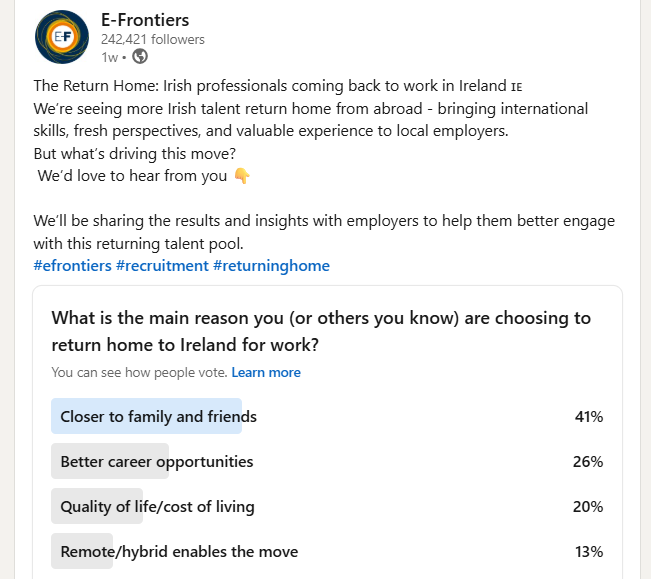
Poll Results: Why Are Irish Professionals Coming Home?
We asked our LinkedIn community: What is the main reason you (or others you know) are choosing to return home to Ireland for work?
👨👩👧 Family & friends, including schooling for children – 41%
💼 Career opportunities – 26%
🌍 Quality of life – 20%
💻 Remote/hybrid – 13%
This aligns with what our consultants hear daily: family first, but opportunity and lifestyle matter too. This mirrors broader research, reinforcing that while family is the emotional driver, career progression and workplace flexibility are often the deciding factors.
To Recap:
Why Are They Coming Back?
As mentioned by our Principal Consultants, our conversations with returning candidates, backed by market data, show four consistent motivators:
1. Family & Lifestyle: Raising children closer to extended family, schooling considerations, and enjoying a better work-life balance in Ireland.
2. Rising Costs Abroad: Higher living costs abroad make Ireland more attractive again. Housing and childcare costs in London, Sydney, and San Francisco are considerations encouraging Irish professionals to reassess long-term career plans.
3. Improved Local Opportunities: Ireland’s economy is strong with growth across construction, finance, engineering, and tech.
4. Remote & Hybrid Work: Flexibility makes the move easier to plan and sustain.
What Employers Can Do
To tap into this growing group of skilled returners:
– Use returner-friendly messaging: e.g., “We welcome applications from Irish professionals currently abroad.”
– Streamline your hiring process: Offer remote interviews, flexible scheduling across time zones, and clear, timely feedback to keep returning candidates engaged. Many are still employed abroad and planning logistics around family moves – so a smooth process can set your role apart from the others.
– Highlight flexible onboarding options: From relocation support to phased or flexible start dates, helping candidates manage the logistics of an international move.
– Speak to recruiters connected to the Irish abroad: Many of our candidates come to us in the early stages of planning a move back. E-Frontiers is in regular contact with returners actively planning moves in Q3-25 and Q4-25 through our international offices in London, Madrid, and New York.
– Consider offering ‘soft landing’ roles: Contract or project-based roles can be a useful bridge for returners to transition smoothly back into the Irish market.
Final Thought
As the Irish economy remains strong and demand for talent continues to grow, returning Irish professionals offer a rare combination of international experience, cultural alignment, and long-term commitment. They’re looking for meaningful work, long-term careers, and a chance to re-establish roots in Ireland – and the right employers will benefit from their skills, commitment, and perspective.
Whether you’re building construction teams or hiring across finance, engineering, software development, and tech, this is a talent pool worth targeting now.
Need help finding skilled returners for your business?
E-Frontiers is actively working with Irish candidates planning their move back home and has recruiters on the ground across the UK, EU, and the USA.
Get in touch to access this talent before your competitors do.
Nigel Bolger – Commercial Manager – nigel.bolger@e-frontiers.ie
Are you a candidate returning to the Irish job market?
Please get in touch for advice – Alexandra Pop – Recruitment Operations Manager – alexandra.pop@e-frontiers.ie
At E-Frontiers, our Construction team spends every day speaking to professionals across all levels of the industry — from graduates to site managers and directors. These conversations give us a unique, real-time understanding of what construction workers want in 2025. And it’s clear: the answer goes far beyond just the payslip.
While salary remains a factor (and we’ll get into that), workers are increasingly placing more value on the culture of the site, the type of projects they work on, and the balance between their work and personal lives.
We’ve profiled thousands of candidates, and here’s what they’re telling us.
1. More Pay — But It Depends on Who You Ask
Unsurprisingly, younger professionals entering the industry are more vocal about salary. Many are ambitious, well-educated, and not shy about asking for a strong package early in their careers. However, this has caused some friction with employers. A common phrase we hear from hiring managers is: “Learn to walk before you can run.”
On the other hand, more experienced professionals — particularly those with 15–20 years under their belt — are often more focused on project fit and site culture rather than chasing an extra few grand. For them, it’s about quality of work, long-term security, and avoiding toxic environments. They’ve done the overtime, worked through winters, and now they want something more meaningful than just money.
2. Flexibility is No Longer a Luxury — It’s a Standard
The 8-6 site grind doesn’t appeal to everyone anymore. Especially post-COVID, many workers are seeking flexible start times, early finish options, or compressed weeks. We’re seeing a growing interest in roles that offer even a small level of adaptability — especially for those with families or long commutes. Flexibility is becoming a critical factor in candidate decision-making.
3. Work-Life Balance Matters More Than Ever
This ties in with flexibility but goes a bit deeper. The old-school attitude of “live to work” is fading fast. Today’s construction professionals — particularly the mid-career group — are looking for companies that promote reasonable hours, and time off when it’s needed. Burnout is real, and candidates are not afraid to turn down roles if the expectations for travel feel excessive.

4. Career Progression That’s Actually Mapped Out
Another major theme in 2025 is the demand for clear progression plans. Candidates want to know:
What’s next for me in 6 months?
In 12 months, will I be on the path to senior roles?
It’s not enough to just say “there’s room to grow.” Construction workers want this spelled out — with timelines, support, and realistic targets. Employers who invest in their people’s development stand out in a big way.
5. Better Tech, Better Tools
Finally, in 2025, workers want access to modern tools, software, and processes. Whether it’s digital snagging tools, site management software, or better machinery — candidates are increasingly tech-aware and frustrated when projects run on outdated systems. This is especially true for younger professionals, who expect innovation and efficiency to be standard.
In Summary…
The construction workforce in Ireland is evolving. If you’re a company trying to attract and retain top talent, it’s no longer just about who offers the highest salary. You need to offer:
Respect
Flexibility
Career clarity
Positive site culture
And yes — competitive pay
At E-Frontiers, we help bridge the gap between what candidates want and what clients offer. And in 2025, that’s more important than ever.
Have a look at our construction roles here
Interested in having a chat with one of our experts in this area? Feel free to contact Colm Costello or Mark Kelly
