


Salaries, Benefits and Opportunities Across Europe
By Mark Kelly | E-Frontiers Recruitment | Data Centre Construction Recruitment
If you work in data centre construction, have you ever wondered whether your salary reflects your experience and the value you bring to a project?
With complex builds, tight deadlines, and growing demand for specialist skills, experienced construction professionals are essential to delivering the next generation of data centres.
As we look towards 2027, understanding your market value and exploring opportunities beyond Ireland could open new doors for your career and finances.
At E-Frontiers, we connect experienced data centre construction professionals with opportunities across Ireland and Europe.
Europe: Opportunities to grow your career and savings
Ireland has an established data centre market, but opportunities extend across Germany, the Netherlands, the Nordics, Spain and other European locations.
For professionals in project management, quantity surveying, construction management, mechanical and electrical engineering, or commissioning, these markets offer the chance to work on major projects, develop specialist expertise, and gain valuable international experience.
But the benefits can go beyond career development
Working in Europe can also be a great opportunity to save more of your salary, as many employers provide accommodation or contribute to living and travel expenses. This may allow you to put a greater proportion of your earnings towards savings, paying off a mortgage, or building your financial future.
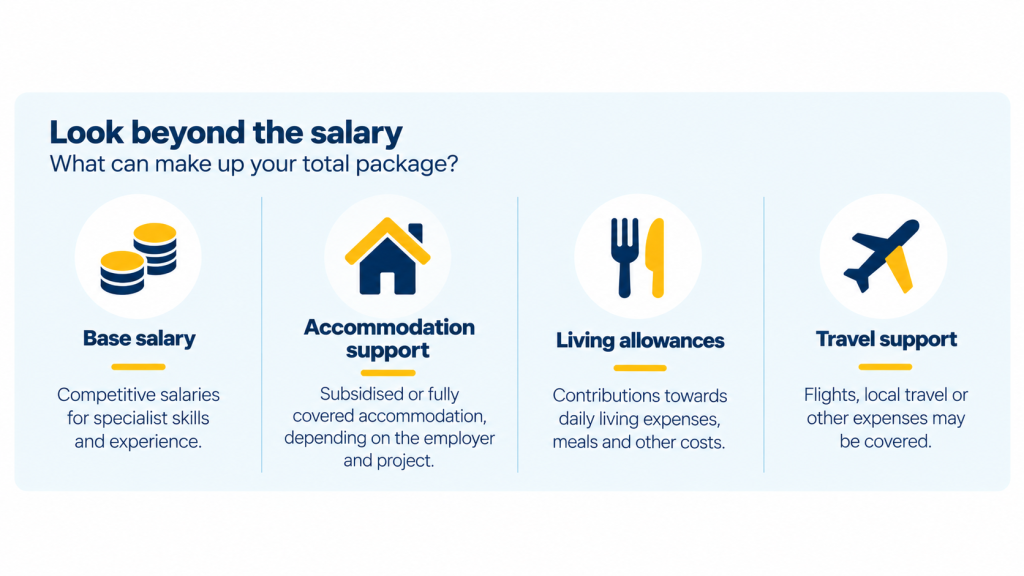
Of course, every package is different. Tax, travel arrangements, contract terms, and the precise benefits offered all need to be considered. Looking at the total value of an employment package, rather than salary alone, could reveal opportunities you might otherwise overlook.
There is also the lifestyle benefit. Spending a year or two working in Germany, the Netherlands or the Nordics will allow you to experience a new culture, meet international teams and strengthen your CV while working on major infrastructure projects.
For some professionals, staying in Ireland will be the right choice. For others, working abroad could offer the opportunity to earn, save and develop their careers at the same time.
Ireland remains a strong foundation for international opportunities
Ireland’s data centre construction sector has given many professionals experience in complex, mission-critical environments across civil, structural, mechanical and electrical disciplines.
That experience can be valuable when exploring roles elsewhere in Europe. Employers look beyond job titles to understand the projects you have delivered, the technical challenges you have managed and the level of responsibility you can take on.
Whether you specialise in M&E, commissioning, project management, construction management or quantity surveying, your experience may be transferable across markets.
Experience gained in pharmaceutical construction, industrial projects and other mission-critical environments may also be relevant to data centre employers.
The key is understanding where your skills are most in demand and which opportunities align with your career ambitions.
What affects your salary in data centre construction?
There is no single salary benchmark that applies to every professional in the sector. Your overall package will depend on several factors.
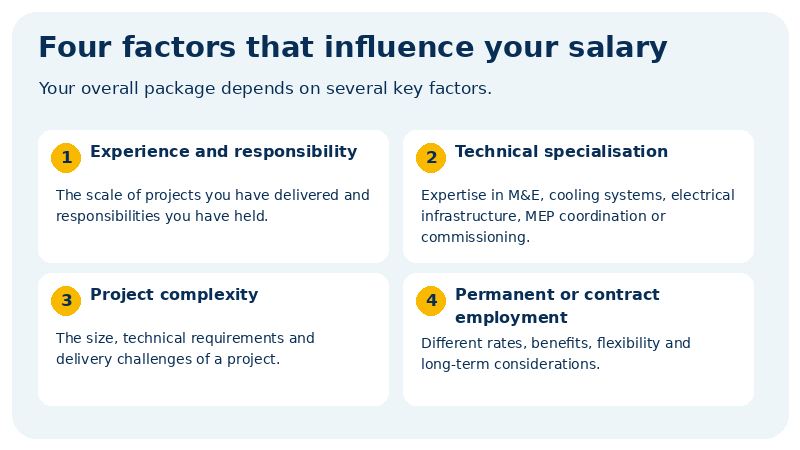
Your experience, technical knowledge, and the responsibilities you take on can all influence your market value. Before comparing opportunities, make sure you understand what each role involves and what is included in the package.
Contract roles may offer flexibility and attractive rates, while permanent positions can provide continuity, pension contributions, paid leave and other benefits. It’s worth comparing the complete package, including expenses, holidays, gaps between contracts and tax considerations, before deciding which option suits you best.
What should you consider before accepting an offer?
Salary is important, but the right opportunity should make sense financially, professionally, and personally.
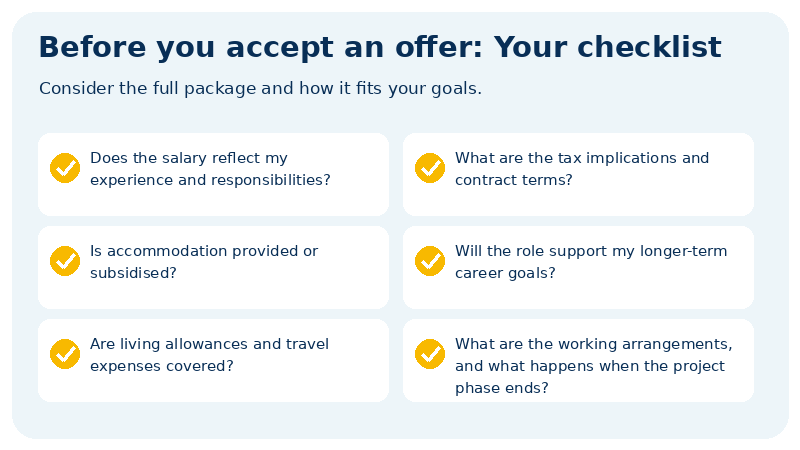
This checklist of questions is particularly important when considering an international role. A higher headline salary does not always mean more money in your pocket, just as a lower salary does not necessarily mean a less attractive offer.
Understanding your likely expenses and the benefits included is essential.
Planning your next move in 2027?
At E-Frontiers, we connect data centre construction professionals with opportunities across Ireland and Europe.
Whether you’re considering your next project in Ireland or exploring opportunities across Europe, it pays to understand what your experience and specialist skills are worth.
Our data centre construction recruitment team can help you explore current opportunities, compare packages, and understand what different markets have to offer.
Get in touch with E-Frontiers to discuss your next career move.
Colm Costello | Head of Construction Recruitment
Mark Kelly | Senior Recruitment Consultant
Muiris Fitzgerald | Recruitment Consultant
E-Frontiers’ perspective on data centre construction recruitment
October 2026.
Got an IT interview coming up? Here’s how to prepare: what employers really want and how to handle interview questions that can leave even experienced candidates stuck.
Getting invited to an interview is a good sign. Your CV has done its job. The employer has looked at your experience and decided there is enough of a match to spend some time getting to know you.
Now comes the slightly trickier part: convincing them that you’re the right person for the role.
For IT professionals, that can mean a mixture of technical questions, problem-solving scenarios, competency questions and plenty of questions about your experience, communication and how you work with others.
And then there are the small questions that everyone seems to dread.
“Tell me about yourself.”
“What’s your biggest weakness?”
“Why are you leaving your current role?”
And, inevitably:
“Do you have any questions for us?”
Knowing your technology is one thing. Being able to talk confidently about your experience is another.
The good news? Interviewing is a skill. And like most skills, it gets better with a bit of preparation.
What are employers really looking for?
An interview isn’t just about checking whether you know your Java from your JavaScript or your AWS from your Azure.
Employers want to understand how you think, how you work and what you can bring to the team.
So don’t think of an interview as an exercise in repeating your CV.
Think of it as your chance to prove the experience behind it.
Prepare your examples, not a script
One of the biggest mistakes candidates make is trying to prepare a perfect answer for every possible interview question.
Don’t.
Instead, think of five or six good examples from your career that show different skills.
For example:
– A technically difficult project
– A problem you solved
– Something that went wrong
– A successful project or achievement
– A difficult stakeholder or team situation
– A time you had to learn something quickly
– A time you took ownership or led something
You can use these examples to answer lots of different questions.
For competency-based questions, STAR is a useful way to structure your answer
Situation – What was happening?
Task – What did you need to achieve?
Action – What did you actually do?
Result – What happened?
It’s useful, particularly for questions beginning with:
“Tell me about a time when…”
But importantly: don’t make it sound like you’re using STAR.
Just tell the story naturally.
And pay particular attention to the A — Action.
IT projects are usually team efforts, so you’ll tend to naturally talk about “we”. But the interviewer needs to know what you did. Use enough detail to make your contribution and the outcome clear.
And the interview questions everyone dreads
“Tell me about yourself.”
Don’t panic. They’re not asking for your life story. Don’t start with your Leaving Cert results!
They’re looking for a short professional summary.
A good structure is:
Where you’ve worked → what you’re doing now → what you’re looking for next.
For example:
“I’ve been working in software development for around seven years, mainly across Java and cloud-based applications. I started in a smaller development team before moving into larger enterprise projects. In my current role, I’m focused heavily on backend development and AWS, and I’ve also taken on some mentoring responsibility. I’m now looking for a role where I can continue developing technically while taking on more responsibility within the wider team.”
Aim for around 60–90 seconds.
Why are you looking to leave your current role?”
This one needs a little diplomacy.
Even if the real answer is “because I can’t stand my manager”, that’s not the version you want to give.
Keep it positive and focus on what you’re moving towards.
For example:
“I’ve learned a lot in my current role, but I’m now looking for a new technical challenge and the opportunity to develop further in a certain area.”
Or:
“My role has changed quite a bit over the last year, and I’m now looking for something closer to the type of development work I’d like to focus on long term.”
You don’t need to pretend everything about your current job is perfect. Just keep the conversation professional.
“Why do you want to work for us?”
This is where a little research goes a long way.
Avoid:
“It’s a great company and the role looks interesting.”
Instead, connect something you’ve learned about the company or role with your own experience.
For example:
“I was particularly interested in the role because of the company’s move towards cloud-based platforms. That’s an area I’ve been focusing on over the last couple of years, and the opportunity to work on that at a larger scale really appeals to me.”
You don’t have to pretend it’s your lifelong dream to work there.
Just show that you’ve thought about why this role makes sense for you.
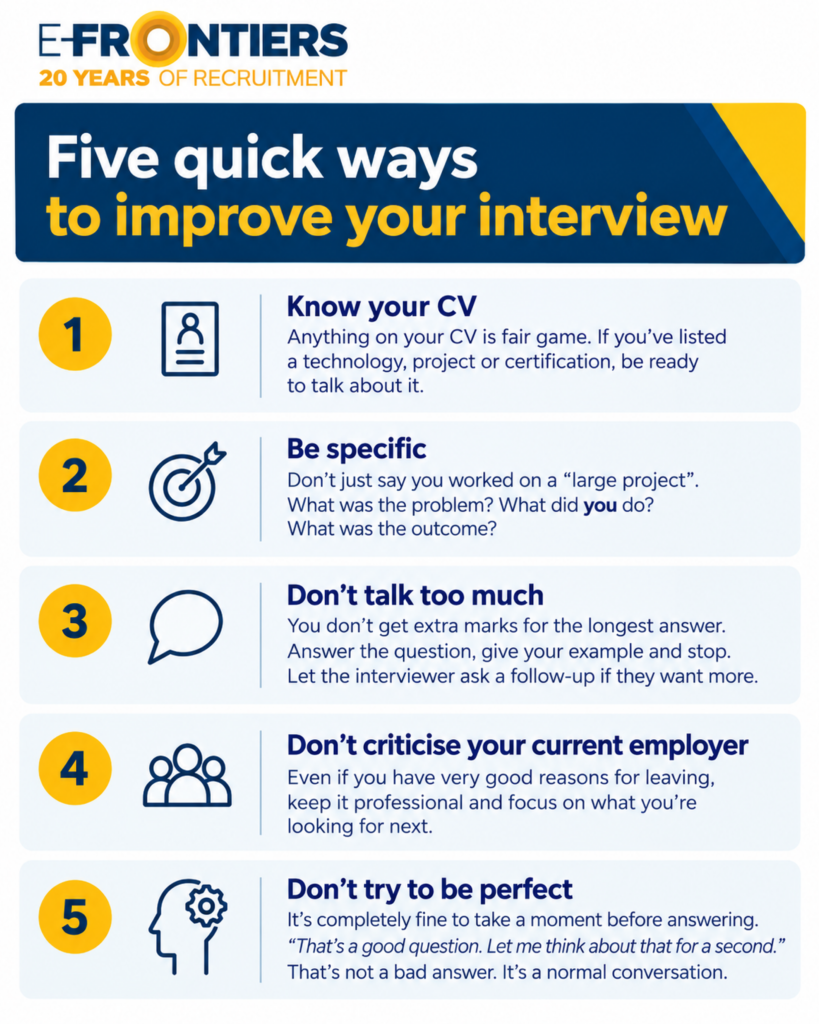
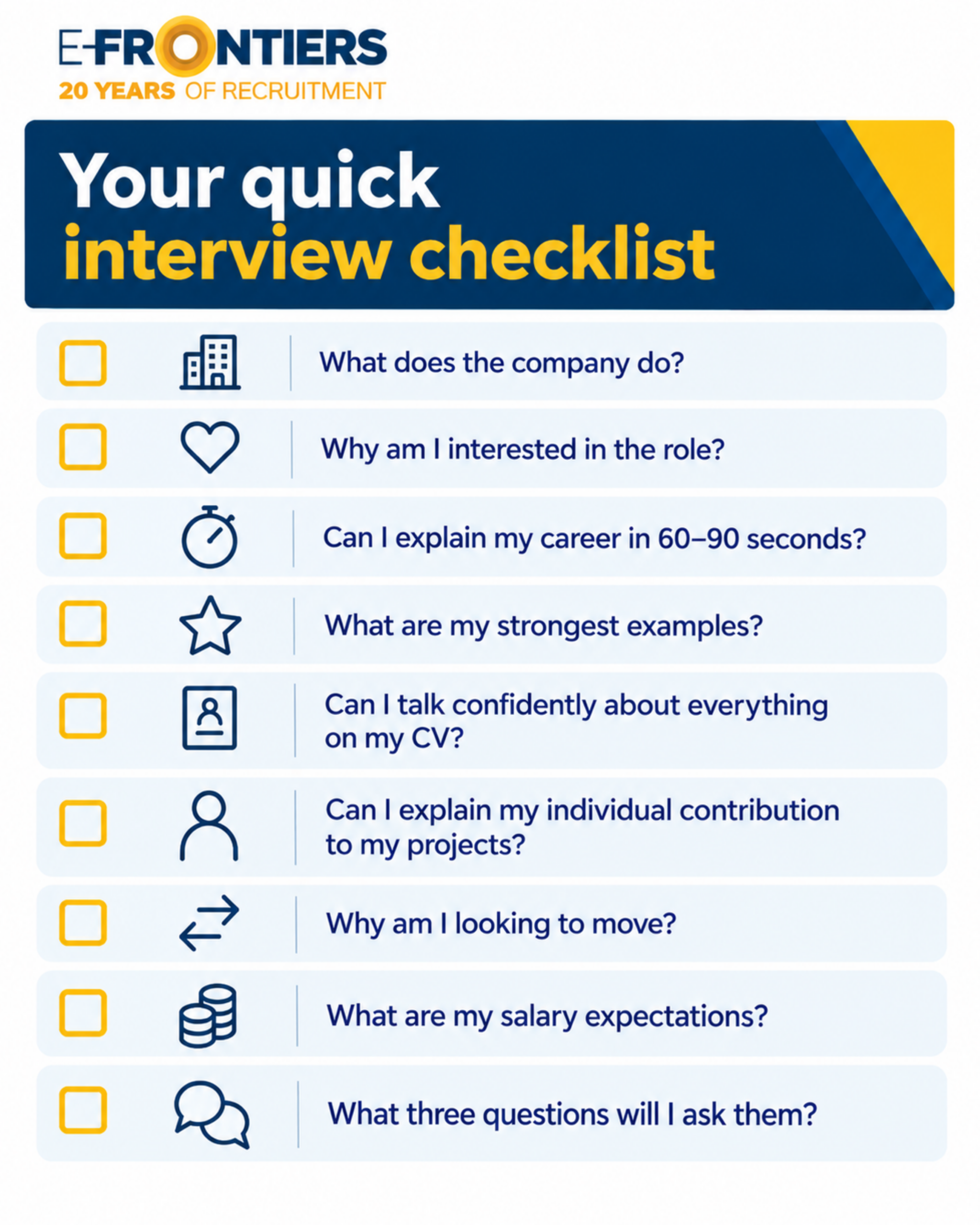
Use our handy checklists below before your interview!

“What’s your biggest weakness?”
How to turn a negative into a positive!
Please don’t automatically say: “I’m a perfectionist.”
Instead, choose something genuine that isn’t fundamental to the role and explain what you’re doing about it.
For example:
“Earlier in my career, I wasn’t particularly confident presenting to larger groups. I was comfortable communicating within a technical team, but presenting to senior stakeholders was something I found more difficult. I’ve deliberately taken on more presentation opportunities over the last couple of years and it’s something I’m much more comfortable with now.”
The trick is:
Weakness → awareness → action → improvement.
That’s much more convincing than pretending you have no weaknesses.
“Tell me about a time you failed.”
Don’t say:
“I can’t think of one.”
Nobody expects you to have had a perfect career.
Choose something genuine but manageable – for example, a project that ran over time, a technical decision that had to be changed, or a mistake that taught you something.
The important part isn’t the failure itself.
It’s what you did afterwards and what you learned from it.
“Tell me about a conflict you’ve had at work.”
Here, the interviewer just wants to know how you handle disagreement.
It could be a technical disagreement, conflicting project priorities, or a difficult stakeholder.
Focus on what you did to move things forward.
For example:
“We had different views on the best technical approach to take for a project. So, I suggested we go back to the requirements and test both of our approaches against them. That gave us a focus to work towards…”
That’s a much better answer than:
“We disagreed but eventually sorted it out.”
What if you don’t know the answer to a technical question?
Don’t bluff.
If you haven’t worked with a particular technology, say so.
For example:
“I haven’t worked directly with that technology, but I have worked extensively with …, which has some similarities.”
That’s a perfectly reasonable answer.
And if you’re given a technical problem that you can’t immediately solve, talk through your thinking.
Explain what you’d check, what information you’d need, and how you’d approach the problem.
Sometimes the interviewer is interested in how you think, not just whether you can produce the answer immediately.
“What are your salary expectations?”
Have a realistic range in mind before the interview, based on the role, your experience, and the current market.
If asked, give a range rather than locking yourself into one figure, and consider the full package – including benefits, bonus, pension, and flexibility.
You could say: “Based on the role and my experience, I’d be looking in the region of €X to €Y, although I’m open to discussing the overall package.
Don’t underestimate the final question
“Do you have any questions for us?”
Never answer this with:
“No, I think you’ve covered everything.”
Have a few questions ready.
For an IT role, you could ask:
“What would you want the person in this role to have achieved after six months?”
“What are the main technical challenges the team is working on at the moment?”
“Can you tell me a little about the team I’d be joining?”
“What are the plans for the technology environment over the next 12–18 months?”
“How do you support technical development and progression?”
And remember, this part works both ways. You’re interviewing them too.
Finally, don’t forget the person behind the CV
An interview isn’t an exam where every question has one perfect answer.
The employer really just wants to understand what you’ve done, how you approach problems, how you work with people, and whether you can contribute to their team.
So, prepare a few strong examples, know your CV, and be clear about your own contribution. You don’t need to know everything – the important thing is being able to explain what you know, how you think, and how you would approach the problem.
Your CV gets you through the door.
The interview is your chance to bring it to life.
If you’re preparing for an IT interview, speak to the E-Frontiers team. Our recruitment consultants work with candidates across IT and technology and can give you insight into the role, the company, and the interview process before you take that next step.
Please Contact:
Anca Antonica | Principal Recruitment Consultant | IT & Technology
As we head into the last quarter of 2026, we look forward to some of the top professional events taking place across Ireland over the next few months. From AI and cybersecurity to software development, construction, and business innovation, these conferences and summits bring together industry leaders, hiring companies, and ambitious professionals.
Whether you’re looking to stay ahead of market trends, grow your network, or explore new career opportunities, there’s something here for everyone. Have a browse and see what’s worth adding to your calendar.
*Dates and places may be subject to change; please click on the links for more information.

The Dublin AI Week | 2nd-9th October 2026 | Dublin
Date: 2nd to 9th October, 2026
Location: Various locations around Dublin
More Information: Dublin AI Week | Oct 2-9, 2026
Event Details: A week-long, community-led programme of 35+ AI events covering areas including AI infrastructure, security and compliance, AI in finance, enterprise AI and creative AI.
Who should attend: AI and software professionals, developers, data specialists, founders and business leaders looking to understand how AI is being developed and applied in Ireland.
Why go: A great opportunity to learn, connect with people building with AI, and explore a wide range of practical AI topics.
IOB Future of Finance Summit | 13th October 2026 | Dublin
Event Details: The Institute of Banking’s flagship event for financial services leaders, exploring the trends and developments shaping the future of finance.
Who should attend: Accounting and finance professionals, banking and financial services professionals, business leaders, and anyone interested in the changing financial landscape.
Why go: Hear from industry experts, gain fresh perspectives, and connect with peers across financial services.
International AI Summit | 14th October 2026 | Dublin
Event Details: A major international summit bringing together government and business leaders, investors, innovators, and academics to explore AI’s impact on competitiveness, infrastructure, investment, skills, and talent.
Who should attend: AI and IT professionals, software developers, technology and business leaders, investors, and anyone interested in the future of AI.
Why go: One of the biggest AI events in Ireland this year, offering insight into where AI technology, investment, and policy are heading.
CIF Digital Construction Summit | 15th October 2026 | Dublin
Date: 15th October, 2026
Location: Croke Park, Dublin
More Information: 2026 Agenda – CIF DIGITAL CONSTRUCTION SUMMIT
Event Details: Focused on the digital transformation of construction, including AI, digital processes, BIM, productivity, and the technology being used on major infrastructure projects.
Who should attend: Construction and engineering professionals, project managers, contractors, infrastructure professionals, and those working in digital construction.
Why go: A strong opportunity to understand how technology is changing the way Ireland’s construction and infrastructure projects are delivered.
Convergence – Digital Infrastructure Ireland Conference | 22nd October 2026 | Dublin
Date: 22nd October, 2026
Location: Croke Park, Dublin
More Information: Convergence 2026 | Digital Infrastructure Ireland
Event Details: A senior-level conference looking at the infrastructure, investment, energy, skills, AI, and cybersecurity needed to support Ireland’s digital economy.
Who should attend: IT and technology professionals, infrastructure and engineering professionals, business leaders, investors, and those working in digital infrastructure.
Why go: Gain a clearer picture of Ireland’s digital infrastructure roadmap and hear directly from the people shaping investment and development in the sector.
IRISSCON 2026 | 11th November 2026 | Dublin
Event Details: Ireland’s annual cybersecurity conference, focusing on the current cyber threats facing businesses and how organisations can respond.
Who should attend: Cybersecurity and IT professionals, security specialists, risk professionals and business leaders.
Why go: Stay up to date with the evolving threat landscape, hear from industry experts and connect with professionals working across cybersecurity in Ireland.
Lean Construction Ireland National Conference | 4th November | Meath
Date: 4th November, 2026
Location: Johnstown Estate, Co Meath
More Information: LciConference – LciConference
Event Details: A major construction event focused on optimising business performance through Lean practices, innovation, and digital transformation. It brings together more than 300 professionals from across the construction industry.
Who should attend: Construction and engineering professionals, contractors, project managers, clients, and anyone interested in improving productivity and project performance.
Why go: A practical opportunity to learn from industry case studies, explore new approaches, and connect with construction professionals across Ireland
DevFest Ireland 2026 | 28th November, 2026 | Dublin
Date: 28th November, 2026
Location: National College of Ireland, Dublin
More Information: DevFest Ireland 2026
Event Details: Ireland’s largest community-led developer festival, with a full day of talks, workshops and hands-on learning across web, cloud, AI and mobile.
Who should attend: Software developers, IT professionals, cloud specialists, AI practitioners, students and anyone looking to develop their technical skills.
Why go: A particularly good event for keeping technical skills current, learning from experienced developers and connecting with Ireland’s wider developer community.
This is part of our 2026 contracting series, with insights, interviews, and tips for businesses and contractors alike. In this article, we focus on why contractors can be a smart investment for organisations.
Contractors are playing a bigger role than ever in helping businesses deliver projects quickly and efficiently.
The True Cost of Hiring: Why Contractors Often Make More Sense Than You Think
When it comes to hiring, it’s easy to focus on the obvious: salaries, job specs, and start dates. But the real cost of a full-time hire often goes much deeper – especially when you factor in onboarding time, overheads, and long-term commitments. That’s where contracting can be a game-changer.
More organisations in Ireland are turning to contractors to deliver specialist projects quickly and efficiently. As companies continue to invest in digital transformation, infrastructure, and business change initiatives, access to experienced professionals on a flexible basis has become increasingly valuable. This trend is reflected in the continued growth of what’s often called the “Project Economy” – highly skilled professionals working on defined projects rather than traditional permanent roles.
According to the latest Ireland’s Project Economy Report from Trinity Business School and Contracting PLUS, the average contractor daily rate across sectors was €552 in 2025, slightly down from €571 in 2024 following a period of rapid growth. Even with this adjustment, average annual earnings for project-based contractors remained strong at €117,978, underlining the ongoing demand for specialist expertise.
In fast-moving sectors like tech and IT, bringing in contractors isn’t just about cost – it’s about flexibility, speed, and getting the right skills exactly when you need them. And when you partner with the right agency, the process becomes even easier.
At E-Frontiers, we’ve spent the last 20 years helping companies build high-performing contract teams. We know what works, and more importantly, how to make it work for you.
Full-Time Hires Come with Hidden Costs
It’s not just the salary—there’s also employer taxes, pensions, insurance, equipment, training, holiday pay, and more. In the UK, National Insurance adds 15% on top of a salary. In Ireland, Emploer PRSI is 11.25% (for weekly earnings above €552). Add benefits and onboarding time, and the true cost can be significantly higher than expected.

Why Contractors Make Financial Sense
Here’s what you get with a contractor:
Minimal overheads – They handle their own tax, insurance, pensions, etc.
Work done = money spent – You pay only for productive time signed off by you.
Faster, leaner hiring – Most contract placements occur within days, not weeks. We recently placed a contractor within 24 hours for a tech client.
And when you partner with us, you’re not starting from scratch every time – we already know your business, your hiring style, and your ideal candidate. That means faster turnarounds, stronger matches, and less admin for you.
💡 Example: One of our clients recently saved over 30% by hiring two contractors for a 6-month data transformation project rather than onboarding two permanent team members. The result? A completed project ahead of schedule, and no long-term overheads
Contractors Give You Room to Move
Contractors Give You Room to Move
Contractors give organisations rapid access to specialist skills – from cloud engineers and AI specialists to regulatory experts — often unavailable within permanent teams. Whether it’s launching a new product, filling a temporary gap, or responding to a sudden shift in business needs, contractors allow companies to scale their teams quickly and keep projects moving.
In today’s fast-paced business environment, the ability to bring in the right expertise at the right time can significantly reduce delivery timelines while avoiding the long-term costs associated with permanent hires.
Simply put, contractors help businesses achieve results faster – without the stress of a lengthy recruitment process.
Test the Fit, Reduce the Risk
Every hire carries some level of uncertainty. Contractors allow you to trial skillsets and cultural fit before making longer-term decisions. Think of it as a risk-free way to get the best talent on board – quickly and confidently.
What the Market’s Telling Us
Here’s a look at what’s happening out there:
Rising daily rates – As mentioned, the average daily rate for project-based contractors in Ireland was €552 in 2025. However, highly specialised ICT contractors still command much higher rates, averaging around €632 per day in 2025. https://www.tcd.ie/business/research/irelands-project-economy/
Shift in hiring trends – 45% of tech roles in 2024 were contract or project-based (up from 30% the year before). This is most certainly grown throughout 2025, the IT Search 2025 market report noted that one of the strongest trends in 2025 was an increase in contract opportunities and that the “contractor-first” approach was expected to continue into 2026.
The project economy continues to grow – High-skilled project-based contractors now significantly outnumber gig-economy workers in Ireland, by roughly 7 to 1, highlighting the continued demand for specialist expertise on defined projects.
More women than ever are choosing Contracting, with female contractors earning a higher average daily rate €565 than their male counterparts, €548
Contracting is retaining older, more experienced, and high-value individuals in the workforce for longer, allowing people to remain active in the workforce beyond traditional employment norms.
Contracting helps keep skilled talent in Ireland, boosts productivity, and adds economic value. It also offers a flexible and inclusive way for people to work, making it easier for those with caregiving responsibilities, limited part-time options, or other barriers to traditional employment to contribute.
Remote talent is the norm – Companies are tapping into skilled contractors globally.
Contracting motivations vary – Millennials and Gen Z are drawn to flexibility and higher pay, Boomers and Gen X value autonomy and impact.
Specialist skills are in demand – From cloud engineers to data architects, contractors are often the fastest way to access niche expertise.
Addressing Common Concerns
“Will they feel part of the team?”
Absolutely. With the right onboarding, contractors can integrate seamlessly. Involving them in team meetings, day-to-day comms, and planning sessions from day one helps build connection and encourages collaboration just like any permanent team member.
“What about confidentiality and data security?”
Standard contractor agreements cover all the legal bases – IP, confidentiality, GDPR.
“Are they as committed as full-time staff?”
In our experience, most contractors are career professionals. They rely on repeat business and referrals, so they’re deeply motivated to deliver quality work and results.
Why Partner with E-Frontiers?
Here’s the real value: when you work with us long term, we become an extension of your hiring team. We already understand your processes, your team structure, and your preferences. That means:
Faster turnarounds on every role
Tailored shortlists – no time wasted
Market insights and contractor availability at your fingertips
Support with onboarding, contracts, and renewals – fully managed
We’re not just filling roles – we’re helping you build a flexible, scalable workforce that grows with your business.
Looking Ahead
Looking ahead to the last quarter of the year, contracting is expected to remain a key part of how organisations build agile teams. Businesses are increasingly delivering work through defined projects – whether that’s digital transformation, AI implementation, cybersecurity upgrades, or infrastructure modernisation. In these environments, contractors provide immediate access to highly specialised skills without the long-term commitment of permanent hires. As companies continue to balance cost management with the need for innovation and speed, we expect demand for experienced contractors across IT, data, and engineering to remain strong throughout the reminder of 2026.
Final Thoughts
In today’s tech-driven world, hiring contractors isn’t just a cost-saving strategy – it’s a smart way to stay nimble, competitive, and ahead of the curve. The right contractors, brought in at the right time, can transform the pace and quality of your delivery.
If you’re looking to explore contracting – or want a partner who can take the stress out of it – get in touch with us at E-Frontiers. We’re here to make it simple, seamless, and successful.
Contact Conor Hackett, Head of Contracting UKI, to discuss how we can help.
E-Frontiers supports businesses across Ireland, the UK, Europe, and the US through a connected, cross-border recruitment model.
Hiring has become increasingly borderless, with companies now competing for talent on a truly international scale.
In today’s hiring landscape, the best talent rarely sits neatly in one location. For many organisations, the challenge is no longer just finding great people – it’s finding them in the right place, at the right time, with the flexibility to scale across multiple markets.
That’s where E-Frontiers comes in.
With established teams and networks across Ireland, the UK, mainland Europe, and the United States, we operate as one connected recruitment partner rather than a series of standalone offices. This means our clients can access talent locally, regionally, and internationally – all through a single, integrated team.
A truly connected international footprint
From our head office in Dublin, our teams work seamlessly with colleagues in London, Madrid, and New York, giving us direct access to four key talent markets.
This structure matters. It means we’re not limited by geography when a role becomes difficult to fill – instead, we can immediately expand the search across borders, tapping into established candidate networks and local market knowledge in each region.
Whether it’s a niche IT requirement in Ireland, a construction leadership role in the UK, a team of finance contractors across Europe, or scaling a project team in the US, we can move quickly and cohesively across markets.
Scaling teams at speed, wherever you need them
One of the biggest advantages we offer clients is the ability to scale teams quickly across multiple locations.
Because our consultants work closely within their specialist markets, they have a clear understanding of local salaries, talent availability, and hiring trends. This helps us create hiring plans that are practical, efficient, and tailored to each location.
Working with one recruitment partner also makes the process much simpler. Instead of managing multiple agencies across different regions, you have one coordinated team, helping to reduce delays and speed up hiring.
For companies expanding into new markets or growing teams across several countries, this joined-up approach helps keep recruitment moving quickly and smoothly.
Going further to find the right candidate
Sometimes the right hire isn’t in your immediate market – or even actively looking.
Our international network allows us to widen the search when needed, identifying candidates who may be open to relocation, returning home, or moving for the right opportunity. This is particularly valuable in sectors where demand is high and local supply or skills are tight.
By combining deep local knowledge with a broader international reach, we’re able to find talent that others may miss – and present candidates who are not just qualified but aligned to long-term business needs.
A partnership approach, not just a placement model
At the core of E-Frontiers is a simple idea: recruitment works best when it feels like a partnership.
Our teams act as an extension of your hiring function, providing market insight, honest advice, and access to specialist talent pools across multiple sectors, including Technology, Construction & Engineering, Finance, and Business Support.
That means you’re not just reacting to hiring needs – you’re planning with better visibility of what’s happening in each market.
Built for a borderless talent market
As companies grow across different regions, the need for flexible, scalable, and connected hiring solutions is only increasing.
E-Frontiers is built for this — helping clients move talent where it’s needed, when it’s needed, without being limited by geography.
As you plan your next phase of growth, we can help make hiring across borders simpler, faster, and more effective.
If you’re planning growth across Ireland, the UK, Europe, or the US, get in touch with the E-Frontiers team to see how we can support your hiring strategy.
Contact: Nigel Bolger | Commercial Manager
Email:Nigel.bolger@e-frontiers.ie
Phone: 00 353 86 3888147
Website: E-Frontiers Recruitment Agency
Trabajando cada día con empresas tecnológicas y candidatos, hay algo que vemos constantemente: el salario sigue siendo importante, pero ya no es lo único que determina si una persona acepta o rechaza una oferta.
Muchos profesionales tech reciben varias oportunidades al mismo tiempo. Y cuando eso ocurre, la decisión final suele depender de otros factores mucho más relacionados con la experiencia laboral.
La flexibilidad, la calidad del liderazgo, las posibilidades de crecimiento o el equilibrio personal pesan cada vez más.
De hecho, algunas empresas siguen perdiendo talento incluso ofreciendo salarios competitivos, simplemente porque su propuesta no conecta con lo que el mercado espera hoy.
Estas son algunas de las cosas que más valoran actualmente los perfiles tecnológicos y que más aparecen en nuestras conversaciones con candidatos.

Flexibilidad real
La flexibilidad sigue siendo el tema que más aparece en prácticamente cualquier proceso. Y no hablamos solo de teletrabajo. Los candidatos valoran especialmente poder organizar su tiempo con autonomía, trabajar en entornos donde exista confianza y evitar culturas demasiado rígidas o presenciales.
Muchas empresas siguen utilizando discursos de flexibilidad bastante superficiales, pero los profesionales detectan rápidamente cuándo esa flexibilidad es real y cuándo no. Hoy, para muchos perfiles tech, volver a modelos excesivamente tradicionales simplemente no es una opción.
Salario competitivo y transparencia
El salario sigue siendo importante, obviamente. Pero algo que ha cambiado mucho es la necesidad de transparencia.
Cada vez más candidatos esperan conocer las bandas salariales desde el inicio del proceso. Cuando una empresa evita hablar de compensación hasta fases muy avanzadas, suele generar bastante fricción. También se valora que existan criterios claros de crecimiento y revisiones salariales coherentes.
Crecimiento profesional
Los candidatos valoran muchísimo trabajar en entornos donde puedan seguir aprendiendo, participar en proyectos interesantes y evolucionar técnicamente.
No se trata solo de ofrecer cursos. También importa tener buenos referentes técnicos, proyectos sólidos y espacio para crecer dentro de la organización.
Buen liderazgo y cultura
Esto tiene muchísimo más impacto del que muchas empresas creen. En recruitment escuchamos constantemente historias de personas que dejan trabajos bien pagados por mala gestión, exceso de burocracia o culturas agotadoras.
Los perfiles tecnológicos suelen valorar entornos organizados, managers accesibles, comunicación clara y equipos donde puedan trabajar con autonomía. Cuando la cultura interna funciona, se nota muchísimo también en la capacidad de retención.
Bienestar y equilibrio personal
Después de años bastante intensos para el sector, muchos profesionales priorizan mucho más el equilibrio personal. Las empresas que realmente respetan horarios, evitan dinámicas constantes de urgencia y promueven entornos sostenibles suelen resultar mucho más atractivas. Aquí entran beneficios como seguro médico, flexibilidad horaria o días adicionales de descanso, pero sobre todo importa la cultura real detrás de esas políticas.
Proyectos interesantes
Algo que muchas veces se subestima es el peso que tiene el propio proyecto. Muchos candidatos quieren trabajar con tecnologías modernas, equipos sólidos y productos donde realmente puedan aportar valor. Especialmente en perfiles senior, el tipo de reto técnico puede influir muchísimo en la decisión final.
Una buena experiencia de trabajo
Puede parecer un detalle pequeño, pero no lo es. Trabajar con herramientas lentas, procesos caóticos o tecnología desactualizada genera muchísima frustración.
Las empresas que cuidan la experiencia diaria del equipo: desde el hardware hasta los procesos internos, suelen generar una percepción mucho más positiva entre los profesionales tech.
Lo que muchas empresas todavía no terminan de ver
Uno de los errores más comunes es pensar que todos los candidatos valoran exactamente lo mismo. Y es que, no existe un único beneficio universal. Nos encontramos con candidatos que priorizan flexibilidad, otras crecimiento, la estabilidad o conciliación.
Por eso las propuestas rígidas funcionan cada vez peor. Lo que sí vemos de forma bastante consistente es que las empresas más atractivas suelen tener algo en común: escuchan al mercado y entienden bien a las personas que quieren contratar.
Qué deberían hacer las empresas en 2026
Desde nuestra experiencia trabajando con empresas del sector tech, sacamos una idea bastante clara: competir únicamente con salario ya no funciona.
Las empresas que mejor están contratando suelen tener propuestas mucho más completas. No necesariamente perfectas, pero sí coherentes. Flexibilidad real, liderazgo sólido, crecimiento profesional y una cultura sana pesan muchísimo más de lo que muchas organizaciones imaginan. Y en un mercado donde el talento tiene capacidad de elegir, esos factores marcan una diferencia enorme.
The Irish construction industry is buoyant at present, with increasing demand for Housing/Apartments, Data Centres, Pharmaceutical projects, Infrastructure works etc. While a workforce shortage has made it challenging to secure skilled professionals for these areas, this also means exciting opportunities for top talent are available.
At E-Frontiers, we deal with the top Tier 1 and Tier 2 Contractors and Residential Developers in Ireland. If you’re currently based in Ireland and exploring new career options or looking to return home in the near future, now is the perfect time to take the next step in your career.
We have summarised some information below about the top construction roles that are in demand at present and how you can contribute to some of the most dynamic and high-profile projects in the industry.

Quantity Surveyors (QS’s)
Quantity Surveyors are indispensable for cost management and financial planning in construction projects. They ensure projects stay on budget without compromising quality.
-Salaries/Packages:
Junior/Project level – €45,000 to €70,000 plus transport & package
Senior QS level – €70,000 to €90,000 plus transport & package
– Qualifications:
A degree in Quantity Surveying, Construction Economics, or a related discipline. Membership in professional bodies like the Society of Chartered Surveyors Ireland (SCSI) is highly desirable though not essential.
As the candidate what’s in it for you:
QS professionals will have the opportunity to influence critical project decisions, develop in-depth financial expertise, and collaborate with multidisciplinary teams. Senior roles offer leadership and strategic planning experience in complex projects.
As the company what can you do:
Emphasise involvement in high-profile projects, flexible working options, and a strong focus on employee well-being to attract top QS talent, CPD opportunities are also very beneficial.
Site/Senior Engineers
Site and Senior Engineers play a critical role in the successful delivery of projects. They are responsible for setting out and ensuring design specifications are met, and maintaining quality standards.
-Salaries/Packages:
Site/Setting Out Engineers – €50,000 to €65,000 plus transport & package
Senior Engineers – €70,000 to €85,000 plus transport & package
-Qualifications:
A degree in Construction Management, Civil or Structural Engineering is typically required, alongside experience with setting-out equipment like total stations and GPS
As the candidate what’s in it for you:
This role offers a chance to bring your existing skillset and knowledge to assist high-profile projects and developments to completion, develop expertise in advanced engineering tools, and progress into leadership positions such as Site/Project Management. Engineers will gain exposure to dynamic environments that challenge their problem-solving and technical skills.
As the company what can you do:
Highlight opportunities for professional development, exposure to cutting-edge technologies, and a supportive team environment. Providing competitive benefits packages, CPD opportunities where possible and clear career progression pathways are vital.
Site Manager/Site Supervisor
These roles involve overseeing on-site operations, managing teams, and ensuring projects are delivered on time and within budget.
-Salaries/Packages:
Site Supervisor/Finishing Foreperson – €60,000 to €70,000 plus transport & package
Site Agent/Manager – €70,000 to €85,000 plus transport & package
-Qualifications:
A background in Construction Management, Engineering, or Trade Qualifications, coupled with strong leadership skills and relevant on-site experience.
As the candidate what’s in it for you:
Site Managers and Supervisors gain leadership experience, exposure to complex construction projects, and the satisfaction of seeing their work take tangible form. These roles are stepping stones to senior management positions in the construction industry.
As the company what can you do:
Highlight the opportunity to lead high-impact projects, provide ongoing leadership training, and offer performance-based bonuses.
Health and Safety Advisors
Health and Safety Advisors are key to ensuring compliance with safety regulations and creating a safe working environment.
-Salaries/Packages:
Junior/Inter level – €40,000 to €60,000 plus transport & package
Senior/Manager level – €65,000 to €85,000 plus transport & package
-Qualifications:
Diploma Level 6 in Occupational Health and Safety, NEBOSH, IOSH, or other recognised safety certifications, combined with experience in construction safety management.
As the candidate what’s in it for you:
Advisors will contribute directly to creating safer workplaces while building your expertise in risk management and compliance. The role offers opportunities for recognition through successful safety initiatives and pathways to senior safety leadership roles.
As the company what can you do:
Showcase your commitment to safety through robust training programs, and recognition schemes for safety performance, along with opportunities for certifications or further education.
Site Manager/Site Supervisor
These roles involve overseeing on-site operations, managing teams, and ensuring projects are delivered on time and within budget.
-Salaries/Packages:
Site Supervisor/Finishing Foreperson – €60,000 to €70,000 plus transport & package
Site Agent/Manager – €70,000 to €85,000 plus transport & package
-Qualifications:
A background in Construction Management, Engineering, or Trade Qualifications, coupled with strong leadership skills and relevant on-site experience.
As the candidate what’s in it for you:
Site Managers and Supervisors gain leadership experience, exposure to complex construction projects, and the satisfaction of seeing their work take tangible form. These roles are stepping stones to senior management positions in the construction industry.
As the company what can you do:
Highlight the opportunity to lead high-impact projects, provide ongoing leadership training, and offer performance-based bonuses.
Building Services Manager
Building Services Managers ensure that electrical, mechanical, and plumbing systems are integrated seamlessly into construction projects. They are pivotal for large-scale developments.
-Salaries/Packages:
Building Services/M&E Coordinator – €60,000 to €75,000 plus transport & package
Building Services/M&E Manager – €75,000 to €90,000 plus transport & package
-Qualifications:
A degree in Building Services, Mechanical, Electrical Engineering, and/or a trade background as a plumbing, electrician, or fitter, with extensive experience managing MEP services.
As the candidate what’s in it for you:
This role offers candidates the chance to get exposure to & to be involved in innovative high-profile Technology, Data Centre & Pharmaceutical projects, to specialise in green building practices, and work with cutting-edge technology. Building Services Coordinators & Managers are critical in shaping sustainable infrastructure and advancing their professional expertise.
As the company what can you do:
Stress the importance of their role in innovation and sustainability, offer opportunities to work on cutting-edge green building projects, and provide favourable benefits packages.
Conclusion
To thrive in Ireland’s competitive construction sector, it’s important to consider what makes a role truly stand out. Top candidates are looking for more than just a pay cheque – they want opportunities for career growth, professional development, work-life balance, and a positive workplace culture. Companies that prioritise employee satisfaction, offer unique benefits and create an environment where people feel valued will attract the best talent.
If you’re exploring new opportunities, look for employers who offer not only competitive salaries but also have a good work-life balance, good company culture, offer the chance to grow, showcase your skills, and be part of successful projects. Whether you’re a Site Engineer or a Building Services Manager, finding a company that aligns with your career goals and values is key to taking the next step in your professional journey.
Are you looking for your next role or top talent in the construction sector?
2. Connect on LinkedIn with our Construction Recruitment Specialist – Mark Kelly
3. For visibility of all our roles visit the jobs section of our website
4. Click here to find out more about our areas of expertise in the construction industry
En nuestros artículos anteriores hablamos sobre cómo construir procesos de selección más efectivos en tecnología y compartimos la visión de un experto sobre los retos y oportunidades del hiring en el sector.
Ahora queremos dar un paso más allá y hablar de algo que cada vez tiene más impacto en las empresas tecnológicas: la diversidad en los equipos.
Durante mucho tiempo, hablar de diversidad en empresas era casi sinónimo de hablar de representación o de iniciativas internas de cultura. Pero en tecnología, cada vez más compañías están viendo algo mucho más tangible: cuando un equipo reúne perspectivas diferentes, normalmente también mejora la forma de trabajar, de construir producto y de tomar decisiones.
Y en un sector como el tecnológico, donde todo cambia rápido y los problemas rara vez tienen una única solución correcta, eso termina teniendo un impacto muy real en el negocio.

Mucho más que un tema de cultura
Cuando hablamos de diversidad en empresas tech no hablamos únicamente de género, edad o nacionalidad. También hablamos de diferentes formas de pensar, trayectorias distintas y experiencias que aportan nuevas perspectivas. Y eso, en tecnología, tiene muchísimo valor.
Los mejores productos rara vez salen de equipos donde todos piensan igual. En un entorno donde la tecnología cambia constantemente, tener siempre la misma mirada puede acabar limitando la capacidad de innovar.
Uno de los efectos más interesantes de los equipos diversos aparece en algo tan cotidiano como la toma de decisiones.
Cuando todos en un equipo tienen trayectorias parecidas, es más fácil caer en dinámicas donde nadie cuestiona demasiado las ideas. Los problemas se interpretan desde el mismo ángulo y las conclusiones suelen llegar rápido… quizá demasiado rápido.
Cuando hay perfiles distintos dentro de un equipo, aparecen preguntas diferentes, puntos de vista que quizá nadie había considerado y conversaciones más completas. Eso ayuda a detectar riesgos antes, entender mejor a los usuarios y construir productos mucho más alineados con realidades distintas.
La innovación suele aparecer donde hay perspectivas distintas
Muchas veces la innovación no aparece únicamente por tener grandes especialistas, sino por combinar personas con experiencias diferentes. Cuando en un equipo conviven perfiles técnicos, culturales y profesionales variados, suelen surgir ideas menos previsibles y soluciones más creativas. Y en empresas tecnológicas, donde adaptarse rápido es clave, eso puede marcar una diferencia enorme.
Cómo cambia también la cultura de empresa
La diversidad no solo impacta producto o negocio. También cambia la dinámica interna de los equipos. También cambia la forma en que trabajan los equipos.
Normalmente se generan entornos más abiertos al feedback, más colaborativos y con mayor capacidad de adaptación. Y eso influye directamente en cómo las personas viven su trabajo.
Cuando alguien siente que puede participar, aportar ideas y crecer dentro de una empresa, es mucho más fácil que quiera quedarse.
El talento también se fija en esto
Hace tiempo que el salario dejó de ser el único factor importante para muchos profesionales tech.
La cultura, la flexibilidad y el tipo de equipo con el que van a trabajar tienen cada vez más peso. Las empresas que construyen entornos inclusivos suelen resultar más atractivas porque transmiten apertura, adaptación y una cultura más humana.
Y eso no solo ayuda a atraer talento, también a retenerlo.
Sí, también tiene impacto en negocio
Aunque muchas veces la conversación se queda en cultura o employer branding, la realidad es que esto también afecta al negocio.
Cada vez más empresas entienden que construir equipos diversos no es solo una iniciativa de recursos humanos. También es una decisión estratégica.
¿Por qué?
Las empresas tecnológicas trabajan para usuarios cada vez más globales y diversos. Tener equipos capaces de entender distintas realidades ayuda a construir mejores productos, detectar oportunidades antes y adaptarse más rápido a los cambios.
Por eso cada vez más compañías entienden la diversidad no solo como un tema de cultura, sino también como una decisión estratégica.
Nada de esto ocurre por casualidad
Eso sí: la diversidad no aparece sola.
Las empresas que realmente consiguen construir equipos diversos suelen revisar cómo contratan, cómo evalúan talento y cómo crean oportunidades de crecimiento dentro de la organización.
Porque no se trata solo de incorporar perfiles distintos, sino de construir un entorno donde esas personas puedan tener impacto.
El verdadero reto: que la diversidad se note de verdad
Tener perfiles distintos en un equipo no garantiza automáticamente una cultura inclusiva.
La verdadera diferencia aparece cuando las personas sienten que su opinión cuenta, que pueden participar sin barreras y que existe espacio para aportar perspectivas diferentes.
Ahí es cuando la diversidad deja de ser un concepto y empieza a generar impacto real.
Y eso requiere liderazgo consciente, comunicación abierta y una cultura donde las diferencias se conviertan en una fortaleza.
Para cerrar
En tecnología, donde la innovación y la capacidad de adaptación marcan la diferencia, los equipos diversos representan mucho más que una tendencia. Son una ventaja competitiva real.
Las empresas que apuestan por diversidad e inclusión no solo construyen mejores culturas. También crean mejores productos, atraen mejor talento y están mejor preparadas para crecer en mercados cada vez más globales y cambiantes.
Porque al final, las mejores soluciones rara vez nacen de personas que piensan exactamente igual.
Y quizá ese sea uno de los mayores aprendizajes para cualquier empresa tech hoy.
Diversity, Equity, and Inclusion (DEI) is no longer a “nice to have” in the workplace – it’s expected. But while many companies talk about DEI, not all deliver on it in a meaningful way.
For job seekers today, the challenge isn’t just finding employers who mention DEI – it’s identifying those who genuinely embed it into their culture, leadership, and day-to-day working environment.
This focus on workplace inclusion is becoming increasingly important across Ireland. In recent years, gender pay gap reporting requirements have expanded significantly, with organisations employing more than 50 people now required to publish annual reports. This increased transparency is giving candidates greater insight into how organisations approach equality, representation, and progression in the workplace.How to report on the Gender Pay Gap
If you’re considering a career move in the second half of 2026, here’s how to look beyond the surface and assess what DEI really looks like in practice.

Why DEI Still Matters – But Looks Different Today
In recent years, the conversation around DEI has matured. It has moved beyond policies and statements and into something far more tangible: the employee experience.
Across Europe, there is a growing focus on how employees experience the workplace, rather than what company policies say on paper. The Financial Times’ 2026 Diversity Leaders ranking, for example, placed significant emphasis on employee feedback when assessing organisations’ diversity and inclusion performance, highlighting the importance of creating genuinely inclusive working environments. FT-Statista 2026 Diversity Leaders ranking and methodology
Today, strong DEI in the workplace shows up as:
– Inclusive leadership and decision-making
– Equal access to opportunities and progression
– Flexibility that supports different lifestyles and responsibilities
– A culture where people feel heard, respected, and safe to contribute
Candidates are increasingly prioritising these factors – not just for ethical reasons, but because they directly impact job satisfaction, performance, and long-term career growth.
What to Look for Before You Apply
Before submitting an application, take a few minutes to assess how an organisation presents itself.
Here are some key indicators:
1. Careers Page & Messaging: Is the language authentic, or does it feel generic? Look for specific examples rather than broad statements.
2. Representation Across the Business: Check leadership teams and company profiles. Is there visible diversity, particularly at senior levels? While progress is being made in Ireland, women still represent less than one-third of senior executive positions across Irish organisations, making leadership representation an important indicator of how inclusion translates into career progression opportunities. Key Findings Gender Balance in Business Survey 2025 – Central Statistics Office
3. Employee Voices: Are there real stories or testimonials from employees? These often give a more honest view than corporate messaging.
4. Evidence of Flexibility: Do they clearly outline hybrid working, flexible hours, or inclusive policies- or is it vague?
Questions You Should Ask Employers
Remember, interviews are a two-way process. Here are a few simple but effective questions to help you assess DEI in an interview:
– “How do you ensure different perspectives are included in decision-making?”
– “What does career progression look like across the team?”
– “How do you support flexible working in practice?”
– “Can you share examples of how employee feedback has shaped the workplace?”
The answers – and how confidently they’re delivered – can be very revealing.
How to Spot DEI in the Hiring Process
The hiring process itself can reveal a great deal about a company’s culture.
Pay attention to:
– Interview structure – Is the process clear and consistent?
– Panel diversity – Are you meeting a range of people?
– Communication style – Do you feel respected and included throughout?
– Accessibility – Are accommodations offered or welcomed?
A company that values inclusion will reflect this in how they engage with candidates – not just what they say.
Red Flags to Watch Out For
Not every organisation gets it right. Some warning signs include:
– Vague or overly polished answers with no real examples
– A lack of diversity at senior level
– Inconsistent hiring experiences
– Little evidence beyond statements or policies
If something feels unclear, it’s worth digging deeper.
Final Thoughts
Looking ahead, workplace transparency is set to become an even bigger factor in the job search process. Alongside Ireland’s gender pay gap reporting requirements, the EU Pay Transparency Directive will introduce new obligations around pay transparency and reporting.
While primarily focused on closing pay gaps, the legislation reflects a broader shift towards fairness, accountability and openness in the workplace. For candidates, this means greater visibility into how organisations approach pay, progression, and equality. How to report on the Gender Pay Gap
DEI is no longer just a company initiative – it’s a key factor in choosing where to build your career.
As a candidate, you have more insight and influence than ever before. By asking the right questions and paying attention to the details, you can make informed decisions and find an environment where you’ll truly thrive.
Because ultimately, the right role isn’t just about what you do – it’s about where you feel you belong.
At E-Frontiers, we’re here to help you find more than just a job — we’re here to help you find the right fit. If you need support or guidance at any stage of your job search, just get in touch.
As organisations continue to navigate economic uncertainty, rapid digital transformation, and evolving workforce expectations, contracting has become a strategic cornerstone of modern hiring. What was once a tactical stopgap is now a key lever for agility, speed, and delivery. To gain further insight into these evolving trends, we caught up with Conor Hackett, Head of Contracting at E-Frontiers, to hear his thoughts on where the contracting market is heading in 2026
The Shift to Speed: Contracting as a Delivery Engine
A defining trend across 2025 and into 2026 is the increasing importance of speed-to-hire and speed-to-impact. Businesses are prioritising how quickly talent can drive outcomes rather than simply focusing on cost efficiency.
In practice, this means organisations are using contractors to rapidly mobilise teams, accelerate delivery timelines, and avoid costly project delays. Contracting is no longer just about plugging gaps; it’s about enabling immediate productivity and maintaining momentum in critical programmes.
Key takeaway: Contracting is evolving into a core mechanism for delivering projects at pace.
The Project Economy Is Now Mainstream
Workforce strategy is increasingly centred around projects rather than permanent roles. Organisations are structuring teams around defined outcomes, digital transformation initiatives, cloud migrations, AI deployment, and large-scale infrastructure programmes.
This shift reinforces the value of highly skilled contractors who can deliver against specific objectives without long-term commitments.
Key areas seeing sustained demand include:
– Technology and software engineering
– Data and AI transformation
– Cybersecurity and cloud infrastructure
What this means: Contractors are becoming the backbone of execution in a project-driven economy.
Specialisation & Talent Scarcity
Demand for niche, high-value skillsets continue to grow. From cloud engineers and DevOps specialists to AI and data experts, organisations are increasingly competing for a limited pool of highly skilled contractors.
Traditional hiring channels often struggle to meet these needs due to:
– Lengthy hiring timelines
– Limited access to passive talent
– Rapidly evolving technical requirements
As a result, pre-qualified contractor networks and specialist recruitment partners are becoming critical to securing the right expertise quickly.
Insight: Access to specialised talent, not just availability, is now the key differentiator in hiring success.
Remote & Distributed Contracting as Standard
Remote work has firmly embedded itself within the contracting model. Organisations are increasingly hiring talent across geographies to access scarce skills and maintain flexibility.
This shift has led to:
– Broader talent pools alongside increased competition for top contractors
– Greater reliance on structured onboarding and compliance frameworks
– A need for seamless collaboration across distributed teams
Trend evolution: Remote contracting is no longer optional; it is the default operating model.
Cost Pressures vs Capability Needs
Despite continued cost sensitivity across many sectors, contracting remains attractive because it aligns closely with both financial discipline and delivery needs.
Businesses benefit from:
– No long-term overheads such as pensions, benefits, or employer taxes
– A pay-for-output model where spend ties directly to delivery
– Reduced hidden costs associated with onboarding and long-term employment
Even where contractor rates fluctuate, the flexibility and productivity gains often outweigh the perceived higher day-rate cost.
Insight: Contracting enables organisations to balance cost control with access to high-impact talent.
Workforce Demographics Are Changing
The contractor workforce is becoming more diverse, experienced, and strategically valuable.
Key shifts include:
– Increased participation across different demographics and experience levels
– Greater representation of professionals choosing contracting for flexibility and autonomy
– A growing number of experienced specialists remaining in the workforce longer through contracting
Insight: Contracting is evolving into a sustainable and attractive career path, strengthening the overall talent market.

Emerging Trends Shaping the Rest of 2026
Looking ahead, several trends are set to define the contracting landscape for the remainder of the year:
- Squad-Based Hiring Will Accelerate
Organisations are increasingly moving beyond hiring individuals to deploying fully formed contractor teams or “squads.”
This model:
– Reduces ramp-up time
– Improves team cohesion from day one
– Aligns with agile and product-led delivery
Expectation: Squad-based hiring will become a standard approach for major transformation programmes.
-
AI, Data & Cybersecurity Will Drive Demand
Investment in emerging technologies continues to surge, particularly in:
– Artificial intelligence implementation
– Data architecture and analytics
– Cybersecurity resilience
These areas require highly specialised expertise that is often best accessed through contracting.
Expectation: The demand for top-tier technical contractors will remain strong, with premium skill sets continuing to command high value.
-
Partner-Led Hiring Models Will Grow
Recruitment partners are playing a more strategic role than ever before. Beyond sourcing talent, they are increasingly involved in:
– Workforce planning
– Talent pipelining
– Compliance and onboarding management
Organisations are relying on partners to act as extensions of their internal hiring functions.
-
Time-to-Hire Will Become a Competitive Advantage
Speed is becoming a key differentiator. Organisations that can secure and onboard talent quickly are outperforming those with slower processes.
Implication: Businesses with lengthy hiring cycles risk losing top contractor talent to faster-moving competitors.
-
Hybrid Workforce Models Will Dominate
The future workforce is not a choice between permanent employees and contractors; it is a blend of both.
Organisations are:
– Maintaining core permanent teams for stability
– Adding contractors for flexibility and specialist delivery
– Scaling teams dynamically based on project requirements
Final Outlook
Contracting has firmly established itself as a strategic hiring solution in a fast-changing business environment. Its ability to provide speed, flexibility, and access to niche expertise makes it indispensable for organisations focused on delivery and transformation.
For the remainder of 2026, successful organisations will be those that:
– Embrace project-based workforce planning
– Build strong contractor ecosystems
– Move quickly and decisively in competitive talent markets
In an era defined by change, contracting offers a powerful advantage: the ability to deliver outcomes with both agility and precision.
At E-Frontiers, we work closely with organisations to help them navigate this evolving landscape – connecting businesses with high-quality contract talent quickly, efficiently, and in line with their project goals. Whether you are scaling teams, delivering transformation programmes, or accessing niche expertise, our specialist teams are here to help you get it right.
For further information to help you on your Contracting career journey, please contact:
Conor Hackett – Head of Contracting – E-Frontiers.
