


Salaries, Benefits and Opportunities Across Europe
By Mark Kelly | E-Frontiers Recruitment | Data Centre Construction Recruitment
If you work in data centre construction, have you ever wondered whether your salary reflects your experience and the value you bring to a project?
With complex builds, tight deadlines, and growing demand for specialist skills, experienced construction professionals are essential to delivering the next generation of data centres.
As we look towards 2027, understanding your market value and exploring opportunities beyond Ireland could open new doors for your career and finances.
At E-Frontiers, we connect experienced data centre construction professionals with opportunities across Ireland and Europe.
Europe: Opportunities to grow your career and savings
Ireland has an established data centre market, but opportunities extend across Germany, the Netherlands, the Nordics, Spain and other European locations.
For professionals in project management, quantity surveying, construction management, mechanical and electrical engineering, or commissioning, these markets offer the chance to work on major projects, develop specialist expertise, and gain valuable international experience.
But the benefits can go beyond career development
Working in Europe can also be a great opportunity to save more of your salary, as many employers provide accommodation or contribute to living and travel expenses. This may allow you to put a greater proportion of your earnings towards savings, paying off a mortgage, or building your financial future.
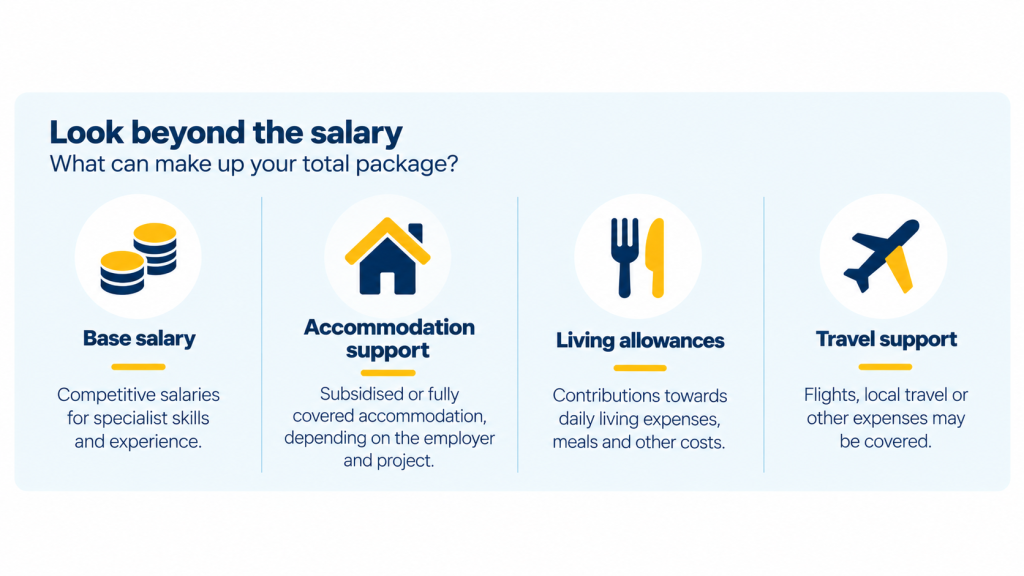
Of course, every package is different. Tax, travel arrangements, contract terms, and the precise benefits offered all need to be considered. Looking at the total value of an employment package, rather than salary alone, could reveal opportunities you might otherwise overlook.
There is also the lifestyle benefit. Spending a year or two working in Germany, the Netherlands or the Nordics will allow you to experience a new culture, meet international teams and strengthen your CV while working on major infrastructure projects.
For some professionals, staying in Ireland will be the right choice. For others, working abroad could offer the opportunity to earn, save and develop their careers at the same time.
Ireland remains a strong foundation for international opportunities
Ireland’s data centre construction sector has given many professionals experience in complex, mission-critical environments across civil, structural, mechanical and electrical disciplines.
That experience can be valuable when exploring roles elsewhere in Europe. Employers look beyond job titles to understand the projects you have delivered, the technical challenges you have managed and the level of responsibility you can take on.
Whether you specialise in M&E, commissioning, project management, construction management or quantity surveying, your experience may be transferable across markets.
Experience gained in pharmaceutical construction, industrial projects and other mission-critical environments may also be relevant to data centre employers.
The key is understanding where your skills are most in demand and which opportunities align with your career ambitions.
What affects your salary in data centre construction?
There is no single salary benchmark that applies to every professional in the sector. Your overall package will depend on several factors.
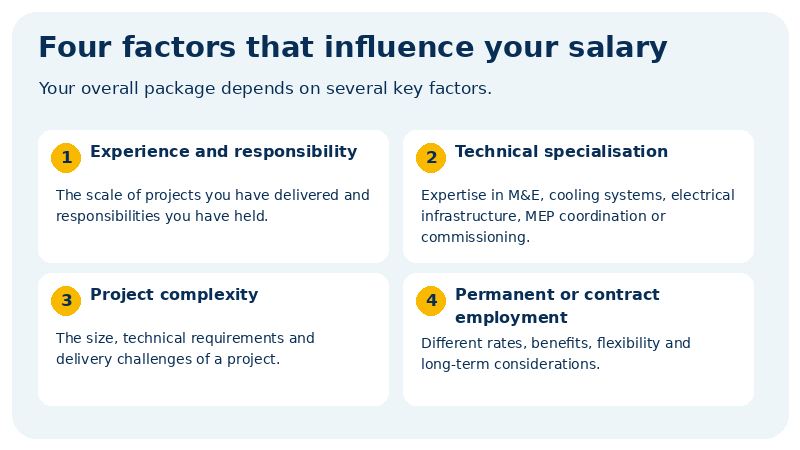
Your experience, technical knowledge, and the responsibilities you take on can all influence your market value. Before comparing opportunities, make sure you understand what each role involves and what is included in the package.
Contract roles may offer flexibility and attractive rates, while permanent positions can provide continuity, pension contributions, paid leave and other benefits. It’s worth comparing the complete package, including expenses, holidays, gaps between contracts and tax considerations, before deciding which option suits you best.
What should you consider before accepting an offer?
Salary is important, but the right opportunity should make sense financially, professionally, and personally.
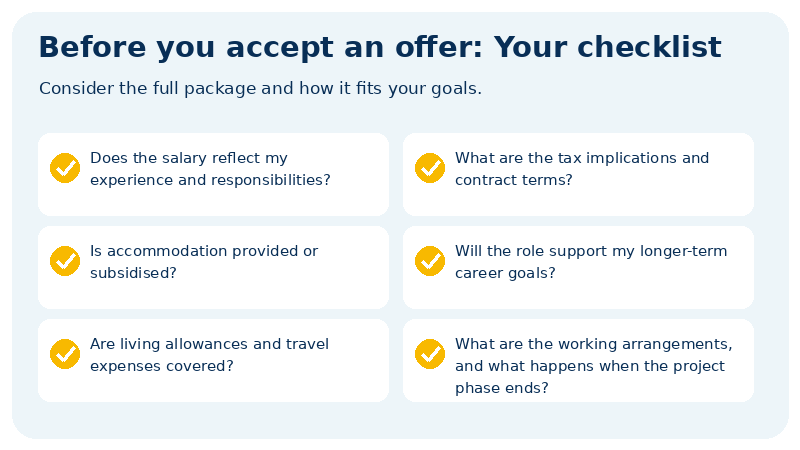
This checklist of questions is particularly important when considering an international role. A higher headline salary does not always mean more money in your pocket, just as a lower salary does not necessarily mean a less attractive offer.
Understanding your likely expenses and the benefits included is essential.
Planning your next move in 2027?
At E-Frontiers, we connect data centre construction professionals with opportunities across Ireland and Europe.
Whether you’re considering your next project in Ireland or exploring opportunities across Europe, it pays to understand what your experience and specialist skills are worth.
Our data centre construction recruitment team can help you explore current opportunities, compare packages, and understand what different markets have to offer.
Get in touch with E-Frontiers to discuss your next career move.
Colm Costello | Head of Construction Recruitment
Mark Kelly | Senior Recruitment Consultant
Muiris Fitzgerald | Recruitment Consultant
E-Frontiers’ perspective on data centre construction recruitment
October 2026.
Got an IT interview coming up? Here’s how to prepare: what employers really want and how to handle interview questions that can leave even experienced candidates stuck.
Getting invited to an interview is a good sign. Your CV has done its job. The employer has looked at your experience and decided there is enough of a match to spend some time getting to know you.
Now comes the slightly trickier part: convincing them that you’re the right person for the role.
For IT professionals, that can mean a mixture of technical questions, problem-solving scenarios, competency questions and plenty of questions about your experience, communication and how you work with others.
And then there are the small questions that everyone seems to dread.
“Tell me about yourself.”
“What’s your biggest weakness?”
“Why are you leaving your current role?”
And, inevitably:
“Do you have any questions for us?”
Knowing your technology is one thing. Being able to talk confidently about your experience is another.
The good news? Interviewing is a skill. And like most skills, it gets better with a bit of preparation.
What are employers really looking for?
An interview isn’t just about checking whether you know your Java from your JavaScript or your AWS from your Azure.
Employers want to understand how you think, how you work and what you can bring to the team.
So don’t think of an interview as an exercise in repeating your CV.
Think of it as your chance to prove the experience behind it.
Prepare your examples, not a script
One of the biggest mistakes candidates make is trying to prepare a perfect answer for every possible interview question.
Don’t.
Instead, think of five or six good examples from your career that show different skills.
For example:
– A technically difficult project
– A problem you solved
– Something that went wrong
– A successful project or achievement
– A difficult stakeholder or team situation
– A time you had to learn something quickly
– A time you took ownership or led something
You can use these examples to answer lots of different questions.
For competency-based questions, STAR is a useful way to structure your answer
Situation – What was happening?
Task – What did you need to achieve?
Action – What did you actually do?
Result – What happened?
It’s useful, particularly for questions beginning with:
“Tell me about a time when…”
But importantly: don’t make it sound like you’re using STAR.
Just tell the story naturally.
And pay particular attention to the A — Action.
IT projects are usually team efforts, so you’ll tend to naturally talk about “we”. But the interviewer needs to know what you did. Use enough detail to make your contribution and the outcome clear.
And the interview questions everyone dreads
“Tell me about yourself.”
Don’t panic. They’re not asking for your life story. Don’t start with your Leaving Cert results!
They’re looking for a short professional summary.
A good structure is:
Where you’ve worked → what you’re doing now → what you’re looking for next.
For example:
“I’ve been working in software development for around seven years, mainly across Java and cloud-based applications. I started in a smaller development team before moving into larger enterprise projects. In my current role, I’m focused heavily on backend development and AWS, and I’ve also taken on some mentoring responsibility. I’m now looking for a role where I can continue developing technically while taking on more responsibility within the wider team.”
Aim for around 60–90 seconds.
Why are you looking to leave your current role?”
This one needs a little diplomacy.
Even if the real answer is “because I can’t stand my manager”, that’s not the version you want to give.
Keep it positive and focus on what you’re moving towards.
For example:
“I’ve learned a lot in my current role, but I’m now looking for a new technical challenge and the opportunity to develop further in a certain area.”
Or:
“My role has changed quite a bit over the last year, and I’m now looking for something closer to the type of development work I’d like to focus on long term.”
You don’t need to pretend everything about your current job is perfect. Just keep the conversation professional.
“Why do you want to work for us?”
This is where a little research goes a long way.
Avoid:
“It’s a great company and the role looks interesting.”
Instead, connect something you’ve learned about the company or role with your own experience.
For example:
“I was particularly interested in the role because of the company’s move towards cloud-based platforms. That’s an area I’ve been focusing on over the last couple of years, and the opportunity to work on that at a larger scale really appeals to me.”
You don’t have to pretend it’s your lifelong dream to work there.
Just show that you’ve thought about why this role makes sense for you.
Use our handy checklists below before your interview!
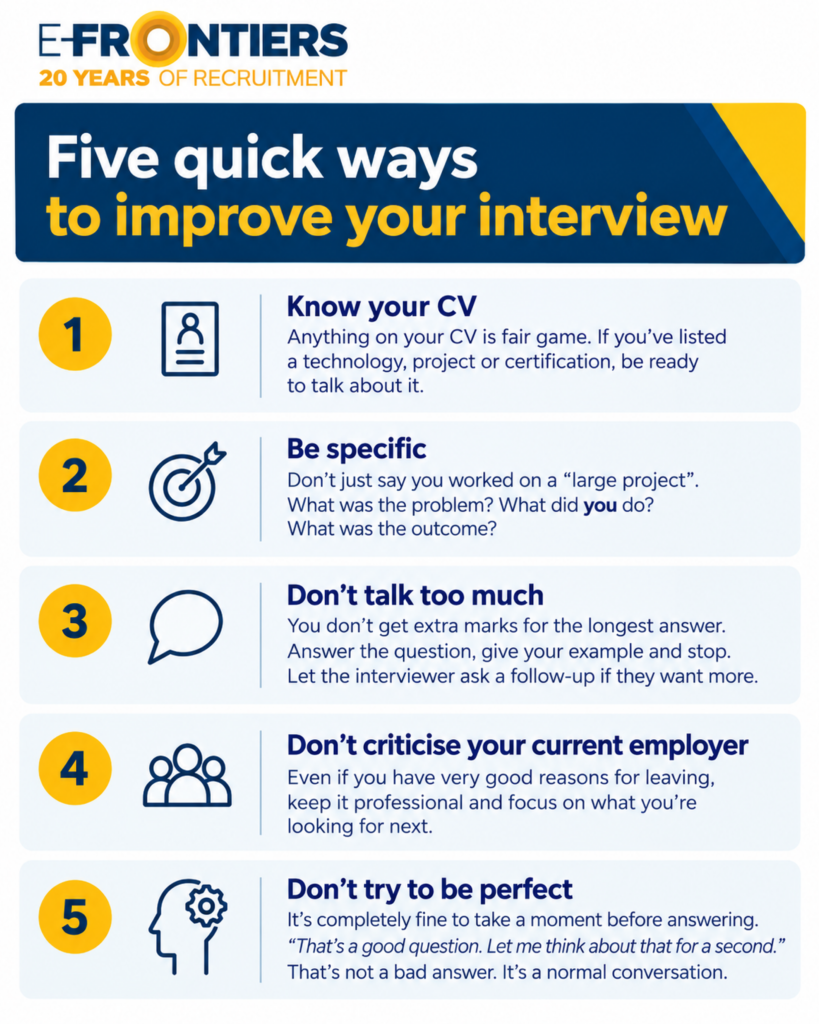

“What’s your biggest weakness?”
How to turn a negative into a positive!
Please don’t automatically say: “I’m a perfectionist.”
Instead, choose something genuine that isn’t fundamental to the role and explain what you’re doing about it.
For example:
“Earlier in my career, I wasn’t particularly confident presenting to larger groups. I was comfortable communicating within a technical team, but presenting to senior stakeholders was something I found more difficult. I’ve deliberately taken on more presentation opportunities over the last couple of years and it’s something I’m much more comfortable with now.”
The trick is:
Weakness → awareness → action → improvement.
That’s much more convincing than pretending you have no weaknesses.
“Tell me about a time you failed.”
Don’t say:
“I can’t think of one.”
Nobody expects you to have had a perfect career.
Choose something genuine but manageable – for example, a project that ran over time, a technical decision that had to be changed, or a mistake that taught you something.
The important part isn’t the failure itself.
It’s what you did afterwards and what you learned from it.
“Tell me about a conflict you’ve had at work.”
Here, the interviewer just wants to know how you handle disagreement.
It could be a technical disagreement, conflicting project priorities, or a difficult stakeholder.
Focus on what you did to move things forward.
For example:
“We had different views on the best technical approach to take for a project. So, I suggested we go back to the requirements and test both of our approaches against them. That gave us a focus to work towards…”
That’s a much better answer than:
“We disagreed but eventually sorted it out.”
What if you don’t know the answer to a technical question?
Don’t bluff.
If you haven’t worked with a particular technology, say so.
For example:
“I haven’t worked directly with that technology, but I have worked extensively with …, which has some similarities.”
That’s a perfectly reasonable answer.
And if you’re given a technical problem that you can’t immediately solve, talk through your thinking.
Explain what you’d check, what information you’d need, and how you’d approach the problem.
Sometimes the interviewer is interested in how you think, not just whether you can produce the answer immediately.
“What are your salary expectations?”
Have a realistic range in mind before the interview, based on the role, your experience, and the current market.
If asked, give a range rather than locking yourself into one figure, and consider the full package – including benefits, bonus, pension, and flexibility.
You could say: “Based on the role and my experience, I’d be looking in the region of €X to €Y, although I’m open to discussing the overall package.
Don’t underestimate the final question
“Do you have any questions for us?”
Never answer this with:
“No, I think you’ve covered everything.”
Have a few questions ready.
For an IT role, you could ask:
“What would you want the person in this role to have achieved after six months?”
“What are the main technical challenges the team is working on at the moment?”
“Can you tell me a little about the team I’d be joining?”
“What are the plans for the technology environment over the next 12–18 months?”
“How do you support technical development and progression?”
And remember, this part works both ways. You’re interviewing them too.
Finally, don’t forget the person behind the CV
An interview isn’t an exam where every question has one perfect answer.
The employer really just wants to understand what you’ve done, how you approach problems, how you work with people, and whether you can contribute to their team.
So, prepare a few strong examples, know your CV, and be clear about your own contribution. You don’t need to know everything – the important thing is being able to explain what you know, how you think, and how you would approach the problem.
Your CV gets you through the door.
The interview is your chance to bring it to life.
If you’re preparing for an IT interview, speak to the E-Frontiers team. Our recruitment consultants work with candidates across IT and technology and can give you insight into the role, the company, and the interview process before you take that next step.
Please Contact:
Anca Antonica | Principal Recruitment Consultant | IT & Technology
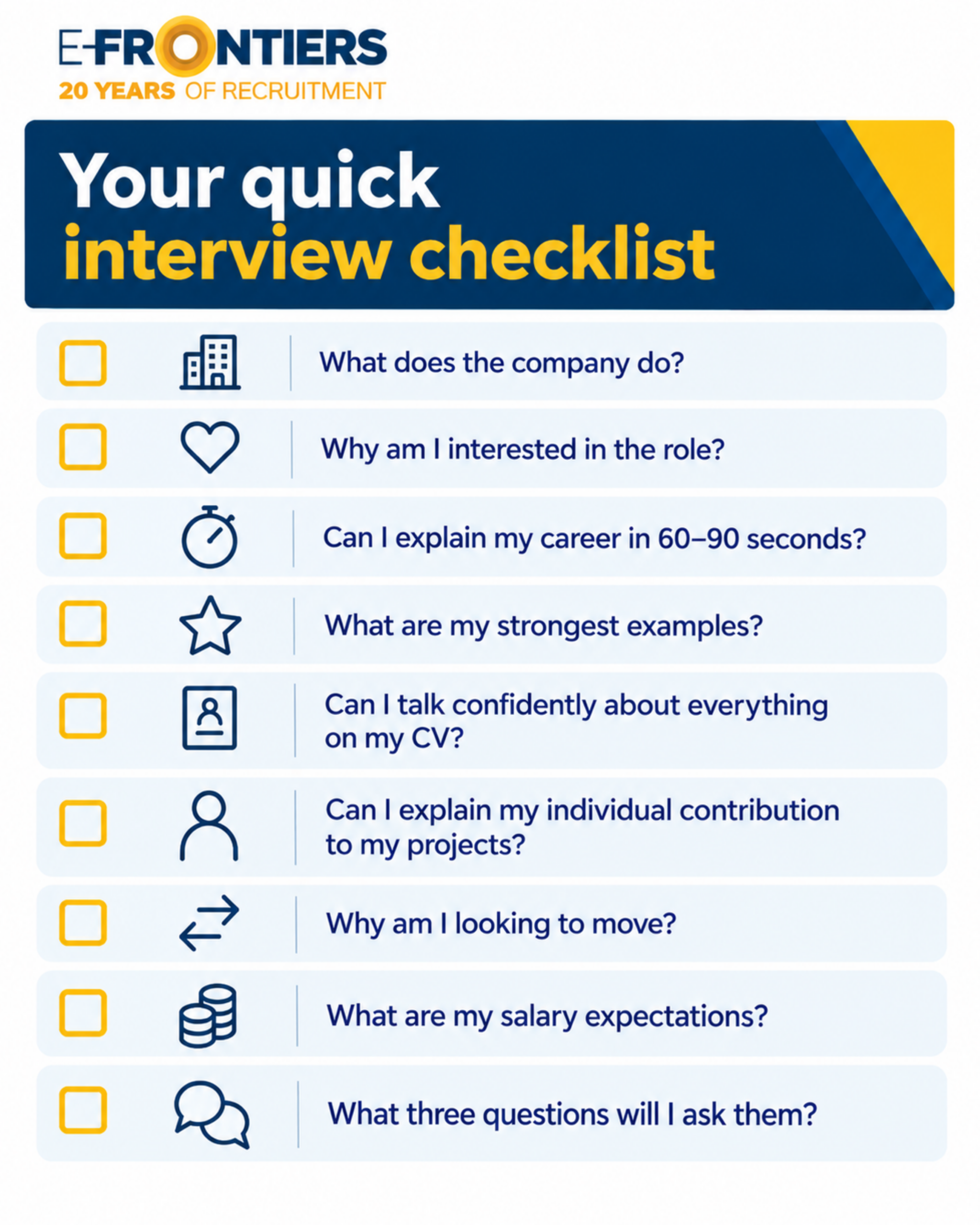
As we head into the last quarter of 2026, we look forward to some of the top professional events taking place across Ireland over the next few months. From AI and cybersecurity to software development, construction, and business innovation, these conferences and summits bring together industry leaders, hiring companies, and ambitious professionals.
Whether you’re looking to stay ahead of market trends, grow your network, or explore new career opportunities, there’s something here for everyone. Have a browse and see what’s worth adding to your calendar.
*Dates and places may be subject to change; please click on the links for more information.

The Dublin AI Week | 2nd-9th October 2026 | Dublin
Date: 2nd to 9th October, 2026
Location: Various locations around Dublin
More Information: Dublin AI Week | Oct 2-9, 2026
Event Details: A week-long, community-led programme of 35+ AI events covering areas including AI infrastructure, security and compliance, AI in finance, enterprise AI and creative AI.
Who should attend: AI and software professionals, developers, data specialists, founders and business leaders looking to understand how AI is being developed and applied in Ireland.
Why go: A great opportunity to learn, connect with people building with AI, and explore a wide range of practical AI topics.
IOB Future of Finance Summit | 13th October 2026 | Dublin
Event Details: The Institute of Banking’s flagship event for financial services leaders, exploring the trends and developments shaping the future of finance.
Who should attend: Accounting and finance professionals, banking and financial services professionals, business leaders, and anyone interested in the changing financial landscape.
Why go: Hear from industry experts, gain fresh perspectives, and connect with peers across financial services.
International AI Summit | 14th October 2026 | Dublin
Event Details: A major international summit bringing together government and business leaders, investors, innovators, and academics to explore AI’s impact on competitiveness, infrastructure, investment, skills, and talent.
Who should attend: AI and IT professionals, software developers, technology and business leaders, investors, and anyone interested in the future of AI.
Why go: One of the biggest AI events in Ireland this year, offering insight into where AI technology, investment, and policy are heading.
CIF Digital Construction Summit | 15th October 2026 | Dublin
Date: 15th October, 2026
Location: Croke Park, Dublin
More Information: 2026 Agenda – CIF DIGITAL CONSTRUCTION SUMMIT
Event Details: Focused on the digital transformation of construction, including AI, digital processes, BIM, productivity, and the technology being used on major infrastructure projects.
Who should attend: Construction and engineering professionals, project managers, contractors, infrastructure professionals, and those working in digital construction.
Why go: A strong opportunity to understand how technology is changing the way Ireland’s construction and infrastructure projects are delivered.
Convergence – Digital Infrastructure Ireland Conference | 22nd October 2026 | Dublin
Date: 22nd October, 2026
Location: Croke Park, Dublin
More Information: Convergence 2026 | Digital Infrastructure Ireland
Event Details: A senior-level conference looking at the infrastructure, investment, energy, skills, AI, and cybersecurity needed to support Ireland’s digital economy.
Who should attend: IT and technology professionals, infrastructure and engineering professionals, business leaders, investors, and those working in digital infrastructure.
Why go: Gain a clearer picture of Ireland’s digital infrastructure roadmap and hear directly from the people shaping investment and development in the sector.
IRISSCON 2026 | 11th November 2026 | Dublin
Event Details: Ireland’s annual cybersecurity conference, focusing on the current cyber threats facing businesses and how organisations can respond.
Who should attend: Cybersecurity and IT professionals, security specialists, risk professionals and business leaders.
Why go: Stay up to date with the evolving threat landscape, hear from industry experts and connect with professionals working across cybersecurity in Ireland.
Lean Construction Ireland National Conference | 4th November | Meath
Date: 4th November, 2026
Location: Johnstown Estate, Co Meath
More Information: LciConference – LciConference
Event Details: A major construction event focused on optimising business performance through Lean practices, innovation, and digital transformation. It brings together more than 300 professionals from across the construction industry.
Who should attend: Construction and engineering professionals, contractors, project managers, clients, and anyone interested in improving productivity and project performance.
Why go: A practical opportunity to learn from industry case studies, explore new approaches, and connect with construction professionals across Ireland
DevFest Ireland 2026 | 28th November, 2026 | Dublin
Date: 28th November, 2026
Location: National College of Ireland, Dublin
More Information: DevFest Ireland 2026
Event Details: Ireland’s largest community-led developer festival, with a full day of talks, workshops and hands-on learning across web, cloud, AI and mobile.
Who should attend: Software developers, IT professionals, cloud specialists, AI practitioners, students and anyone looking to develop their technical skills.
Why go: A particularly good event for keeping technical skills current, learning from experienced developers and connecting with Ireland’s wider developer community.
The Irish construction industry is buoyant at present, with increasing demand for Housing/Apartments, Data Centres, Pharmaceutical projects, Infrastructure works etc. While a workforce shortage has made it challenging to secure skilled professionals for these areas, this also means exciting opportunities for top talent are available.
At E-Frontiers, we deal with the top Tier 1 and Tier 2 Contractors and Residential Developers in Ireland. If you’re currently based in Ireland and exploring new career options or looking to return home in the near future, now is the perfect time to take the next step in your career.
We have summarised some information below about the top construction roles that are in demand at present and how you can contribute to some of the most dynamic and high-profile projects in the industry.

Quantity Surveyors (QS’s)
Quantity Surveyors are indispensable for cost management and financial planning in construction projects. They ensure projects stay on budget without compromising quality.
-Salaries/Packages:
Junior/Project level – €45,000 to €70,000 plus transport & package
Senior QS level – €70,000 to €90,000 plus transport & package
– Qualifications:
A degree in Quantity Surveying, Construction Economics, or a related discipline. Membership in professional bodies like the Society of Chartered Surveyors Ireland (SCSI) is highly desirable though not essential.
As the candidate what’s in it for you:
QS professionals will have the opportunity to influence critical project decisions, develop in-depth financial expertise, and collaborate with multidisciplinary teams. Senior roles offer leadership and strategic planning experience in complex projects.
As the company what can you do:
Emphasise involvement in high-profile projects, flexible working options, and a strong focus on employee well-being to attract top QS talent, CPD opportunities are also very beneficial.
Site/Senior Engineers
Site and Senior Engineers play a critical role in the successful delivery of projects. They are responsible for setting out and ensuring design specifications are met, and maintaining quality standards.
-Salaries/Packages:
Site/Setting Out Engineers – €50,000 to €65,000 plus transport & package
Senior Engineers – €70,000 to €85,000 plus transport & package
-Qualifications:
A degree in Construction Management, Civil or Structural Engineering is typically required, alongside experience with setting-out equipment like total stations and GPS
As the candidate what’s in it for you:
This role offers a chance to bring your existing skillset and knowledge to assist high-profile projects and developments to completion, develop expertise in advanced engineering tools, and progress into leadership positions such as Site/Project Management. Engineers will gain exposure to dynamic environments that challenge their problem-solving and technical skills.
As the company what can you do:
Highlight opportunities for professional development, exposure to cutting-edge technologies, and a supportive team environment. Providing competitive benefits packages, CPD opportunities where possible and clear career progression pathways are vital.
Site Manager/Site Supervisor
These roles involve overseeing on-site operations, managing teams, and ensuring projects are delivered on time and within budget.
-Salaries/Packages:
Site Supervisor/Finishing Foreperson – €60,000 to €70,000 plus transport & package
Site Agent/Manager – €70,000 to €85,000 plus transport & package
-Qualifications:
A background in Construction Management, Engineering, or Trade Qualifications, coupled with strong leadership skills and relevant on-site experience.
As the candidate what’s in it for you:
Site Managers and Supervisors gain leadership experience, exposure to complex construction projects, and the satisfaction of seeing their work take tangible form. These roles are stepping stones to senior management positions in the construction industry.
As the company what can you do:
Highlight the opportunity to lead high-impact projects, provide ongoing leadership training, and offer performance-based bonuses.
Health and Safety Advisors
Health and Safety Advisors are key to ensuring compliance with safety regulations and creating a safe working environment.
-Salaries/Packages:
Junior/Inter level – €40,000 to €60,000 plus transport & package
Senior/Manager level – €65,000 to €85,000 plus transport & package
-Qualifications:
Diploma Level 6 in Occupational Health and Safety, NEBOSH, IOSH, or other recognised safety certifications, combined with experience in construction safety management.
As the candidate what’s in it for you:
Advisors will contribute directly to creating safer workplaces while building your expertise in risk management and compliance. The role offers opportunities for recognition through successful safety initiatives and pathways to senior safety leadership roles.
As the company what can you do:
Showcase your commitment to safety through robust training programs, and recognition schemes for safety performance, along with opportunities for certifications or further education.
Site Manager/Site Supervisor
These roles involve overseeing on-site operations, managing teams, and ensuring projects are delivered on time and within budget.
-Salaries/Packages:
Site Supervisor/Finishing Foreperson – €60,000 to €70,000 plus transport & package
Site Agent/Manager – €70,000 to €85,000 plus transport & package
-Qualifications:
A background in Construction Management, Engineering, or Trade Qualifications, coupled with strong leadership skills and relevant on-site experience.
As the candidate what’s in it for you:
Site Managers and Supervisors gain leadership experience, exposure to complex construction projects, and the satisfaction of seeing their work take tangible form. These roles are stepping stones to senior management positions in the construction industry.
As the company what can you do:
Highlight the opportunity to lead high-impact projects, provide ongoing leadership training, and offer performance-based bonuses.
Building Services Manager
Building Services Managers ensure that electrical, mechanical, and plumbing systems are integrated seamlessly into construction projects. They are pivotal for large-scale developments.
-Salaries/Packages:
Building Services/M&E Coordinator – €60,000 to €75,000 plus transport & package
Building Services/M&E Manager – €75,000 to €90,000 plus transport & package
-Qualifications:
A degree in Building Services, Mechanical, Electrical Engineering, and/or a trade background as a plumbing, electrician, or fitter, with extensive experience managing MEP services.
As the candidate what’s in it for you:
This role offers candidates the chance to get exposure to & to be involved in innovative high-profile Technology, Data Centre & Pharmaceutical projects, to specialise in green building practices, and work with cutting-edge technology. Building Services Coordinators & Managers are critical in shaping sustainable infrastructure and advancing their professional expertise.
As the company what can you do:
Stress the importance of their role in innovation and sustainability, offer opportunities to work on cutting-edge green building projects, and provide favourable benefits packages.
Conclusion
To thrive in Ireland’s competitive construction sector, it’s important to consider what makes a role truly stand out. Top candidates are looking for more than just a pay cheque – they want opportunities for career growth, professional development, work-life balance, and a positive workplace culture. Companies that prioritise employee satisfaction, offer unique benefits and create an environment where people feel valued will attract the best talent.
If you’re exploring new opportunities, look for employers who offer not only competitive salaries but also have a good work-life balance, good company culture, offer the chance to grow, showcase your skills, and be part of successful projects. Whether you’re a Site Engineer or a Building Services Manager, finding a company that aligns with your career goals and values is key to taking the next step in your professional journey.
Are you looking for your next role or top talent in the construction sector?
2. Connect on LinkedIn with our Construction Recruitment Specialist – Mark Kelly
3. For visibility of all our roles visit the jobs section of our website
4. Click here to find out more about our areas of expertise in the construction industry
Diversity, Equity, and Inclusion (DEI) is no longer a “nice to have” in the workplace – it’s expected. But while many companies talk about DEI, not all deliver on it in a meaningful way.
For job seekers today, the challenge isn’t just finding employers who mention DEI – it’s identifying those who genuinely embed it into their culture, leadership, and day-to-day working environment.
This focus on workplace inclusion is becoming increasingly important across Ireland. In recent years, gender pay gap reporting requirements have expanded significantly, with organisations employing more than 50 people now required to publish annual reports. This increased transparency is giving candidates greater insight into how organisations approach equality, representation, and progression in the workplace.How to report on the Gender Pay Gap
If you’re considering a career move in the second half of 2026, here’s how to look beyond the surface and assess what DEI really looks like in practice.

Why DEI Still Matters – But Looks Different Today
In recent years, the conversation around DEI has matured. It has moved beyond policies and statements and into something far more tangible: the employee experience.
Across Europe, there is a growing focus on how employees experience the workplace, rather than what company policies say on paper. The Financial Times’ 2026 Diversity Leaders ranking, for example, placed significant emphasis on employee feedback when assessing organisations’ diversity and inclusion performance, highlighting the importance of creating genuinely inclusive working environments. FT-Statista 2026 Diversity Leaders ranking and methodology
Today, strong DEI in the workplace shows up as:
– Inclusive leadership and decision-making
– Equal access to opportunities and progression
– Flexibility that supports different lifestyles and responsibilities
– A culture where people feel heard, respected, and safe to contribute
Candidates are increasingly prioritising these factors – not just for ethical reasons, but because they directly impact job satisfaction, performance, and long-term career growth.
What to Look for Before You Apply
Before submitting an application, take a few minutes to assess how an organisation presents itself.
Here are some key indicators:
1. Careers Page & Messaging: Is the language authentic, or does it feel generic? Look for specific examples rather than broad statements.
2. Representation Across the Business: Check leadership teams and company profiles. Is there visible diversity, particularly at senior levels? While progress is being made in Ireland, women still represent less than one-third of senior executive positions across Irish organisations, making leadership representation an important indicator of how inclusion translates into career progression opportunities. Key Findings Gender Balance in Business Survey 2025 – Central Statistics Office
3. Employee Voices: Are there real stories or testimonials from employees? These often give a more honest view than corporate messaging.
4. Evidence of Flexibility: Do they clearly outline hybrid working, flexible hours, or inclusive policies- or is it vague?
Questions You Should Ask Employers
Remember, interviews are a two-way process. Here are a few simple but effective questions to help you assess DEI in an interview:
– “How do you ensure different perspectives are included in decision-making?”
– “What does career progression look like across the team?”
– “How do you support flexible working in practice?”
– “Can you share examples of how employee feedback has shaped the workplace?”
The answers – and how confidently they’re delivered – can be very revealing.
How to Spot DEI in the Hiring Process
The hiring process itself can reveal a great deal about a company’s culture.
Pay attention to:
– Interview structure – Is the process clear and consistent?
– Panel diversity – Are you meeting a range of people?
– Communication style – Do you feel respected and included throughout?
– Accessibility – Are accommodations offered or welcomed?
A company that values inclusion will reflect this in how they engage with candidates – not just what they say.
Red Flags to Watch Out For
Not every organisation gets it right. Some warning signs include:
– Vague or overly polished answers with no real examples
– A lack of diversity at senior level
– Inconsistent hiring experiences
– Little evidence beyond statements or policies
If something feels unclear, it’s worth digging deeper.
Final Thoughts
Looking ahead, workplace transparency is set to become an even bigger factor in the job search process. Alongside Ireland’s gender pay gap reporting requirements, the EU Pay Transparency Directive will introduce new obligations around pay transparency and reporting.
While primarily focused on closing pay gaps, the legislation reflects a broader shift towards fairness, accountability and openness in the workplace. For candidates, this means greater visibility into how organisations approach pay, progression, and equality. How to report on the Gender Pay Gap
DEI is no longer just a company initiative – it’s a key factor in choosing where to build your career.
As a candidate, you have more insight and influence than ever before. By asking the right questions and paying attention to the details, you can make informed decisions and find an environment where you’ll truly thrive.
Because ultimately, the right role isn’t just about what you do – it’s about where you feel you belong.
At E-Frontiers, we’re here to help you find more than just a job — we’re here to help you find the right fit. If you need support or guidance at any stage of your job search, just get in touch.
As organisations continue to navigate economic uncertainty, rapid digital transformation, and evolving workforce expectations, contracting has become a strategic cornerstone of modern hiring. What was once a tactical stopgap is now a key lever for agility, speed, and delivery. To gain further insight into these evolving trends, we caught up with Conor Hackett, Head of Contracting at E-Frontiers, to hear his thoughts on where the contracting market is heading in 2026
The Shift to Speed: Contracting as a Delivery Engine
A defining trend across 2025 and into 2026 is the increasing importance of speed-to-hire and speed-to-impact. Businesses are prioritising how quickly talent can drive outcomes rather than simply focusing on cost efficiency.
In practice, this means organisations are using contractors to rapidly mobilise teams, accelerate delivery timelines, and avoid costly project delays. Contracting is no longer just about plugging gaps; it’s about enabling immediate productivity and maintaining momentum in critical programmes.
Key takeaway: Contracting is evolving into a core mechanism for delivering projects at pace.
The Project Economy Is Now Mainstream
Workforce strategy is increasingly centred around projects rather than permanent roles. Organisations are structuring teams around defined outcomes, digital transformation initiatives, cloud migrations, AI deployment, and large-scale infrastructure programmes.
This shift reinforces the value of highly skilled contractors who can deliver against specific objectives without long-term commitments.
Key areas seeing sustained demand include:
– Technology and software engineering
– Data and AI transformation
– Cybersecurity and cloud infrastructure
What this means: Contractors are becoming the backbone of execution in a project-driven economy.
Specialisation & Talent Scarcity
Demand for niche, high-value skillsets continue to grow. From cloud engineers and DevOps specialists to AI and data experts, organisations are increasingly competing for a limited pool of highly skilled contractors.
Traditional hiring channels often struggle to meet these needs due to:
– Lengthy hiring timelines
– Limited access to passive talent
– Rapidly evolving technical requirements
As a result, pre-qualified contractor networks and specialist recruitment partners are becoming critical to securing the right expertise quickly.
Insight: Access to specialised talent, not just availability, is now the key differentiator in hiring success.
Remote & Distributed Contracting as Standard
Remote work has firmly embedded itself within the contracting model. Organisations are increasingly hiring talent across geographies to access scarce skills and maintain flexibility.
This shift has led to:
– Broader talent pools alongside increased competition for top contractors
– Greater reliance on structured onboarding and compliance frameworks
– A need for seamless collaboration across distributed teams
Trend evolution: Remote contracting is no longer optional; it is the default operating model.
Cost Pressures vs Capability Needs
Despite continued cost sensitivity across many sectors, contracting remains attractive because it aligns closely with both financial discipline and delivery needs.
Businesses benefit from:
– No long-term overheads such as pensions, benefits, or employer taxes
– A pay-for-output model where spend ties directly to delivery
– Reduced hidden costs associated with onboarding and long-term employment
Even where contractor rates fluctuate, the flexibility and productivity gains often outweigh the perceived higher day-rate cost.
Insight: Contracting enables organisations to balance cost control with access to high-impact talent.
Workforce Demographics Are Changing
The contractor workforce is becoming more diverse, experienced, and strategically valuable.
Key shifts include:
– Increased participation across different demographics and experience levels
– Greater representation of professionals choosing contracting for flexibility and autonomy
– A growing number of experienced specialists remaining in the workforce longer through contracting
Insight: Contracting is evolving into a sustainable and attractive career path, strengthening the overall talent market.

Emerging Trends Shaping the Rest of 2026
Looking ahead, several trends are set to define the contracting landscape for the remainder of the year:
- Squad-Based Hiring Will Accelerate
Organisations are increasingly moving beyond hiring individuals to deploying fully formed contractor teams or “squads.”
This model:
– Reduces ramp-up time
– Improves team cohesion from day one
– Aligns with agile and product-led delivery
Expectation: Squad-based hiring will become a standard approach for major transformation programmes.
-
AI, Data & Cybersecurity Will Drive Demand
Investment in emerging technologies continues to surge, particularly in:
– Artificial intelligence implementation
– Data architecture and analytics
– Cybersecurity resilience
These areas require highly specialised expertise that is often best accessed through contracting.
Expectation: The demand for top-tier technical contractors will remain strong, with premium skill sets continuing to command high value.
-
Partner-Led Hiring Models Will Grow
Recruitment partners are playing a more strategic role than ever before. Beyond sourcing talent, they are increasingly involved in:
– Workforce planning
– Talent pipelining
– Compliance and onboarding management
Organisations are relying on partners to act as extensions of their internal hiring functions.
-
Time-to-Hire Will Become a Competitive Advantage
Speed is becoming a key differentiator. Organisations that can secure and onboard talent quickly are outperforming those with slower processes.
Implication: Businesses with lengthy hiring cycles risk losing top contractor talent to faster-moving competitors.
-
Hybrid Workforce Models Will Dominate
The future workforce is not a choice between permanent employees and contractors; it is a blend of both.
Organisations are:
– Maintaining core permanent teams for stability
– Adding contractors for flexibility and specialist delivery
– Scaling teams dynamically based on project requirements
Final Outlook
Contracting has firmly established itself as a strategic hiring solution in a fast-changing business environment. Its ability to provide speed, flexibility, and access to niche expertise makes it indispensable for organisations focused on delivery and transformation.
For the remainder of 2026, successful organisations will be those that:
– Embrace project-based workforce planning
– Build strong contractor ecosystems
– Move quickly and decisively in competitive talent markets
In an era defined by change, contracting offers a powerful advantage: the ability to deliver outcomes with both agility and precision.
At E-Frontiers, we work closely with organisations to help them navigate this evolving landscape – connecting businesses with high-quality contract talent quickly, efficiently, and in line with their project goals. Whether you are scaling teams, delivering transformation programmes, or accessing niche expertise, our specialist teams are here to help you get it right.
For further information to help you on your Contracting career journey, please contact:
Conor Hackett – Head of Contracting – E-Frontiers.
La diversidad en el entorno laboral se ha consolidado como un elemento clave para las organizaciones que buscan innovar y adaptarse a un entorno en constante cambio. Más allá de una cuestión ética, construir equipos diversos se ha convertido en una ventaja competitiva real.
Aun así, llevar la diversidad a la práctica diaria sigue siendo un reto. Desde los sesgos inconscientes hasta la falta de medición o el papel del liderazgo, las empresas se enfrentan a desafíos que requieren un enfoque más estructural y sostenido.
Para profundizar en este tema, hablamos con Pedro Corchado, especialista en comunicación corporativa y contenidos digitales. Hoy nos comparte su experiencia y visión sobre los retos, las oportunidades y las claves para impulsar culturas verdaderamente inclusivas.
Desde tu experiencia, tanto como empleado como miembro del grupo de diversidad en tu actual trabajo, ¿cuáles son hoy los principales retos que enfrentan las empresas para construir entornos de trabajo verdaderamente diversos e inclusivos?
Creo que el principal reto es pasar del discurso a la realidad. Muchas empresas ya entienden que la diversidad y la inclusión son importantes, pero no siempre consiguen traducirlas en decisiones, procesos y acciones concretos.
También sigue siendo clave entender que la inclusión no se construye solo con políticas, sino con cultura. Puedes tener protocolos o campañas, pero si las personas no sienten que pueden ser ellas mismas y desarrollarse sin sesgos, todo se queda en el papel.
Y, por último, diría que hacen falta más escucha y más hecho: escuchar mejor a los equipos y hacer que la diversidad forme parte real del día a día, no solo de momentos puntuales.
¿Qué iniciativas o prácticas has visto que realmente marquen la diferencia en la inclusión diaria dentro de las organizaciones?
Las que hacen que la inclusión sea real en el día a día, no solo una política. Por ejemplo, revisar el lenguaje, cuidar los procesos de selección, dar visibilidad a referentes diversos o asegurar que distintas voces participan en la toma de decisiones.
También funcionan muy bien los espacios de escucha, los grupos internos de diversidad y las acciones que ayudan a que las personas se sientan parte de la organización sin tener que encajar a la fuerza.
Al final, lo que marca la diferencia no suele ser una gran campaña, sino una suma de decisiones.
Cuentanos, desde tu experiencia en el grupo de diversidad de tu actual empresa, ¿cómo se puede medir de forma efectiva el impacto de las políticas de diversidad e inclusión?
Creo que hay que combinar datos y experiencia. Por un lado, medir cuestiones como representación, promoción, rotación o participación en iniciativas. Y por otro, escuchar cómo se sienten realmente las personas dentro de la organización.
Encuestas, entrevistas, focus groups o canales de escucha ayudan a entender si la gente percibe igualdad de trato, seguridad y pertenencia.
Y también hay señales muy valiosas en la participación: si aumentan las propuestas, los espacios compartidos, las actividades o el número de personas que se sienten lo suficientemente seguras como para implicarse, exponerse y formar parte activa de estas iniciativas.
Para mí, una buena medición no consiste solo en contar cuántas acciones se han hecho, sino en comprobar si esas acciones están cambiando percepciones, comportamientos y oportunidades reales dentro de la organización.
Pedro Corchado, Senior Communications Specialist & Media Content Coordinator en Cuatrecasas. Cuenta con una larga trayectoria en el de la comunicación corporativa y actualmente forma parte del grupo de afinidad de Diversidad de su actual empresa.

¿Qué papel juegan los líderes y RRHH en impulsar una cultura inclusiva y cómo pueden las empresas acompañarlos en este proceso?
Tienen un papel fundamental. Los líderes marcan el paso a través de sus decisiones, su forma de comunicar y el entorno que generan en sus equipos. Si no están comprometidos, cualquier iniciativa pierde fuerza.
RRHH, además, tiene una función estratégica: revisar procesos, detectar sesgos, impulsar políticas y acompañar a las personas durante todo su recorrido en la empresa.
Pero para que ambos puedan hacerlo bien, la organización tiene que darles formación, herramientas y espacios para aprender y resolver dudas.
Desde tu punto de vista, ¿cuáles son los errores más habituales que cometen las organizaciones al abordar la diversidad, y cómo pueden evitarlos?
Uno de los errores más habituales es tratar la diversidad como una acción puntual o como una cuestión de imagen. Otro, comunicar mucho hacia fuera y transformar poco hacia dentro.
También pasa a menudo que se apuesta por la diversidad, pero no por la inclusión: se incorporan perfiles diversos, pero no siempre se garantiza que puedan crecer, participar y sentirse parte del entorno.
Para evitarlo, hacen falta escucha, coherencia y compromiso a largo plazo.
Con una mirada orientada a la comunicación, branding y marca empleadora, ¿cuáles son los beneficios de tener una cultura que cuida la diversidad y la inclusión?
El principal beneficio es la credibilidad. Hoy no solo importa lo que una empresa dice, sino cómo actúa y cómo cuida a las personas que forman parte de ella.
Una cultura inclusiva fortalece la marca empleadora, mejora la atracción y fidelización del talento y refuerza el orgullo de pertenencia. Además, hace que la comunicación sea más consciente, más representativa y más conectada con la realidad.
En ese sentido, la diversidad y la inclusión no son solo una cuestión cultural, también son un activo de marca.
Para aquellas empresas que están empezando su camino en diversidad e inclusión, ¿qué pasos prácticos recomendarías para avanzar de forma auténtica y sostenible?
Lo primero es entender cuál es su punto de partida: escuchar a las personas, identificar barreras y detectar prioridades reales.A partir de ahí, conviene definir una hoja de ruta realista, implicar al liderazgo y revisar procesos clave como selección, promoción, formación o comunicación interna. Y, sobre todo, asumir que esto no va de hacerlo perfecto desde el principio, sino de avanzar con compromiso, coherencia y continuidad.
Si buscas apoyo en la búsqueda y selección de perfiles tech y de ventas, contáctanos. Podemos ayudarte a diseñar procesos que impulsen la incorporación de talento diverso en tu organización.
Contracting continues to appeal to tech professionals looking for flexibility, strong earning potential, and exposure to exciting projects – but it also comes with its own challenges and trade-offs.
To give candidates an honest perspective on what contracting is really like, we spoke with an experienced Software Development Engineer currently working as a contractor in Ireland. From uncertainty and contract renewals to flexibility, independence, and career growth, this Q&A provides practical insights for anyone considering a move into contracting.
From Permanent Employee to Contractor
What was your career like before contracting, and what made you consider this route?
I was working as a full-time Software Engineer before getting into contracting. What attracted me initially was the flexibility, especially around money management, which has been a big plus for me personally.
Deciding to Take the Leap
What made you decide that contracting was the right path for you?
To be honest, it took me about a year of working as a contractor before I decided I wanted to continue long term.
There is some uncertainty involved in contracting, but there are also plenty of opportunities. One downside is that, as a contractor, you sometimes can’t represent the company at conferences or industry events. I missed out on a few opportunities at major conferences, but overall, I was comfortable with that trade-off.
The Early Experience
What was it really like when you first started contracting?
I was anxious at the start, but the team I worked with never made me feel like an external contractor. I always felt like any other employee and a part of the company.
I was given good opportunities by my leaders and felt very comfortable in the environment.
The Challenges Nobody Talks About
What challenges did you face, and how did you navigate them?
I had no idea about becoming a director or setting up a limited company before starting contracting, so that was a completely new space for me and something I had to learn quickly.
Another challenge was the uncertainty around contract renewals every six months. Sometimes renewals were smooth and sometimes stressful.
Anca and the team at E-Frontiers were so helpful to me throughout the process and supported me through those situations.

Advice for Anyone Considering Contracting
What advice would you give to someone thinking about moving into contracting?
Learn about becoming a director or setting up a limited company early, as it can really help you in the long run.
You also need to think carefully about the realities of contracting – not getting paid for holidays, time off, or public holidays is a big adjustment for some people.
At the same time, contracting offers flexibility, independence, and a level of freedom that can be very rewarding.
Looking Back
How has contracting shaped your career and would you make the same choice again?
I was fortunate enough to get a call from E-Frontiers even when I wasn’t actively looking for a change. I took a leap of faith, and it worked out well for me.
I’m extremely grateful for the opportunity. Working independently has allowed me to contribute more to projects while also giving me greater freedom in my work.
I would absolutely make the same choice again.
The Best Part of Contracting
What’s your favourite part about being a contractor?
One thing that stood out to me throughout my experience is that I never really felt like “just a contractor.”
I still felt involved in company activities, team events, and the wider culture.
Personally, my favourite part of contracting has been the flexibility and the ability to manage my own finances more independently.
Final Thoughts
Contracting isn’t for everyone. It comes with uncertainty, responsibility, and the need to adapt quickly – but for many experienced tech professionals, it can also offer flexibility, autonomy, and strong career opportunities.
The key is understanding both the advantages and the realities before making the move.
If you’re considering a move into IT contracting and want to understand the current market, day rates, or opportunities available, the team at E-Frontiers is always happy to have a confidential conversation.
Contact Anca Antonica or Trish Lynch with any queries.
Email anca.antonica@e-frontiers.ie | trish.lynch@e-frontiers.ie
As Ireland’s contracting market continues to mature, 2026 is shaping up to be a year defined by opportunity, flexibility, and strategic career choices. No longer seen as a short-term solution, contracting is now a deliberate path for professionals across IT, finance, engineering, and beyond.
To explore what’s really happening on the ground, E-Frontiers spoke with Gerard Kiernan, Managing Director of ICON Accounting, a firm specialising in providing accounting and payroll solutions for Limited Company Contractors in Ireland.
Drawing on his experience supporting contractors across multiple sectors, Gerard shares practical insights on market trends, common pitfalls, and how professionals can build a sustainable and rewarding contracting career.
Gerard, from your vantage point supporting contractors across IT, Tech, Finance, and beyond, how would you describe the Irish contracting market as we head into 2026?
From our perspective at Icon, the contracting market is not just holding up, it is evolving.
While IT remains a core pillar, we are seeing real expansion across Pharma, Engineering, Finance, Medical, Insurance and Marketing. Businesses are no longer relying on contractors as a stopgap, they are building them into their workforce strategy and projects.
There are challenges, but the overall picture is strong. Demand for high quality talent remains high, and contracting continues to be a key solution for companies that need flexibility and expertise.
Contracting is increasingly being viewed as a long-term career choice rather than a short-term solution. What are the key benefits you see for professionals choosing this path today?
Control is the big shift.
Professionals want control over their income, their time, and the work they take on. Contracting delivers all three.
We are also seeing a clear move from umbrella structures to Personal Limited Companies. That step gives contractors far greater flexibility around tax planning, financial management, and long-term wealth building.
On top of that, contractors can choose the projects they work on, the clients they engage with, and how they structure their work-life balance. For many, it is no longer an alternative career path, it is the preferred one.
For professionals considering contracting for the first time, what are the best practices ICON strongly recommends before making the move?
Do your homework properly.
Start by speaking to a specialist contract recruiter to understand demand, day rates and where your skills fit in the market. Then speak to a contractor focused accountant to get a clear financial comparison.
Contracting can significantly increase your income, but you need to understand the full picture. You are stepping away from PAYE, which means managing your own pension, holidays, sick pay and protection.
At Icon Accounting, we walk clients through that entire comparison not just the upside, but how to structure things properly so they are protected and set up for the long term.
What are the most common mistakes or ‘don’ts’ you see new contractors make — and how can they avoid them?
The biggest mistake is guessing.
Too many people rely on second-hand advice instead of speaking to professionals. Contracting is too important a move to figure out as you go.
Cash flow is another trap. Payment cycles are different, and if you are not prepared, it can catch you off guard in the early months.
We also see contractors misunderstanding company finances, particularly those operating through a limited company. Not everything that lands in your account is yours, there are tax obligations and business costs to manage.
Another major issue is protection. Too many contractors do not put income protection in place early, which creates unnecessary risk.

How important is it for contractors to have the right professional support around them – accounting, recruitment, legal – and what impact does this have on long-term success?
It is the difference between surviving and thriving.
The right recruiter does not just place you once, they help you build continuity between contracts. That consistency is what turns contracting into a sustainable career.
At the same time, your accounting and legal setup needs to be right from day one. Choosing between an umbrella structure and a Personal Limited Company is not just admin, it directly impacts your income, compliance, and long-term strategy.
Get that foundation right early and everything else becomes easier.
For professionals working with recruiters like E-Frontiers and accounting partners like Icon Accounting, what advice would you give on building a sustainable and rewarding contracting career in Ireland?
Treat your career like a business because that is exactly what it is.
Invest in your skills. The contractors who consistently upskill are the ones who command the highest rates and those costs are often tax efficient.
Build your network. Your next contract often comes from relationships, not job boards.
Finally, surround yourself with the right partners. A strong recruiter and a specialist accounting firm do not just support you, they accelerate your career.
At Icon, we also focus heavily on the Contractor community. Contracting can be independent, but it does not have to be isolating. The more connected you are, the stronger your career becomes.
In summary, the message is clear: contracting in Ireland is not just growing, it’s evolving into a long-term, strategic career choice. For professionals willing to approach it with the right mindset, preparation and support, the rewards can be significant.
As Gerard highlights, success in contracting comes down to treating your career like a business, staying informed, and surrounding yourself with the right experts. With the right foundations in place, contractors are well positioned to not only navigate the market in 2026, but to thrive in it.
For further information to help you on your Contracting career journey, please contact:
Gerard Kiernan – MD – Icon Accounting
Conor Hackett – Head of Contracting – E-Frontiers.
El modelo freelance ha dejado de ser una alternativa puntual para convertirse en una pieza cada vez más relevante dentro de las estrategias de talento en el sector tecnológico. En un contexto marcado por la necesidad de agilidad, especialización y adaptación constante, las empresas empiezan a mirar más allá de la contratación tradicional para dar respuesta a sus retos de negocio.
Sin embargo, el crecimiento de este modelo en España no está exento de complejidad. Factores como la regulación, la competencia internacional por el talento y la falta de madurez del mercado plantean desafíos que obligan a las organizaciones a repensar sus procesos internos y su forma de colaborar con estos perfiles.
Para entender mejor cómo encaja el talento freelance dentro de las empresas tech y qué oportunidades y retos presenta, hablamos con, Octavio de Elía, Head of Contractor Supply y con una gran trayectoria en el ámbito de la adquisición de talento en entornos tech. Nos comparte, en enta entrevista, su visión sobre la evolución del mercado, las ventajas de este modelo y las claves para integrarlo de forma estratégica y eficiente.
¿Cómo ves en estos momentos el papel del freelance en España? ¿Crees que está cambiando la tendencia y cada vez más empresas apuestan por este modelo de colaboración?
El mercado de freelance en España es complejo. Por un lado podemos observar un claro interés de las empresas, especialmente en el sector de tecnología, hacia modelos de trabajos flexibles. Este modelo se presenta como muy atractivo a la hora de pensar en suplir necesidades a corto plazo y reducir el riesgo laboral. Muchas empresas están dispuestas a pagar un precio más alto por este modelo, para garantizar mayor estabilidad en la planificación de su plantilla a largo plazo. Sin embargo el mercado es altamente complejo y regulado a la hora de optar por este tipo de modelo, lo que conlleva mucho trabajo interno de cumplimiento normativo y gestión de riesgos.
Por otro lado, España se ha convertido en un Hub de tecnología muy importante y atractivo para la región. Especialmente ubicaciones como Barcelona, Madrid y Málaga cuentan con mucho talento local y expatriado que trabajan remoto para múltiples países de la Unión Europea e incluso Estados Unidos. Esto genera que el talento freelance local acceda a oportunidades internacionales con remuneraciones que dificultan la competencia para empresas nacionales. Por lo que se puede decir que el mercado freelance en España, no solo es un mercado en desarrollo, sino que es altamente competitivo.
Desde tu posición como Head of Talent Acquisition, ¿qué retos a nivel empresa os llevan a apostar por perfiles freelance en vuestros equipos tech?
Hay dos beneficios claros. El primero es la velocidad en la que estos perfiles pueden comenzar a trabajar en los proyectos. La contratación a tiempo completo requiere no sólo procesos de selección más largos y exhaustivos, sino que también obliga a lidiar con períodos de aviso previo. Estos, dependiendo de la especificidad del rol, pueden ir de 15 días a 3 meses. El talento freelance, al trabajar por proyectos, suele poder ingresar de manera inmediata, algo que muchas veces es necesario. Adicionalmente, al tener una naturaleza mucho más transaccional que los empleados, contamos con un proceso de selección reducido, que ayuda con la velocidad de contratación.
El segundo beneficio es la naturaleza temporal de este tipo de relación laboral. Muchas veces nos encontramos con el desafío de encontrar personas con habilidades técnicas que no forman parte de las necesidades a largo plazo de la empresa. Al trabajar por proyectos, este talento permite hacer una inversión a corto plazo para suplir necesidades específicas.
Octavo de Elía, Head of Contractor Supply en Thoughtworks. Cuenta con una larga trayectoria en el ámbito de la adquisición de talento en entornos tech.

¿Es fácil encontrar perfiles bajo esta modalidad o aún hay poco conocimiento sobre los beneficios de ser freelancer ?
No diría que es fácil, aunque con la ayuda de los partners adecuados es muy factible. El mercado español no es de los más desarrollados en Europa para esta modalidad por lo que cuesta encontrar perfiles adecuados. En mi opinión, todavía hace falta más desarrollo y madurez en el mercado para que sea una opción viable a gran escala.
¿Cómo encaja el modelo freelance dentro de vuestra estrategia global de talento? ¿Cómo son los onboardings de este tipo de perfiles?
A nivel de estrategia de talento, el modelo freelance es sin duda una apuesta muy interesante. Creo que una empresa de servicios profesionales se puede ver muy beneficiada por este esquema y suple necesidades muy concretas y estratégicas.
A nivel de costos, da una flexibilidad muy valiosa que permite planificar el trabajo y el crecimiento de manera estratégica.
El proceso de incorporación (Onboarding) para estos colaboradores se simplifica considerablemente. Dado que no son empleados directos, es posible limitarlo a la información esencial para sus proyectos y los sistemas de trabajo esenciales. Esta optimización maximiza el tiempo productivo en proyectos, haciendo que el modelo sea significativamente más rentable.
Desde tu punto de vista, ¿qué ventajas os aporta trabajar con freelancers frente a la contratación indefinida tradicional?
Como he mencionado antes, los beneficios principales son la naturaleza temporal de estos trabajadores y la velocidad en la que pueden ingresar al negocio. Especialmente, trabajar con freelancers permite reaccionar a las necesidades de los clientes de una manera mucho más rápida que con modelos de contratación tradicionales.
Otra variable interesante, es que el mercado de talento freelance cuenta con muchos trabajadores especializados, con quienes trabajar por proyectos por un tiempo determinado es la estrategia más eficiente. Esto se debe tanto a la naturaleza de su trabajo como a que las compañías pueden no requerir estas funciones de forma permanente.
Para cerrar, ¿qué consejo darías a otras empresas tecnológicas que están valorando incorporar freelancers?
Un consejo claro es que preparen sus equipos internos para dar soporte a este tipo de reclutamiento y relación laboral. Las diferencias entre trabajar con freelancers y empleados es considerable y no debe ser tomada a la ligera. La educación hacia los equipos internos en cómo tratar y colaborar con los freelancer es altamente necesaria para garantizar el cumplimiento normativo y para lograr colaboraciones exitosas. Es igual de importante educar a los equipos de negocio para entender las ventajas y beneficios que este tipo de trabajadores trae. Los procesos internos, particularmente de selección, onboarding y ciclo de vida han de ser adaptados para aprovechar todas las ventajas que el modelo de trabajo flexible trae.
Otro aprendizaje que puedo compartir, es que es importante saber identificar cuándo es beneficioso y cuándo no. Muchas veces los equipos internos no entienden todas las diferencias entre un freelancer y un empleado. Por lo tanto, los equipos de Talento debemos hacer un buen trabajo de ser socios estratégicos del negocio y aconsejarlos adecuadamente.
Si buscas apoyo en la búsqueda y selección de perfiles tech y de ventas, contáctanos y veamos cómo podemos acompañarte a crear un entorno donde las personas quieran quedarse y crecer.
