


La diversidad en el entorno laboral se ha consolidado como un elemento clave para las organizaciones que buscan innovar y adaptarse a un entorno en constante cambio. Más allá de una cuestión ética, construir equipos diversos se ha convertido en una ventaja competitiva real.
Aun así, llevar la diversidad a la práctica diaria sigue siendo un reto. Desde los sesgos inconscientes hasta la falta de medición o el papel del liderazgo, las empresas se enfrentan a desafíos que requieren un enfoque más estructural y sostenido.
Para profundizar en este tema, hablamos con Pedro Corchado, especialista en comunicación corporativa y contenidos digitales. Hoy nos comparte su experiencia y visión sobre los retos, las oportunidades y las claves para impulsar culturas verdaderamente inclusivas.
Desde tu experiencia, tanto como empleado como miembro del grupo de diversidad en tu actual trabajo, ¿cuáles son hoy los principales retos que enfrentan las empresas para construir entornos de trabajo verdaderamente diversos e inclusivos?
Creo que el principal reto es pasar del discurso a la realidad. Muchas empresas ya entienden que la diversidad y la inclusión son importantes, pero no siempre consiguen traducirlas en decisiones, procesos y acciones concretos.
También sigue siendo clave entender que la inclusión no se construye solo con políticas, sino con cultura. Puedes tener protocolos o campañas, pero si las personas no sienten que pueden ser ellas mismas y desarrollarse sin sesgos, todo se queda en el papel.
Y, por último, diría que hacen falta más escucha y más hecho: escuchar mejor a los equipos y hacer que la diversidad forme parte real del día a día, no solo de momentos puntuales.
¿Qué iniciativas o prácticas has visto que realmente marquen la diferencia en la inclusión diaria dentro de las organizaciones?
Las que hacen que la inclusión sea real en el día a día, no solo una política. Por ejemplo, revisar el lenguaje, cuidar los procesos de selección, dar visibilidad a referentes diversos o asegurar que distintas voces participan en la toma de decisiones.
También funcionan muy bien los espacios de escucha, los grupos internos de diversidad y las acciones que ayudan a que las personas se sientan parte de la organización sin tener que encajar a la fuerza.
Al final, lo que marca la diferencia no suele ser una gran campaña, sino una suma de decisiones.
Cuentanos, desde tu experiencia en el grupo de diversidad de tu actual empresa, ¿cómo se puede medir de forma efectiva el impacto de las políticas de diversidad e inclusión?
Creo que hay que combinar datos y experiencia. Por un lado, medir cuestiones como representación, promoción, rotación o participación en iniciativas. Y por otro, escuchar cómo se sienten realmente las personas dentro de la organización.
Encuestas, entrevistas, focus groups o canales de escucha ayudan a entender si la gente percibe igualdad de trato, seguridad y pertenencia.
Y también hay señales muy valiosas en la participación: si aumentan las propuestas, los espacios compartidos, las actividades o el número de personas que se sienten lo suficientemente seguras como para implicarse, exponerse y formar parte activa de estas iniciativas.
Para mí, una buena medición no consiste solo en contar cuántas acciones se han hecho, sino en comprobar si esas acciones están cambiando percepciones, comportamientos y oportunidades reales dentro de la organización.

Pedro Corchado, Senior Communications Specialist & Media Content Coordinator en Cuatrecasas. Cuenta con una larga trayectoria en el de la comunicación corporativa y actualmente forma parte del grupo de afinidad de Diversidad de su actual empresa.

¿Qué papel juegan los líderes y RRHH en impulsar una cultura inclusiva y cómo pueden las empresas acompañarlos en este proceso?
Tienen un papel fundamental. Los líderes marcan el paso a través de sus decisiones, su forma de comunicar y el entorno que generan en sus equipos. Si no están comprometidos, cualquier iniciativa pierde fuerza.
RRHH, además, tiene una función estratégica: revisar procesos, detectar sesgos, impulsar políticas y acompañar a las personas durante todo su recorrido en la empresa.
Pero para que ambos puedan hacerlo bien, la organización tiene que darles formación, herramientas y espacios para aprender y resolver dudas.
Desde tu punto de vista, ¿cuáles son los errores más habituales que cometen las organizaciones al abordar la diversidad, y cómo pueden evitarlos?
Uno de los errores más habituales es tratar la diversidad como una acción puntual o como una cuestión de imagen. Otro, comunicar mucho hacia fuera y transformar poco hacia dentro.
También pasa a menudo que se apuesta por la diversidad, pero no por la inclusión: se incorporan perfiles diversos, pero no siempre se garantiza que puedan crecer, participar y sentirse parte del entorno.
Para evitarlo, hacen falta escucha, coherencia y compromiso a largo plazo.
Con una mirada orientada a la comunicación, branding y marca empleadora, ¿cuáles son los beneficios de tener una cultura que cuida la diversidad y la inclusión?
El principal beneficio es la credibilidad. Hoy no solo importa lo que una empresa dice, sino cómo actúa y cómo cuida a las personas que forman parte de ella.
Una cultura inclusiva fortalece la marca empleadora, mejora la atracción y fidelización del talento y refuerza el orgullo de pertenencia. Además, hace que la comunicación sea más consciente, más representativa y más conectada con la realidad.
En ese sentido, la diversidad y la inclusión no son solo una cuestión cultural, también son un activo de marca.
Para aquellas empresas que están empezando su camino en diversidad e inclusión, ¿qué pasos prácticos recomendarías para avanzar de forma auténtica y sostenible?
Lo primero es entender cuál es su punto de partida: escuchar a las personas, identificar barreras y detectar prioridades reales.A partir de ahí, conviene definir una hoja de ruta realista, implicar al liderazgo y revisar procesos clave como selección, promoción, formación o comunicación interna. Y, sobre todo, asumir que esto no va de hacerlo perfecto desde el principio, sino de avanzar con compromiso, coherencia y continuidad.
Si buscas apoyo en la búsqueda y selección de perfiles tech y de ventas, contáctanos. Podemos ayudarte a diseñar procesos que impulsen la incorporación de talento diverso en tu organización.
El modelo freelance ha dejado de ser una alternativa puntual para convertirse en una pieza cada vez más relevante dentro de las estrategias de talento en el sector tecnológico. En un contexto marcado por la necesidad de agilidad, especialización y adaptación constante, las empresas empiezan a mirar más allá de la contratación tradicional para dar respuesta a sus retos de negocio.
Sin embargo, el crecimiento de este modelo en España no está exento de complejidad. Factores como la regulación, la competencia internacional por el talento y la falta de madurez del mercado plantean desafíos que obligan a las organizaciones a repensar sus procesos internos y su forma de colaborar con estos perfiles.
Para entender mejor cómo encaja el talento freelance dentro de las empresas tech y qué oportunidades y retos presenta, hablamos con, Octavio de Elía, Head of Contractor Supply y con una gran trayectoria en el ámbito de la adquisición de talento en entornos tech. Nos comparte, en enta entrevista, su visión sobre la evolución del mercado, las ventajas de este modelo y las claves para integrarlo de forma estratégica y eficiente.
¿Cómo ves en estos momentos el papel del freelance en España? ¿Crees que está cambiando la tendencia y cada vez más empresas apuestan por este modelo de colaboración?
El mercado de freelance en España es complejo. Por un lado podemos observar un claro interés de las empresas, especialmente en el sector de tecnología, hacia modelos de trabajos flexibles. Este modelo se presenta como muy atractivo a la hora de pensar en suplir necesidades a corto plazo y reducir el riesgo laboral. Muchas empresas están dispuestas a pagar un precio más alto por este modelo, para garantizar mayor estabilidad en la planificación de su plantilla a largo plazo. Sin embargo el mercado es altamente complejo y regulado a la hora de optar por este tipo de modelo, lo que conlleva mucho trabajo interno de cumplimiento normativo y gestión de riesgos.
Por otro lado, España se ha convertido en un Hub de tecnología muy importante y atractivo para la región. Especialmente ubicaciones como Barcelona, Madrid y Málaga cuentan con mucho talento local y expatriado que trabajan remoto para múltiples países de la Unión Europea e incluso Estados Unidos. Esto genera que el talento freelance local acceda a oportunidades internacionales con remuneraciones que dificultan la competencia para empresas nacionales. Por lo que se puede decir que el mercado freelance en España, no solo es un mercado en desarrollo, sino que es altamente competitivo.
Desde tu posición como Head of Talent Acquisition, ¿qué retos a nivel empresa os llevan a apostar por perfiles freelance en vuestros equipos tech?
Hay dos beneficios claros. El primero es la velocidad en la que estos perfiles pueden comenzar a trabajar en los proyectos. La contratación a tiempo completo requiere no sólo procesos de selección más largos y exhaustivos, sino que también obliga a lidiar con períodos de aviso previo. Estos, dependiendo de la especificidad del rol, pueden ir de 15 días a 3 meses. El talento freelance, al trabajar por proyectos, suele poder ingresar de manera inmediata, algo que muchas veces es necesario. Adicionalmente, al tener una naturaleza mucho más transaccional que los empleados, contamos con un proceso de selección reducido, que ayuda con la velocidad de contratación.
El segundo beneficio es la naturaleza temporal de este tipo de relación laboral. Muchas veces nos encontramos con el desafío de encontrar personas con habilidades técnicas que no forman parte de las necesidades a largo plazo de la empresa. Al trabajar por proyectos, este talento permite hacer una inversión a corto plazo para suplir necesidades específicas.

Octavo de Elía, Head of Contractor Supply en Thoughtworks. Cuenta con una larga trayectoria en el ámbito de la adquisición de talento en entornos tech.

¿Es fácil encontrar perfiles bajo esta modalidad o aún hay poco conocimiento sobre los beneficios de ser freelancer ?
No diría que es fácil, aunque con la ayuda de los partners adecuados es muy factible. El mercado español no es de los más desarrollados en Europa para esta modalidad por lo que cuesta encontrar perfiles adecuados. En mi opinión, todavía hace falta más desarrollo y madurez en el mercado para que sea una opción viable a gran escala.
¿Cómo encaja el modelo freelance dentro de vuestra estrategia global de talento? ¿Cómo son los onboardings de este tipo de perfiles?
A nivel de estrategia de talento, el modelo freelance es sin duda una apuesta muy interesante. Creo que una empresa de servicios profesionales se puede ver muy beneficiada por este esquema y suple necesidades muy concretas y estratégicas.
A nivel de costos, da una flexibilidad muy valiosa que permite planificar el trabajo y el crecimiento de manera estratégica.
El proceso de incorporación (Onboarding) para estos colaboradores se simplifica considerablemente. Dado que no son empleados directos, es posible limitarlo a la información esencial para sus proyectos y los sistemas de trabajo esenciales. Esta optimización maximiza el tiempo productivo en proyectos, haciendo que el modelo sea significativamente más rentable.
Desde tu punto de vista, ¿qué ventajas os aporta trabajar con freelancers frente a la contratación indefinida tradicional?
Como he mencionado antes, los beneficios principales son la naturaleza temporal de estos trabajadores y la velocidad en la que pueden ingresar al negocio. Especialmente, trabajar con freelancers permite reaccionar a las necesidades de los clientes de una manera mucho más rápida que con modelos de contratación tradicionales.
Otra variable interesante, es que el mercado de talento freelance cuenta con muchos trabajadores especializados, con quienes trabajar por proyectos por un tiempo determinado es la estrategia más eficiente. Esto se debe tanto a la naturaleza de su trabajo como a que las compañías pueden no requerir estas funciones de forma permanente.
Para cerrar, ¿qué consejo darías a otras empresas tecnológicas que están valorando incorporar freelancers?
Un consejo claro es que preparen sus equipos internos para dar soporte a este tipo de reclutamiento y relación laboral. Las diferencias entre trabajar con freelancers y empleados es considerable y no debe ser tomada a la ligera. La educación hacia los equipos internos en cómo tratar y colaborar con los freelancer es altamente necesaria para garantizar el cumplimiento normativo y para lograr colaboraciones exitosas. Es igual de importante educar a los equipos de negocio para entender las ventajas y beneficios que este tipo de trabajadores trae. Los procesos internos, particularmente de selección, onboarding y ciclo de vida han de ser adaptados para aprovechar todas las ventajas que el modelo de trabajo flexible trae.
Otro aprendizaje que puedo compartir, es que es importante saber identificar cuándo es beneficioso y cuándo no. Muchas veces los equipos internos no entienden todas las diferencias entre un freelancer y un empleado. Por lo tanto, los equipos de Talento debemos hacer un buen trabajo de ser socios estratégicos del negocio y aconsejarlos adecuadamente.
Si buscas apoyo en la búsqueda y selección de perfiles tech y de ventas, contáctanos y veamos cómo podemos acompañarte a crear un entorno donde las personas quieran quedarse y crecer.
Introduction – Looking Ahead to 2026
As we move into 2026, the Irish jobs market continues to show strength, but it’s operating in a world that feels far from predictable. Employment levels are strong, but global events, economic uncertainty, and fast-changing technology are shaping how businesses hire and plan their teams. Understanding where the market is headed – and what candidates want – is more important than ever.
Current Irish Jobs Market
One of steady growth
Employment Levels & Unemployment
Ireland’s labour market finished 2025 with record employment, with approximately 2.82 million people in work and unemployment near 5.0%, one of the lowest rates in the EU, compared with 6.4% in the euro area and 6.0% in the EU.
Employer Hiring Outlook
Surveys continue to show positive hiring intentions for 2026, with nearly one in four employers expecting to increase hiring in the year ahead and particularly strong confidence in the technology and construction sectors. Irish Jobs –RTE article
43% of employers plan to increase staff numbers, 39% expect no change, and just 14% anticipate reductions. Uncertainty remains low, with only 4% unsure of their hiring plans. Manpower Group Survey
Inflation
The annual average inflation rate in Ireland was about 2.2% in 2025, with food and services continuing to drive price increases. Consumer Price Index December 2025 – Central Statistics Office. Forecasts expect inflation to average close to 2% in 2026. In the UK, Inflation remains above target, rising to around 3.4% in late 2025, though the Bank of England expects it to move closer to its 2% goal from April onwards.
What Candidates Care About in 2026
Candidates’ priorities continue to evolve:
Salary and compensation remain the top motivators, closely followed by work-life balance and role stability. Technical Skills Most Highly Sought-after Skills by Employers – Irish Tech News
Opportunities for skills development and clear career progression are increasingly important, particularly in tech driven sectors.
Remote and hybrid working continue to influence decisions: 41% of candidates now rule out roles without flexible options, highlighting how embedded flexibility has become in candidate expectations. IrishJobs salary and benefits trends for 2026 – IrishJobs Recruiter News

Recruitment Market Trends
Insights from the Hiring Lab-Ireland-jobs-hiring-trends-report:
-Irish job postings are down from their post-pandemic peak but remain 7% above pre-pandemic levels.
-Job losses have remained limited, and unemployment is expected to stay near its current level of 5% in 2026.
-A tight labour market will keep wages rising in some sectors, so employers will need to compete as candidates expect real pay increases.
-Competitive pay, along with non-monetary benefits like flexibility and career progression, remains key to attracting and keeping talent.
-In 2025, postings mentioning remote or hybrid work hit a record 19.4% by December.
-Youth unemployment is rising: the rate for 15–24-year-olds reached 14% in December, the highest since mid-2021.
-By 7 June 2026, EU countries must implement the Pay Transparency Directive to help close the gender pay gap and support equal pay. EU Pay Transparency Directive
-Immigration will remain an important channel for labour, while AI adoption is reshaping how businesses structure and balance teams.
In-Demand Skills
According to recent Irish Jobs research:
– 69% of employers report difficulty finding candidates with the right skills. Median time to hire is 10 weeks. Technical Skills Most Highly Sought-after Skills by Employers – Irish Tech News
– Technology and specialist digital skills: AI, data analytics, cybersecurity, cloud platforms, and software engineering remain among the most in-demand skills, with 30% of employers now prioritising technical skills.
– Technical trades and industry expertise continue to be highly sought after across construction and engineering.
– Employers increasingly value candidates who combine technical expertise with strong soft skills, such as leadership, problem-solving, and collaboration.
– Construction remains the strongest hiring sector, with eight of the ten most in-demand roles in 2025 linked to the industry, including project managers, site managers, supervisors, and quantity surveyors.
– Accountants were the second most in-demand profession, with demand increasing by 39% in 2025.
Insights from our Recruitment Specialists
Alongside broader market trends, our recruiters share what they’re seeing on the ground – from hiring patterns to emerging candidate priorities, and sector challenges.
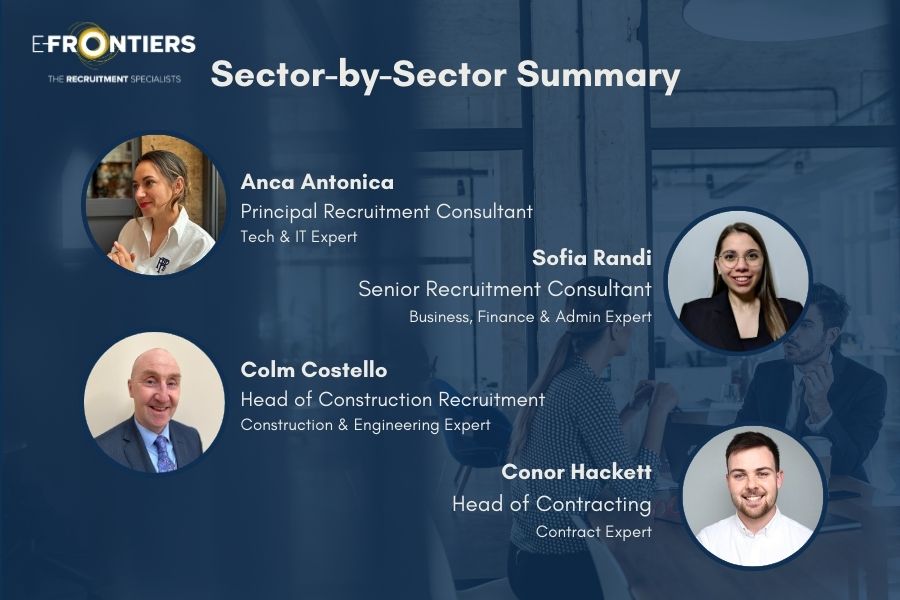
IT
Anca Antonica | Principal IT Recruiter
Demand remains strong across consultancies, fintech, and product companies, particularly for skills in cloud, DevOps, AI, data, and software engineering. Candidates prioritise flexibility, project stability, and technical leadership, while standout employers offer clear career paths, modern tech stacks, and exposure to critical platforms. Skills shortages and slow decision-making in larger firms remain the main challenges. Companies treating engineering and platform teams as long-term investments are attracting and retaining the strongest talent.
Business
Sofia Randi | Senior Recruiter
Steady but cautious growth is expected, with roles becoming broader and more commercially focused. Candidates value flexibility, meaningful work, and progression, and employers that offer hybrid-first setups, faster hiring, and clear career paths stand out. Hiring timelines and mid-to-senior talent shortages remain the main challenges. Companies that move fast, stay flexible, and communicate well attract the best business talent.
Construction
Colm Costello | Head of Construction Recruitment
The market is highly competitive for experienced engineers, site managers, and commercial professionals. Candidates are now more selective, weighing salary, project location, work-life balance, and company culture. Skills shortages at mid-to-senior levels persist, and there is high demand across multiple project types. Recruitment is now a strategic process: early engagement, swift decisions, and partnering with specialist recruiters enhance success.
Contracting
Conor Hackett | Head Of Contracting UKI
Demand is rising as companies prioritise flexibility and strategic project-based hiring, with overall Irish market growth forecast at 6% in 2026. Contractors look for higher rates, remote/hybrid options, and clear project scopes, and they very much value streamlined onboarding and rapid decision-making. Skills shortages – particularly in tech-enabled roles – remain the biggest challenge with 96% of Irish employers reported shortages in 2025. Employers increasingly favour skills-based hiring for short-term, high-value expertise.
Conclusion – Making the most of 2026
The Irish recruitment market in 2026 offers plenty of opportunities, but it also requires a careful and flexible approach. Employment remains strong, demand for specialist skills is high, and candidates are placing more value than ever on flexibility, career progression, and stability.
Even with easing inflation, global factors mean the market can change quickly. Employers who stay close to trends, act fast, and adapt to candidate priorities will be best placed to attract and retain the right talent.
Let’s Talk
If you’d like to discuss any of the trends in this report or chat about your hiring plans for 2026, feel free to contact Nigel Bolger, Commercial Manager. He’d be happy to have a conversation and explore how we can support your team.
Ph: 086 3888147
Free and Paid Courses That Are Truly Worth It
In the world of tech, standing still means falling behind. Tools evolve, languages change, and companies are constantly looking for professionals who stay up to date. Upskilling is no longer optional—it’s essential for anyone looking to grow and stand out in the IT sector.
Whether you’re just starting out or looking to specialise in areas like cloud computing, artificial intelligence, web development, or cybersecurity, there are fantastic platforms out there (many of them free!) to help you on your journey.
As recruiters, we encourage our candidates to keep learning, adding new skills and knowledge to their toolbox to advance in their careers.
In this article, we’re sharing a curated list of the best places to learn, practise, and get certified, with free and premium options.

Free or Freemium Platforms
freeCodeCamp
One of the most active learning communities out there. Offers hundreds of hours of hands-on content in web development, JavaScript, Python, data science, and more.
https://www.freecodecamp.org
The Odin Project
Great for those wanting to learn fullstack development from scratch, with a project-based approach.
https://www.theodinproject.com
CS50 by Harvard (edX)
The world’s most famous introduction to computer science. Builds strong fundamentals in computing.
https://cs50.harvard.edu
Google Digital Garage
Free Google courses on digital skills, marketing, AI fundamentals, and more.
https://learndigital.withgoogle.com
MIT OpenCourseWare
Complete university-level courses from MIT, available online for free. Great for those seeking academic depth.
https://ocw.mit.edu
OpenSAP
Free SAP and digital skills courses, focused on practical and business applications.
https://open.sap.com
Paid Platforms or Premium Plans
Udemy
One of the largest libraries out there, offering affordable courses in every IT area.
Pluralsight
Focused on technology, cloud, and development. Ideal for technical profiles looking to go deeper.
LinkedIn Learning
Regularly updated courses with a focus on both tech skills and professional soft skills.
Coursera Plus
A subscription that gives you access to courses from top universities like Stanford, Duke, and Google. Includes certifications.
🔗 https://www.coursera.org
DataCamp and Codecademy
Specialised in programming, data analysis, SQL, and data science. Interactive and well-structured.
🔗 https://www.datacamp.com | https://www.codecademy.com
A Cloud Guru / Cloud Academy
Perfect for those looking to get certified in AWS, Azure, or Google Cloud. Guided learning paths and real-world labs.
🔗 https://acloudguru.com
Bonus: Alternative Resources & Communities
GitHub Learning Lab – Learn by building real projects on GitHub.
Dev.to / Hashnode / Medium – Tech blogs written by developers, for developers.
YouTube – Channels like Traversy Media, Fireship, and Tech with Tim offer high-quality, free content.
Discord & Slack Communities – Join topic-specific communities by language, stack or field to share knowledge and find opportunities.
How to Choose the Right Course
Define your goal: Are you changing careers, landing your first job, or aiming for a promotion?
Check reviews and feedback: Not all courses are created equal.
Prioritise real-world practice: Theory alone won’t take you far.
Join a community: Learning with others makes it faster—and more fun.
Let’s Chat
Technical knowledge is more accessible than ever. A university degree is no longer a prerequisite to begin – or progress – in the IT sector. What truly matters is your ability to learn, adapt, and apply your skills effectively.
Do you have a platform you’d recommend? Are you exploring new career opportunities? Get in touch — we’d be happy to connect.
Need to scale fast? See how E-Frontiers delivered a compliant, high-performing engineering squad in just 14 days for a global fintech facing tight delivery deadlines.
Client Overview
A leading global fintech enterprise with over 25,000 employees worldwide launched a major greenfield initiative to enhance its European digital payments infrastructure.
The programme was centred in Ireland and required specialist engineering squads to be operational within tight delivery windows to meet Q2 development goals for a greenfield project.

The Challenge
The client needed to:
– Rapidly build a full squad of senior Java microservices engineers.
– Start onboarding within 10 business days from project kick-off.
– Ensure all contractors were compliant, reference-checked, and onboarded to enterprise security and tooling protocols.
Complicating the situation:
– The client’s internal recruitment was already at capacity.
– The technology stack was highly specific (Java, Spring Boot, AWS Lambda, Docker, Kubernetes, GitHub Actions).
– Project delays could cost up to €250k per sprint in lost development velocity.
Our Approach
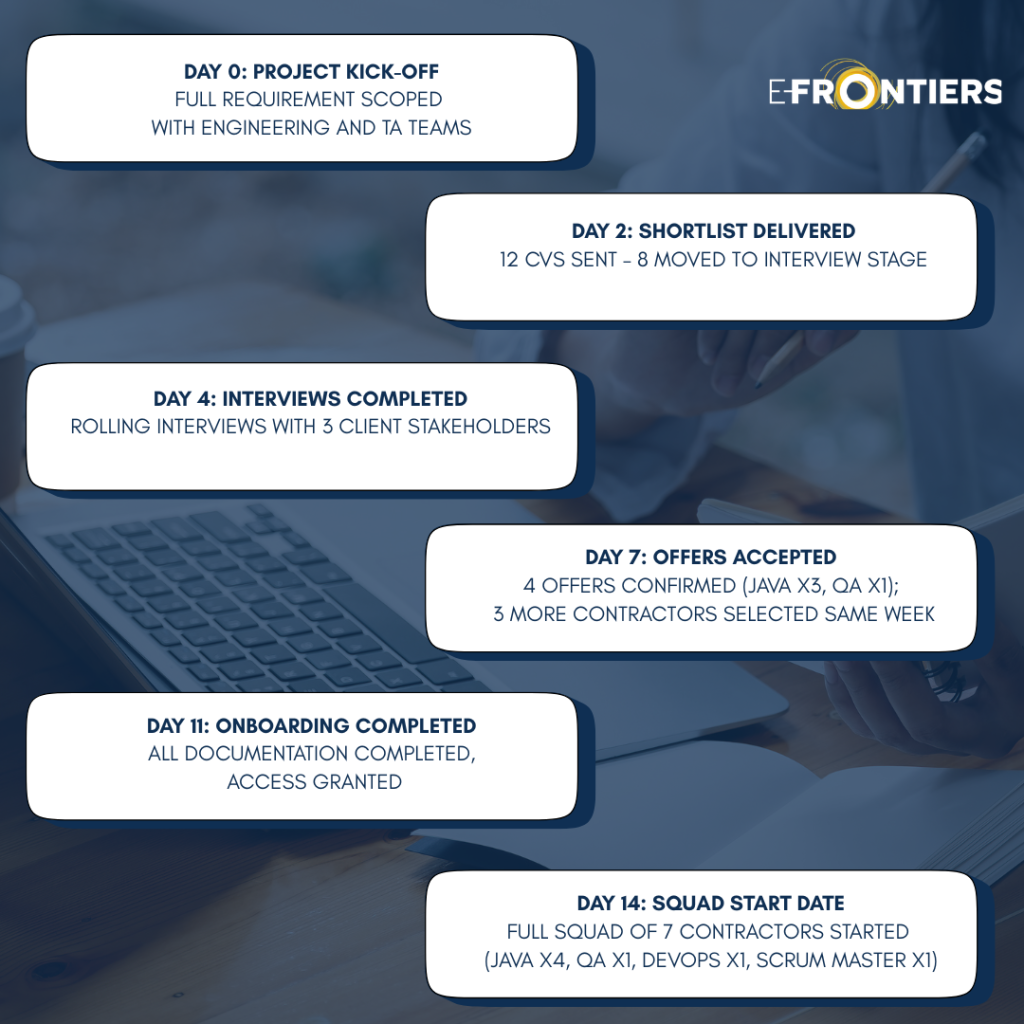
We assigned a 3-person delivery team (1 Account Manager + 2 Principal Recruiters) who ran a structured sprint-based recruitment workflow:
– Day 0 (Project Kick-off): Requirements gathered via live session with engineering leadership and TA partner.
– Day 1–2: Candidate pool activation via Contractor Database, network, contract market penetration.
– Day 3: 12 qualified CVs submitted.
– Day 4–6: Rolling interviews scheduled across 8 shortlisted candidates.
– Day 7: First 4 offers made and accepted.
– Day 8–9: Compliance + onboarding prep (ID verification, tax checks, background screening).
– Day 10: Equipment shipped / VPN access confirmed.
– Day 14: Full team started on-site and remote.
The Results
– 7 contractors onboarded in 14 calendar days — ahead of the client’s 3-week target.
– Zero offer rejections, 100% retention post first 3 sprints.
– Client sprint velocity achieved in week 1, contributing directly to a successful MVP delivery.
– Saved the client an estimated €80,000+ vs. typical agency time-to-hire lag (~30 days).
– Created a repeatable squad delivery model for future team builds in Q3 and Q4.
Key Takeaways
– A 14-day time-to-value is achievable with specialist contract delivery models.
– Structured shortlisting, automated outreach, and pre-qualified talent pools cut hiring timelines dramatically.
– When onboarding is managed by the recruitment partner, internal teams save dozens of hours.
Need to scale a team in weeks, not months?
Contact us to learn how our specialist contracting solutions can help you build and onboard technical squads with precision and speed.
This case study was written by Kenneth O’Connor, Head of Contracting for Ireland and the UK at E-Frontiers.
Considering Contracting in 2025? Here’s Your Essential Compliance Checklist for Ireland.
First things first: What is a contractor?
Independent contractors are professionals who offer their services or products to clients for payment but are not classified as employees. This distinction means they typically do not receive employee benefits like paid leave, sick days, or minimum wage protections. However, in exchange, contractors enjoy greater flexibility, allowing them to choose their projects, set their schedules, and work in a way that best suits their lifestyle.
Embarking on a contracting career in Ireland’s tech and project management sectors can be both exciting and rewarding. The flexibility, exposure to diverse projects, and potential for higher earnings are appealing. However, it’s crucial to stay compliant with Ireland’s regulatory and legal requirements to ensure a smooth and successful journey.
Here’s a comprehensive checklist to guide you:

1. Business Structure: Choose Wisely
Decide on the most suitable business structure for your contracting activities. This really depends on the type of person you are and your skillset. In Ireland, contractors typically choose one of the following options:
– Sole Trader: Register as self-employed, making you responsible for filing tax returns, managing pension contributions, and handling financial matters independently. This can be tricky for some and many opt to hire an accountant to assist with these responsibilities.
– Limited Company: Establishing a limited company can offer tax efficiencies and liability protection, but requires more administrative work.
– Umbrella Company: You pay an umbrella company to manage tax, pension contributions, and holiday entitlements. However, this convenience comes at a cost, often up to 15% of your salary in fees.
Each option has its implications for liability, taxation, and administrative responsibilities. Consulting with a financial advisor can help determine the best fit for you and your situation.
2. Tax Obligations: Stay Informed and Compliant
– Register with Revenue: Ensure you’re registered with the Irish Revenue Commissioners for all relevant taxes, including Income Tax, Corporation Tax (if applicable), and Value Added Tax (VAT). This is essential to avoid penalties.
– Understand Your Tax Liabilities: Familiarise yourself with the tax rates and allowable deductions for your business structure. Make sure to keep track of all legitimate business expenses so you can use these to lessen your tax burden.
– Timely Filings: Timing is very important here. You must adhere to all tax filing deadlines to avoid penalties. Hiring a professional accountant can be a huge help here.
3. Insurance: Protect Yourself and your Business
– Professional Indemnity Insurance: This covers claims arising from professional negligence or errors.
– Public Liability Insurance: Protects against claims for injury or property damage caused to third parties.
– Employer’s Liability Insurance: This one is necessary if you hire employees or subcontractors.
4. Contracts: Clarity is Key – Establish Clear Agreements
– Written Agreements: Always have a clear, written contract outlining the scope of work, payment terms, confidentiality clauses, and termination conditions. Clear agreements set expectations and work to protect both parties.
– Avoid Misclassification: ensure the client has classified you as an independent contractor and not an employee to prevent issues with Revenue.
– Review Terms Thoroughly: Understand all your contractual obligations. It is a good idea to seek legal advice if any terms are unclear.
5. Pension and Social Security: Plan for the future
– Contribute to a Pension Scheme: As a contractor, you’re responsible for your retirement planning. Setting up a personal pension plan to secure your future is crucial.
– Social Insurance (PRSI): PRSI payments are important as these are your gateway to state benefits. Ensure you’re making the appropriate Pay Related Social Insurance contributions, otherwise it may affect your entitlements.
6. Continuous Professional Development (CPD): Stay Competitive
– Invest in Learning: Stay updated with industry trends, technologies, and best practices. Regularly attending workshops, courses, and seminars can enhance your skill set and marketability.
7. Health and Safety Compliance: Prioritise Well-being
– Risk Assessments: Conduct regular risk assessments, especially if you’re working on-site or managing projects.
– Safety Statements: Prepare and maintain a safety statement as required by the Safety, Health and Welfare at Work Act.
– Training: Ensure you have the necessary health and safety training relevant to your work.
8. Data Protection: Keep Personal Information Safe
– Follow GDPR Regulations: If handling personal data, comply with GDPR rules by keeping data secure, obtaining necessary permissions, and understanding individuals’ rights regarding their information.
9. Networking: Build Your Professional Connections
– Join Professional Groups: Becoming a member of industry associations can help you meet the right people, stay updated, and enhance your credibility.
– Be Part of the Conversation: Get involved in online forums, go to industry events, and connect with others to stay in the loop and build valuable relationships.
.
Why Compliance Matters
Following the rules isn’t just about avoiding fines – it’s about setting yourself up for long-term success. Staying compliant helps you:
– Build Trust: Clients prefer to work with contractors who are professional and follow legal standards.
– Stay Financially Secure: Managing your taxes and finances properly helps you avoid surprises and ensures business stability.
– Keep Your Career on Track: Staying informed on industry regulations and best practices makes you a reliable and in-demand professional.
The Bright Side of Contracting
Once you’ve navigated the compliance landscape, contracting offers numerous benefits:
– Flexibility: Control over your schedule and choice of projects.
– Diverse Experience: Exposure to various industries, technologies, and methodologies.
– Potential for Higher Earnings: With the ability to set your rates and manage your workload, there’s potential for increased income compared to traditional employment.
By proactively addressing compliance requirements, you can pave the way for a rewarding and dynamic contracting career in Ireland’s tech and project management sectors.
For further reading and resources, consider exploring the following:
– Benefits of Contracting: Pros and Cons of Being a Contractor
– Current contract jobs – E-Frontiers
– Useful Contacts:
– E-Frontiers | Head of Contracting Ireland & UK Kenneth O’ Connor
– E-Frontiers | Contracts Manager Trish Lynch
Embarking on this path requires diligence and proactive management, but with the right approach, contracting can be a fulfilling and prosperous career choice.
Thinking about a new job?
The typical pathway to finding a new job involves anything from 5-12 steps. Yes, you read that right, up to 12 steps! And let’s face it, most of these steps are far from enjoyable for you as the candidate. At E-Frontiers, we can take the pain out of the recruitment process for you when looking for a new job. Our goal is to make the recruitment journey as seamless and stress-free as possible for you. We value your time and strive to provide a positive and transparent experience at every step. This really is the main reason you need to consider working with one of our recruiters for your next new job search.

The difficult part
You are probably already familiar with the drill. A huge amount of time is spent trawling through job ads online, working your contacts and network. Seemingly never-ending rounds of CVs and applications, sent out with very little in return.
Trying to decipher cryptic job specs to determine who the job in question is looking for, you or perhaps indeed a superhuman. It’s time-consuming, stressful, and sometimes overwhelming, and it’s all too easy to give up too soon before you’ve gotten near to landing your dream job or getting your foot onto the next rung of the career ladder.
Make it easier for yourself!
The value we bring to the recruitment process? Simple. We can cut through the noise and do it in 4 steps for you!
Let’s simplify the recruitment process. With continuous communication and support throughout from E-Frontiers, we can reduce this process to 4 steps. Meet, Chat & Plan; Evaluate Opportunities; Interview Stage; Onboarding!
As the recruiter, we know the client and what they are looking for. Your recruiter will have the real low down on whether you are in with a decent shot at securing the position– answering the all-important question ‘Where am I in the running?’. You can then decide whether to invest more time and energy in this application or cut your losses and move on to the next opportunity.
Keep your options open
There are many opportunities out there and it can be easy to miss out on the best and most suitable of them as you concentrate all your time on one option. Your recruiter can avoid this pitfall by planning and thinking ahead for you.
We look at other suitable roles and opportunities as they arise and will apply and start the process on your behalf. This means you have the time to focus on one process at a time, without getting frazzled and stressed about the ‘what ifs’.
How E-Frontiers can help
You can conduct your job search the hard way as just described above, or the easy way. So, what happens with the easy way? Our recruiter will put the time in for you. While you concentrate on your day-to-day, your recruiter will do the leg work for you. The background research. The detailed job applications. The due diligence on whether the position and company are a good cultural fit for you.
We will give you direction and ideas on upskilling, based on what your peers in the same industry are investing in. You will receive lots of CV advice, and we know that making the appropriate CV changes and improvements BEFORE the job application will hugely increase your chances of getting an audience with the client.
Use your recruiter to your advantage
Your recruiter is your ally. Meet up for a coffee and chat and take advantage of their resources and their knowledge of the position and client. We want you to succeed and will do everything we can to make it happen. Quite often, client interview processes can be longwinded, going the route of stop, start and stop again, and are generally fraught with difficulties and stress. Your recruiter will be on hand to support you through this on a daily and weekly basis, giving meaningful feedback and providing you with a genuine insight into what is going on with the client. This way you don’t feel alone in the process or feel like there’s no hope and give up.
Help is always at hand
If you are shortlisted for the interview stage and need help, you have the option of using the services of an interview coach. We will help with coaching you on the questions and answers to consider, and give you inside tips on what the client is looking for so you can then tailor your responses accordingly. We’ll give you proper feedback after each stage and further advice and insights for the next stage.
Conclusion
And once you secure the role, our support doesn’t end there. We are on hand to help you with your negotiations on benefits, salary, and your total package and onboarding experience. The lines of communication always remain open, and we are a phone call away if you need our expertise at any stage, now, or indeed into the future when the time is right to consider your next move.
Contact any member of our team today to discuss options for your next career move.
Did you know that only 1 in 8 candidates manage to get past the first interview? Securing a job interview is a crucial milestone in pursuing your dream job. However, even the most talented candidates can sometimes stumble and make mistakes during the interview process, resulting in rejection.
We have collected feedback from over 690 first interviews conducted across Ireland this year. Here, we highlight some common mistakes our clients have pointed out as the reasons for rejecting candidates. To help you avoid these pitfalls, our recruiters offer valuable advice and insights. So let’s take a dive into the most common mistakes candidates make in an interview.

1. Inability to expand on technical skills.
The core aspect of the interview process for IT roles primarily revolves around assessing your technical expertise. Whether or not you are tasked with a preliminary technical exercise, it remains crucial to proficiently articulate and showcase your skills and problem-solving approaches.
Advice: Give examples…
A valuable guideline to follow is that if a particular skill is listed on your CV, you should be capable of explaining when and how you’ve applied that skill, as well as demonstrating the depth of your knowledge in that domain. The best way to do that is by giving a few examples of projects where you’ve applied it and the thought process behind using the technology of choice.
2. Inability to discuss experience
Candidates who struggle to articulate their past experience, fail to impress employers. A good idea would be to apply the STAR method when putting together your answer. That will touch on the situation, task, action, and result of the skill you are looking to prove your experience in.
Advice: Use the STAR Method…
For example, if you are asked to outline your experience in API integrations, you should start by summarising your experience and then proceed into giving details about:
-Situation- Projects that involved API
-Task- Your responsibility on the project in respect to API
-Action- How did you go about completing your tasks
-Result- what was your contribution to the project
You need to find the right balance between giving a detailed answer and talking too much, but practice makes perfect. Write your answer down and make sure to assign the time to prepare before the interview.
3. Negative remarks about previous employers
If you are one of the unlucky ones and have experienced a bad working environment or a manager that you clashed with, I’m sorry you had to go through that. I know, we are all human, and frustrations and emotions can play a part in some situations. However, there is a place and time for giving out about your previous employer or colleagues, but during an interview is not the place. Keep that discussion for your closer acquaintances and focus on opportunities for career progression, learning and development, and exploring new challenges.
Advice: A new opportunity awaits…
Think about the interview as an opportunity to start a new positive experience and this all starts at the interview stage. Negative remarks will only damage that clean slate. If you do need to address a previous conflict, the best way to go about it is to focus on acknowledging your mistakes and the lessons learned. The other party is not being interviewed here, you are!
4. Culture fit and interest
Would you accept an offer from a company you have no interest in? Or if there is a misalignment between their values and yours?
It’s a two-way street and as much as you need to impress in an interview, it’s important that you get a good feel about the company and the culture to ensure that it’s a place where you would actually like to work. In preparation for your interview, you should review their values, and check their social pages and Glassdoor reviews to try and get a feel of what they are as an employer.
Advice: Ask the right questions…
But, don’t stop there, remember, you need to show interest. How to do that you ask? By asking questions! What is it like working for you? How do you give back to the community? How do you support your employees with their career development goals? What will onboarding look like? Their answer will give you a sense of how they treat their employees and what the day-to-day will look like.
Advice: Demonstrate your research…
Another great way to show you’ve done your research and that you are keen is to reference the things you know about the employer. For example, ‘I saw you are branching out into AI, that is so interesting, I’m very passionate about that field and would love the opportunity to be part of that initiative.’
Conclusion
Interview failures can often stem from these common mistakes made by candidates. By addressing these, candidates will greatly improve their chances of success. Our recruiters play a crucial role in guiding candidates to avoid these common pitfalls, to be prepared, and to thus optimize their interview performance.
Please don’t hesitate to reach out to us and our team of recruiters for interview help and career advice.
.
All the daily conversations I have with clients or with candidates always reflect and evaluate the Contracting market – How are you seeing it? Where is the opportunity? What skills are in demand? How are the rates?
Given my role and the industry we are in, we are always keen to hear our clients take on things as our demand will be driven by them. With all the talk of layoffs and the talk of an impending recession, it did feel like things would inevitably slow, which they did – on the permanent side of the recruitment world. Subsequently, we saw an increase in the flow of new contracting requirements coming in. This occurred from November through to the end of January and could be attributed to several factors such as year-end, budgets, and all the other usual reasons.
The expectation is that in times of uncertainty permanent headcount requirements can always be paused. This is true. Being the eternal optimist and working on the contracting side of the business, I am of the opinion uncertainty can be good for contracting. This has certainly been the case since November. A recent conversation with a senior figure in a large consulting firm has reinforced this viewpoint. Albeit some clients may choose the consultancy route over the contractor route.
The demand is remaining consistent across the PM/BA skillsets as well as the Software Engineering. Noticeable increases have been seen in the DevOps skillset in the last 6 months also – although this may not surprise many.
Additionally, a publication from Contractor UK echoes our own experience in the market for January, leaning toward cautious optimism.

Contracting Market: What we have seen in 2023 so far
Contractor renewals are extremely high with above 95% being renewed.
The number of requirements coming to us is maintaining.
Lead time has lengthened from interviews to offer – could be due to hesitancy in the market in general.
Candidates converting from permanent roles to go contracting have reduced (albeit not significantly).
Demand for 12-month contracts is at an all-time high.
Supply of 12-month contracts is not at an all-time high.
Rates are maintaining.
Now, why am I writing this article? I guess it is to try to convey a sense of optimism in the contracting market that is currently seeing lots of layoffs from Big Tech. While this is no doubt a very difficult transition period for those affected, I am speaking purely with my contract recruitment hat on. Outside of the fact that while there may be a slight softening at some stage, we are seeing signs of the contractor market maintaining for the foreseeable.
I am having more conversations with clients who are looking to explore or even just gather more information on the contractor market and process given some of the challenges around permanent headcount. My role is to advise and present the contractor route as a solution to our clients who still require projects to be delivered.
If this is you then do reach out, even if it is just to gain a better understanding of the area. We can provide a turnaround within 24 hours depending on the complexity of the request. Enough of the sell for now.
Demand is still there if you are thinking of becoming a contractor and leaving the security of a permanent job. Just do your research and speak to the agencies (or rather our recruitment company) to get a feel for what’s on offer.
Head of Contracting
To get hired fast, besides checking your rich experience and knowledge of the industry in your CV, employers also expect their software engineers to have some basic soft skills to integrate into their new team and work environment. Let’s discuss the 5 crucial soft skills for IT professionals.

1. Communication
This is the most basic soft skill that is required not only for software engineers but also in many other roles. Communication skill includes listening, understanding and sharing your opinions and perspectives. It often requires both verbal and written communication. This soft skill will contribute to effective teamwork.
2. Problem-solving
No matter how carefully we plan a project, there are always unexpected situations. Therefore, employers prefer software engineers who have the problem-solving skills to propose solutions for complex issues instead of avoiding them. They need to understand the project’s goals, processes, and technologies so that they can brainstorm solutions.
3. Adaptability
Technologies are constantly updated and developed, so adaptability becomes one of the vital soft skills of IT engineers. They need to adapt quickly and stay up to date with not only technology but also society. It will help them plan their projects, complete their tasks and solve problems faster.
4. Time management
Most of the tasks of software engineers require to commit to the schedule of a team or a whole project. Therefore, organising their daily tasks and priority jobs is crucial. Managing their time properly allows them to optimise their time for daily tasks, group work, or urgent tasks. This soft skill helps to reduce their stress and limit extended work while still being productive.
5. Teamwork
Most important projects are done by a group of developers. Therefore, teamwork is always the soft skill that determines whether you are hired or not. Teamwork includes listening skills, focusing on common goals, personal responsibility, and supporting other members. Exchanging experience and knowledge with other software engineers not only helps to achieve common success but also supports oneself to promote their strengths and self-development.
The soft skills above are only five of many other crucial skills that are expected in a developer. If you are looking for an IT job in Ireland, UK, USA or Spain, do not hesitate to reach out to us. Send us your CV, our recruiters will contact you if they find a job that suits you the best and support you through the interview process.
If you are lacking in one of those soft skills, it’s time to get out of your comfort zone and upgrade yourself.
