



En este artículo queremos ofrecer una introducción al fascinante mundo del cloud computing, desde sus inicios hasta su relevancia actual. Se destacan las ventajas empresariales, las principales opciones de servicios en la nube y las oportunidades laborales en el sector, con un enfoque particular en España. Es una lectura para comprender este campo en constante evolución y su impacto en la tecnología y el empleo.
Introducción al Cloud Computing
Ya desde finales de los años 60 el informático John McCarthy propuso la idea de que “la computación podría ser organizada de manera pública”, asentando las bases, sin saberlo de la computación en la nube que hoy conocemos.
No fue hasta finales de los años 90 que la empresa Salesforce dio los primeros pistoletazos a la nube actual, siendo Amazon Web Services en 2002 quien elaboró una serie de servicios basados en la nube dando lugar a EC2 y arrancando de esta manera la carrera de la computación en la nube que conocemos hoy en día.
Pero, ¿qué ha supuesto esto en el paradigma de desarrollo que conocemos en la actualidad? Desde entonces los servicios y tecnologías en la nube han ido incrementando y mejorando exponencialmente, dando lugar a una serie de beneficios a las empresas que se han adaptado a estos entornos.
Entre sus múltiples ventajas, nos gustaría destacar:
– Reducción de costes: un punto primordial en cualquier empresa. Los servicios en la nube no requieren de inversión en infraestructuras físicas, por lo que permite una reducción importante de gastos para cualquier entidad.
– Acceso remoto: uno de los puntos clave. Con una simple conexión a internet cualquier persona es capaz de acceder a los servicios en la nube facilitando de esta manera el trabajo remoto y la rapidez.
– Seguridad: aspecto importante para grandes empresas con un volumen importante de datos sensibles. Los proveedores de servicios Cloud cuentan por lo general con las medidas de ciberseguridad más modernas del mercado, superando con creces cualquier medida que pudiera tomar cualquier empresa de menor tamaño con recursos limitados.
¿De qué puedo trabajar en el sector Cloud?
El mundo del Cloud Computing ha abierto puertas a nuevos roles con profesiones que hace años ni se pensaban. Entre ellas podemos encontrar:
– Cloud Architect: encargado del diseño de la arquitectura de los sistemas y aplicaciones en la nube.
– Administrador Cloud: responsable de la administración, supervisión y configuración de todos los recursos en la nube.
– Desarrollador de aplicaciones en entornos Cloud: un paso más en el desarrollo de software donde los desarrolladores están empezando a trabajar en entornos en la nube para el despliegue de aplicaciones.
– Cloud Security Engineer: persona encarga de garantizar la seguridad de los datos y los sistemas, monitoreando e identificando posibles amenazas.
Puedes echar un vistazo a los roles cloud que tenemos actualmente abiertos aquí
¿Qué opciones tengo como empresa?
En el mercado actual existen numerosas empresas que ofrecen servicios Cloud a terceros, destacando actualmente estas 4:
– Amazon Web Services: pioneros en el mercado, con una enorme presencia global, ofrecen una amplia gama de servicios a sus clientes y una actualización constante de los mismos.
– Microsoft Azure: respaldados por el gigante de Microsoft, en 2010 nació Microsoft Azure, dando un soporte descomunal en computación en la nube especialmente beneficioso para aquellas organizaciones que ya utilizaban productos y servicios Microsoft.
– Google Cloud Platform: Google también se quiso unir a la marea del Cloud Computing sacando su propia versión. Desde entonces han ido creciendo de manera gigante convirtiéndose en uno de los principales motores Cloud del mercado.
– Alibaba Cloud: Principal motor Cloud dentro del mercado asiático. Desde los últimos años se han estado abriendo poco a poco un hueco dentro del mercado más occidental.
¿Cómo son las oportunidades del sector Cloud en España?
Actualmente, podemos observar una creciente demanda de estos perfiles en el mercado, tanto a nivel internacional como nacional. Solo en España, hay más de 200 empresas en búsqueda activa de talento con estas habilidades y conocimientos y todo apunta a que la demanda de estos perfiles crezca en los próximos años.
También vemos como la oferta de estudios superiores de especialización (Posgrado y Master) en Cloud Computing se amplía haciendo notable la necesidad de actualización de profesionales IT hacia esta área.
Tanto si eres una empresa que necesita perfiles Cloud como si eres profesional del sector en búsqueda de un cambio, no dudes en contactarnos. Alfonso Moreiras (Senior Technical Recruiter) está especializado en entender estos requerimientos de este tipo de posiciones y encontrar perfiles que más se adapten a las necesidades de nuestros clientes.

Durante la última década hemos visto un crecimiento agigantado de empresas orientadas a servicios IT, tanto a nivel consultoría como empresas de desarrollo de producto propio. Esto ha supuesto un crecimiento en paralelo de la oferta de profesionales del sector, que no ha crecido de la mano con el número de profesionales especializados, por lo que la búsqueda de los mismos conlleva meses de trabajo para encontrar el candidato adecuado en un sector donde le llueven las ofertas. De esta manera, ha crecido a su vez las agencias de reclutamiento, que permiten agilizar y externalizar estos procesos a empresas que buscan talento constantemente. Pero, ¿en qué me puede beneficiar una empresa de estas características en mi día a día?
Ahorro del tiempo
Una agencia dedicará el 100% de su tiempo en la búsqueda del talento necesario para tu empresa, permitiendo que no inviertas tiempo en búsqueda y filtrado de candidatos en tu día a día y asó poder enfocarte por completo en tus verdaderas tareas.
Especialización
Las agencias de reclutamiento suelen estar especializadas en un sector o tipo de perfiles en concreto, teniendo en sus filas un banquillo de reclutadores que, desde el primer momento, conocen el perfil que se está buscando, las tecnologías en las que se tienen que centrar o, incluso, una red de contactos amplia en el sector que les permitirá presentarte al candidato ideal en poco tiempo.
Ahorro económico
Contando con un equipo de contratación externo te evitarás la contratación de otros servicios como portales de empleo, departamento interno de selección, tiempo, etc.
Acceso a una amplia red de candidatos
La mayor ocupación de las agencias de reclutamiento está orientada a la comunicación constante con candidatos en búsqueda activa de empleo o con interés en un cambio. Con ello, las agencias tienen siempre en su radar candidatos que puedan encajar con tus vacantes y que están abiertos a iniciar un proceso de selección, agilizando de esta manera la búsqueda inicial de posibles profesionales.
Asesoramiento constante
Colaborando con una agencia de reclutamiento tendrás a tu disposición profesionales en selección de personal que te darán apoyo constante en todas las fases, desde la toma de requerimientos, a la construcción de las descripciones de puestos, hasta la organización de entrevistas y negociación de la oferta, además de un apoyo posterior a la incorporación para asegurar que el candidato se ha integrado en tu empresa de manera correcta.

En conclusión, contar con un equipo de selección externo como el de e-Frontiers puede facilitar las cosas en tus procesos de selección, tanto por el ahorro económico y de tiempo, como por el apoyo que recibirás de un equipo profesional especializado, que agilizará tus procesos de manera que te permita enfocar tu tiempo en tus tareas reales.
E-Frontiers lleva 10 años operando en el mercado español, contando con un equipo de 5 reclutadores especializados en asesoramiento a clientes, búsqueda y selección de talento. Nuestra amplia red de contactos y recursos agilizan los procesos de selección para ofrecer un servicio eficiente a nuestros clientes.
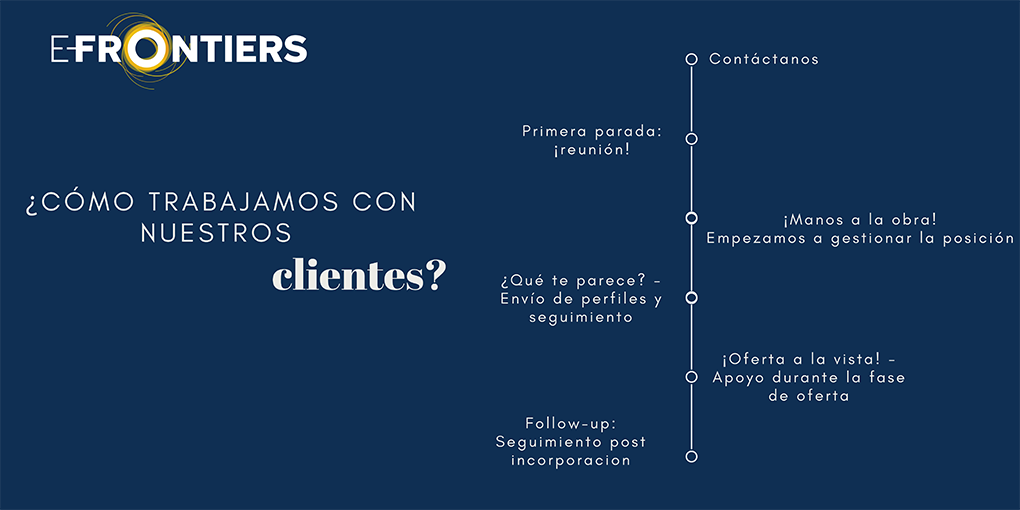
Necesito ayuda, ¿cómo es el proceso con vosotros?
Contáctanos – Alejandro Pino (Lead Recruiter – alejandro.pino@e-frontiers.ie) o Ana Martín (Technical Recruiter – ana.martin.romero@e-frontiers.ie)
Nos conocemos – Organizaremos contigo una llamada para saber más sobre tu empresa, los perfiles que necesitas y sobre vuestro proceso de selección. También te asesoraremos sobre el mercado, salarios, etc. Y te informaremos de nuestra manera de trabajar y que esperar si empezamos a colaborar.
¡Manos a la obra! – Uno de nuestros recruiters empezará a gestionar tu posición. La búsqueda activa por diferentes vías es esencial. También hará un filtrado por teléfono pudiendo recoger información extra y necesaria para que valores su perfil.
¿Qué te parece? Envío de perfiles y seguimiento – Una de nuestras señas de identidad es la calidad ante la cantidad. Si necesitas, podemos apoyaros en tareas más administrativas como gestión y cierre de entrevistas, envío de pruebas técnicas en vuestro nombre y recoger-ofrecer feedback.
¡Oferta a la vista! – Apoyo durante la fase de oferta. Si el candidato encaja con lo que estáis buscando y decidís ofertar, os ayudaremos durante este punto también.
Follow-up – Para nosotros no todo termina con la oferta e incorporación, ya que hacemos seguimiento post incorporación del candidato (de hecho, consideramos esta parte bastante importante). Estando en contacto con él o ella durante las primeras semanas para asegurar que todo va bien.
Si tienes alguna duda o te interesa saber más sobre esto, no dudes en contactarnos. Alejandro Pino (Lead Recruiter – alejandro.pino@e-frontiers.ie) o Ana Martín (Technical Recruiter – ana.martin.romero@e-frontiers.ie)
In a recent webinar hosted by Anca Antonica and Paula Coffey from E-Frontiers Recruitment Agency, technology enthusiasts and industry professionals had the privilege of gaining valuable insights from Paul Lynch, the Co-founder of Showtime Analytics. This captivating webinar took participants on a journey through Paul’s extensive career in tech entrepreneurship and his experience in revolutionising the cinema industry through data analytics. Let’s dive into the highlights of this engaging discussion.

Exploring Paul’s career
Paul’s journey in technology began at a young age, influenced by his father’s role as a software developer. Growing up with computers in his household, Paul’s fascination with technology drove him to attend coding schools and develop his skills in building flash games and applications. His early exposure to technology laid a solid foundation for his future endeavours.
Starting his career at Vision, a consultancy firm, Paul gained a wealth of experience working across various industries. He highlighted the advantages of working in consultancy, where he had the opportunity to reinvent himself with each new client. This exposure allowed him to learn from talented individuals and strengthen his technical and business acumen.
Paul’s career path took an exciting turn when he joined Acceleration, a product-focused company within Vision. This experience made him realise his passion for working on innovative products, which led him and his co-founder, Richie, to establish Skupe Net—a global classified ads venture. While the ideas were promising, Paul acknowledged that the company faced challenges in implementation and eventually pivoted to focus on the lucrative motor industry.
Embracing the Value of Failure
During his career journey, Paul had a profound realisation about the importance of embracing failure and learning from it. A job interview that emphasised the need for a “fail fast” approach shaped his perspective. This valuable advice inspired him to constantly assess the value his initiatives provided to customers and iterate accordingly.
The Birth of Showtime Analytics
Paul’s passion for data analytics and an opportunity within his family’s cinema business sparked the birth of Showtime Analytics. Recognizing the data-rich nature of the cinema industry, Paul and his team aimed to provide actionable insights by consolidating and leveraging data assets. Their efforts quickly positioned Showtime Analytics as a leading player in the cinema data realm, working closely with cinemas and now expanding to collaborate with studios.
Paul Lynch’s webinar presentation illuminated the transformative power of data analytics in the cinema industry. His personal journey showcased the importance of early exposure to technology, embracing failure as a catalyst for growth, and the incredible potential of data-driven decision-making. As the co-founder of Showtime Analytics, Paul continues to drive innovation and empower the cinema industry with actionable insights derived from data.
Relationships between Showtime Analytics and E-Frontiers
Paul mentioned the relationship between Showtime Analytics and E-Frontiers recruitment has been mutually beneficial. Showtime Analytics values the screening and recruitment services provided by E-Frontiers, ensuring a more efficient hiring process. Additionally, E-Frontiers’ insights into various markets and their expanding technical talent pool have proven invaluable to Showtime Analytics. This partnership has facilitated the expansion of Showtime Analytics’ QA team in Spain and the exploration of new markets and countries. The collaboration between these two companies has fostered growth and success for both parties. Showtime Analytics expresses gratitude for E-Frontiers’ contributions and acknowledges their positive impact on their operations.
The webinar left participants inspired and eager to explore the limitless possibilities of data analytics in their respective fields. It served as a reminder that by harnessing the power of data, industries can unlock new opportunities, make informed decisions, and stay ahead in the ever-evolving digital landscape.
If you’re seeking growth and need top talent, don’t hesitate to contact us or explore our services as a premier recruitment agency. We operate internationally, with experienced recruitment teams based in Ireland, Spain, the UK, and the US.
According to the data 2021 of the Federal Reserve, LinkedIn is one of the most powerful platforms for job seekers to connect directly with recruiters and hiring managers in their industry. Recruiters often reach out to potential candidates who haven’t applied for their jobs yet by sending InMails. It’s always a good idea to accept InMails from recruiters, even if you are not interested in the job or connecting with them.

Don’t worry about your privacy
It’s understandable why job seekers decline InMails from recruiters. They are afraid that they may be spammed in the future. However, LinkedIn has policy measures that protect the user’s privacy and prevent harassment. If you decline an InMail, the recruiter won’t be able to keep contacting you repeatedly in the future.
Stay connected for future opportunities
By accepting the InMails from recruiters, you can politely decline the job offer but still stay connected with them for potential opportunities in the future. If your circumstances change or the recruiter has a different job that matches you, you will still be able to message them even if you are not a first connection.
Think long-term
With the current economic climate being uncertain, it’s worth being kind to recruiters and thinking long-term. Even if you are not in a job right now, you never know what opportunities may arise in the future. By replying to the InMails from recruiters and staying connected, you will have a better chance of staying informed about potential job openings and industry trends.
A polite decline can go a long way in building relationships and opening doors for future opportunities.
If you or your friends want to learn more about the IT opportunities in Spain, check for it on our job page, or feel free to say hi to Teresa via her LinkedIn or teresa.quintana@e-frontiers.ie.
Teresa Quintana Niñerola | Lead Technical Recruiter
The tech sector in Ireland has suffered in recent months – we all know of the glut of layoffs for many of the big tech giants amid global downsizing or right sizing. However, there is still strong demand for tech talent across the wider economy in other sectors such as medtech, pharma and financial services, with data analytics and cybersecurity being identified as two key areas for future growth. There are many data analytics jobs in the market, so if you are qualified in this area, you probably will be able to pick.

Fintech
The financial sector in Ireland has also seen a significant increase in demand for data-related roles. This is largely due to the need for these roles to support the increasing digitisation of the financial industry, which has been accelerated by the pandemic.
Medtech
Similarly, the healthcare sector in Ireland – there is a wealth of data being generated in healthcare, from patient records to clinical trials and medical research, and the ability to analyse this data is becoming a key factor in improving patient outcomes and driving innovation in the healthcare sector.
Start Ups
Start-ups are also a growing area of focus for data analysts. Many start-ups are data-driven, and data analytics plays a crucial role in helping these companies to gain insights into their customers behaviour, identify trends, and optimize their business processes and improve their products and services
Other Regions
Spain also has a vibrant and growing data industry and is seeing a significant increase in demand for professionals with skills in data analysis, data science, business intelligence, and machine learning. This trend has been driven by the increasing importance of data in making informed business decisions across a wide range of industries.
One of the main factors contributing to the growth of the data industry in Spain and indeed Southern Europe, is the increasing adoption of new technologies such as cloud computing, big data, and artificial intelligence. This has created a need for professionals with expertise in these areas, as well as in traditional data analytics and reporting.
Here are some of the key trends in the world of Data right now:
Artificial Intelligence (AI) and Machine Learning (ML) help businesses automate repetitive tasks, optimise processes, and personalise user experiences.
Big Data such as Hadoop, Spark, and NoSQL databases are becoming very popular.
Data privacy and security is becoming more important. Governments around the world are implementing stricter data protection regulations such as the GDPR in Europe and CCPA in California.
Data Visualization is becoming more important as businesses look for ways to communicate data insights to non-tech stakeholders. Data visualisation tools such as Tableau and Power BI are becoming increasingly popular.
Data Ethics: Data scientists need to be aware of potential biases in the data they work with and ensure that their models are fair and transparent.
So what does the future hold?
Going into the future there will be a huge need for a talent pipeline who have invested in these new skills and capabilities. We’d recommend candidates have a broad skill base and be proficient in Data Management, Governance, AI, ML, Big Data, Data Security and Cloud Computing. Candidates who upskill in these areas will be in high demand in the job market
The demand for data-related roles in both countries is growing and will continue to do so in the coming years, as more companies recognise the importance of data-driven decision making. Ireland has been positioning itself as a hub for data and technology. This can be seen through the many Government supported initiatives and programs that have been launched to support the growth of the technology sector in Ireland.
The Spanish government has also recently launched initiatives to promote the development of the data industry, including investment in research and development and the creation of data-focused training programs.
If you work in this area and would like to chat about current data analytics job opportunities or need careers advice on upskilling for the future, please get in contact with our expert recruiters in each region:
Spain: Alejandro
E: alejandro.pino@e-frontiers.ie
M: +34 629 72 14 95
Ireland: Emma
E: emma.bradley@e-frontiers.ie
DevOps & QA
The DevOps and QA Engineering fields have been evolving at a rapid pace with significant growth and change over the past few years and this trend is expected to continue in the coming years. In this blog post, we will discuss some of the trends in these fields and the emerging skills gap. We will also suggest some ways in which candidates can upskill, stand out and future-proof themselves for success in this area.

Emerging Trends
The world of DevOps, Cloud, and QA engineering is rapidly evolving, with new technologies and tools emerging almost daily. As a result, the market for these IT jobs has become highly competitive in Ireland and other regions, with difficulties in finding qualified candidates. This has led to an increase in demand for these jobs, and the need for organisations to hire professionals who can help them stay ahead of the curve.
DevOps
One of the most significant trends in DevOps is the increasing adoption of cloud technologies, such as Amazon Web Services (AWS), Microsoft Azure, and Google Cloud Platform (GCP). This trend is expected to continue as more and more organisations move their applications and infrastructure to the cloud. Another trend in DevOps is the use of automation tools for testing, deployment, and monitoring. Automation tools like Jenkins, Ansible, and Puppet are becoming increasingly popular and are expected to continue to be widely used.
QA Engineering
In the field of QA Engineering, one of the biggest trends is the adoption of Agile and DevOps methodologies. These methodologies emphasise collaboration, continuous integration, and testing, and are being widely adopted by organisations. Another trend in QA Engineering is the increasing use of Artificial Intelligence (AI) and Machine Learning (ML) for testing. AI and ML can help automate repetitive tasks, increase efficiency, and thus reduce errors in testing.
Skills Gaps
One of the biggest challenges in the market is the skills gap. Many companies are struggling to find qualified candidates with the necessary skills and expertise. Candidates need to find ways to stand out from the crowd and demonstrate their skills and experience. DevOps and QA engineers need to demonstrate a broad range of skills, including coding, testing, and automation. They also need to have good communication and collaboration skills to work effectively with different teams.
Candidates can achieve stand out by showcasing any relevant projects or open-source contributions that they have made. This can demonstrate their practical experience and ability to work with others in a collaborative environment. Additionally, candidates should ensure that their CVs are tailored to the specific job they are applying for, highlighting their relevant skills and experiences.
Upskill and Future Proof
To upskill and future-proof their careers, candidates can take courses and certifications in cloud technologies, Agile and DevOps methodologies, and automation tools. Candidates should highlight any relevant certifications or training that they have received. These can show that a candidate is committed to staying up to date with the latest technologies and practices. They can also participate in online communities, attend conferences and meetups, and read blogs and articles to stay updated on the latest trends and technologies. By following these strategies, candidates can increase their chances of landing their dream job in these exciting and in-demand fields.
For further careers advice and to find out about exciting DevOps and QA job opportunities in this area:
Contact John Ryan(Ireland) or Alfonso(Spain)
Top tips on relocation to Spain to find work
Read our recruiter’s expert advice to help you with relocation to Spain.
Alejandro Pino (Principal Recruiter in Spain): The work-life balance and general quality of life, along with the weather and beaches are just some of the reasons to think about moving to Spain. Are you considering a relocation to Spain to find work but are unsure where to start? Here are some points to consider before making the move:

Employment Opportunities
Research the job market in Spain to ensure that you have viable employment options. Consider reaching out to recruitment agencies and Spanish recruiters before your relocation to prepare in advance. This research may also guide you in terms of choosing a specific location or city.
Legal Requirements
Before you make a move to Spain, ensure that you have all the necessary legal requirements and paperwork in order. Irish and EU citizens don’t need a visa to enter Spain, but if you plan to live in Spain for more than 3 months, you’ll need to get a Certificate of Registration after arriving in Spain. This includes obtaining a NIE number (a tax identification number for foreigners in Spain).
Cost of Living
The cost of living in Spain can vary depending on where you choose to live. Research the cost of living in the cities or towns you are considering and compare it to the cost of living in Ireland. This will help you make an informed decision about whether your relocation is financially viable and what adjustments you may need to make to your lifestyle and budget.
Location
Decide on a location. Spain has many beautiful cities and regions to choose from. Think about the type of lifestyle you want and the amenities you need. For example, do you prefer living in a big city like Madrid or Barcelona, or would you rather be near the beach in Valencia or Malaga?
Accommodation
Once you have determined your budget and location, start looking for rental listings. You can search online on websites such as Idealista, Fotocasa, or Pisos.com. You can also work with a real estate agent or visit local property management offices.
Language
Spanish is the official language of Spain, and while many Spaniards speak English, it’s important to learn Spanish as it will make your transition easier. Start learning the language before you move and immerse yourself in the culture and language once you arrive. Consider taking classes or finding a language exchange partner to improve your language skills.
Contact Alejandro today to find out about new job opportunities in Spain:
M: +34 629 72 14 95
E: alejandro.pino@e-frontiers.ie

Estamos asistiendo a una situación sin precedentes. Debido a la falta de demanda, de la noche a la mañana hemos visto como determinados sectores están colapsando y con ello la imposibilidad de retener el talento en esas empresas. Muchas organizaciones tienen miedo de afrontar nuevas contrataciones y, mientras esperan la llegada de tiempos mejores, sus competidores se adelantan y se atreven a invertir en ese talento ahora sin proyecto.
Un ejemplo de ello nos lo ofrece HP a finales de los años 40. Tras la segunda guerra mundial, su negocio decayó al mismo tiempo que numerosos ingenieros que trabajaban en la industria militar se quedaron en la calle. No se lo pensaron dos veces y aprovecharon la situación para la incorporar ese talento a sus filas, lo que les ayudó a crecer en los años venideros y convertirse en una de las mayores empresas del mundo. Esto fue posible debido principalmente a dos factores: porque podían y porque se atrevieron. Actualmente, por desgracia no todas las empresas pueden. Pero las que si tienen esa posibilidad de invertir en talento, depende exclusivamente de ellas decidir si salir de la crisis por delante de sus competidores o no.
Por otro lado, por parte de los candidatos que cuentan con trabajo estable existe cierta incertidumbre a la hora de buscar una nueva oportunidad. Si hace unos meses eran más proclives a aceptar una oferta interesante, ahora muchos prefieren mantenerse en su puesto aunque no cumpla con sus expectativas. Es especialmente importante en estos casos mostrar un proyecto consolidado, con un desarrollo profesional claro y eliminando todos los obstáculos innecesarios del proceso de selección.
Y vosotros que pensáis, ¿es un un buen momento para invertir en el futuro con nuevo talento y para redefinir los procesos de selección?
Spanish team
June 2020

Hemos detectado la dificultad de muchos candidatos para superar las entrevistas de selección, ya sea porque el CV no es adecuado, no saben como buscar empleo o cometen errores imperdonables en sus entrevistas. Por aquí os dejamos algunos tips que os ayudarán a tener éxito en vuestros procesos
¿Cuáles son los tips básicos para la creación de un CV atractivo?
Creo que la creatividad y ser uno mismo en la clave para darle personalidad a un CV. A mi no me gusta dar tips de lo que hay que hacer para no sesgar la parte de «ser uno mismo», pero si me gusta comentar lo que no hay que hacer. Por ejemplo, incluir demasiados detalles personales como DNI, estado civil, la dirección de casa… los considero aspectos privados, no relevantes y que ocupan espacio. Extendernos demasiado en el CV, genera cierta pesadez en la persona que lo tiene que leer, 2 – 3 páginas (a lo sumo, si tienes más de veinte años de experiencia), podría valer. Para experiencias laborales muy antiguas, no es necesario extendernos porque ya han dejado de ser relevantes y en el mundo IT las tecnologías van a estar obsoletas. A nivel general, no debemos perder de vista aspectos importantes como la claridad, la buena impresión de conjunto y evitar incluir demasiados colores o imágenes para no desviar la atención.
¿Cuáles crees que son los errores más comunes que un candidato suele cometer en el proceso de selección?

Un comentario frecuente con el que nos encontramos es que los candidatos hace más referencia a lo que no saben (por miedo o inseguridad) que a todo lo que pueden aportar al puesto de trabajo. Otro error frecuente es no ser concisos en las respuestas. El hecho de querer contar mucha información hace que finalmente no se responda a lo que se pregunta.
Si tuvieras que darle un consejo a alguien que va a realizar su primera entrevista, ¿qué le dirías?
Suena a tópico pero lo primero es tranquilizarse, respirar hondo y pensar que todo va a salir bien. Si le transmitimos a nuestro cerebro mensajes como: «me va a salir mal», «no se que decir», «no soy capaz», ¿cómo van a ser tus respuestas? Negativas, poco acertadas e inseguras; todo lo contrario a nuestro propósito. Por tanto, considero imprescindible afrontar el reto con una actitud positiva, segura y siendo conscientes de que de podemos hacer y además, hacerlo bien.
Bajo tu punto de vista, ¿cuáles son los puntos clave para garantizar el éxito en un proceso de selección?
Un proceso de selección puede constar de varias entrevistas y puede ser largo y tedioso. Creo que la clave está en ser paciente, preparar cada una de las entrevistas y mostrarse flexible durante todo el proceso. Con esto último me refiero a facilitar llegar a un acuerdo para agendar una entrevista, por ejemplo. Estas suelen ser en horarios cuando los candidatos tienen obligaciones (laborales o familiares) y es frecuente una respuesta de: «no puedo a esa hora y ese día» y esperan a que el entrevistador vuelva a ofrecer una nueva fecha y hora para, probablemente, dar la misma respuesta. Esa actitud da mucha sensación de falta de interés que no beneficia a ser el candidato elegido.

¿Qué crees que es aquello que en una primera entrevista puede hacer al candidato marcar la diferencia respecto al resto?
Creo que la clave está preparar un guión de lo que quieres hablar, haberlo practicado (un par de veces delante del espejo) para que no se olvide nada y ser conciso en las respuestas; saber escuchar también es fundamental, muchas veces los nervios juegan malas pasadas. La persona que tenemos enfrente lo único que quiere es conocernos y ver si nuestras habilidades hacen match con el puesto, no hay que tener miedo, ¡tomémoslo como una charla con un amigo al que acabamos de conocer!
June 2020
Virginia Dueñas
