


Introduction – Looking Ahead to 2026
As we move into 2026, the Irish jobs market continues to show strength, but it’s operating in a world that feels far from predictable. Employment levels are strong, but global events, economic uncertainty, and fast-changing technology are shaping how businesses hire and plan their teams. Understanding where the market is headed – and what candidates want – is more important than ever.
Current Irish Jobs Market
One of steady growth
Employment Levels & Unemployment
Ireland’s labour market finished 2025 with record employment, with approximately 2.82 million people in work and unemployment near 5.0%, one of the lowest rates in the EU, compared with 6.4% in the euro area and 6.0% in the EU.
Employer Hiring Outlook
Surveys continue to show positive hiring intentions for 2026, with nearly one in four employers expecting to increase hiring in the year ahead and particularly strong confidence in the technology and construction sectors. Irish Jobs –RTE article
43% of employers plan to increase staff numbers, 39% expect no change, and just 14% anticipate reductions. Uncertainty remains low, with only 4% unsure of their hiring plans. Manpower Group Survey
Inflation
The annual average inflation rate in Ireland was about 2.2% in 2025, with food and services continuing to drive price increases. Consumer Price Index December 2025 – Central Statistics Office. Forecasts expect inflation to average close to 2% in 2026. In the UK, Inflation remains above target, rising to around 3.4% in late 2025, though the Bank of England expects it to move closer to its 2% goal from April onwards.
What Candidates Care About in 2026
Candidates’ priorities continue to evolve:
Salary and compensation remain the top motivators, closely followed by work-life balance and role stability. Technical Skills Most Highly Sought-after Skills by Employers – Irish Tech News
Opportunities for skills development and clear career progression are increasingly important, particularly in tech driven sectors.
Remote and hybrid working continue to influence decisions: 41% of candidates now rule out roles without flexible options, highlighting how embedded flexibility has become in candidate expectations. IrishJobs salary and benefits trends for 2026 – IrishJobs Recruiter News

Recruitment Market Trends
Insights from the Hiring Lab-Ireland-jobs-hiring-trends-report:
-Irish job postings are down from their post-pandemic peak but remain 7% above pre-pandemic levels.
-Job losses have remained limited, and unemployment is expected to stay near its current level of 5% in 2026.
-A tight labour market will keep wages rising in some sectors, so employers will need to compete as candidates expect real pay increases.
-Competitive pay, along with non-monetary benefits like flexibility and career progression, remains key to attracting and keeping talent.
-In 2025, postings mentioning remote or hybrid work hit a record 19.4% by December.
-Youth unemployment is rising: the rate for 15–24-year-olds reached 14% in December, the highest since mid-2021.
-By 7 June 2026, EU countries must implement the Pay Transparency Directive to help close the gender pay gap and support equal pay. EU Pay Transparency Directive
-Immigration will remain an important channel for labour, while AI adoption is reshaping how businesses structure and balance teams.
In-Demand Skills
According to recent Irish Jobs research:
– 69% of employers report difficulty finding candidates with the right skills. Median time to hire is 10 weeks. Technical Skills Most Highly Sought-after Skills by Employers – Irish Tech News
– Technology and specialist digital skills: AI, data analytics, cybersecurity, cloud platforms, and software engineering remain among the most in-demand skills, with 30% of employers now prioritising technical skills.
– Technical trades and industry expertise continue to be highly sought after across construction and engineering.
– Employers increasingly value candidates who combine technical expertise with strong soft skills, such as leadership, problem-solving, and collaboration.
– Construction remains the strongest hiring sector, with eight of the ten most in-demand roles in 2025 linked to the industry, including project managers, site managers, supervisors, and quantity surveyors.
– Accountants were the second most in-demand profession, with demand increasing by 39% in 2025.
Insights from our Recruitment Specialists
Alongside broader market trends, our recruiters share what they’re seeing on the ground – from hiring patterns to emerging candidate priorities, and sector challenges.
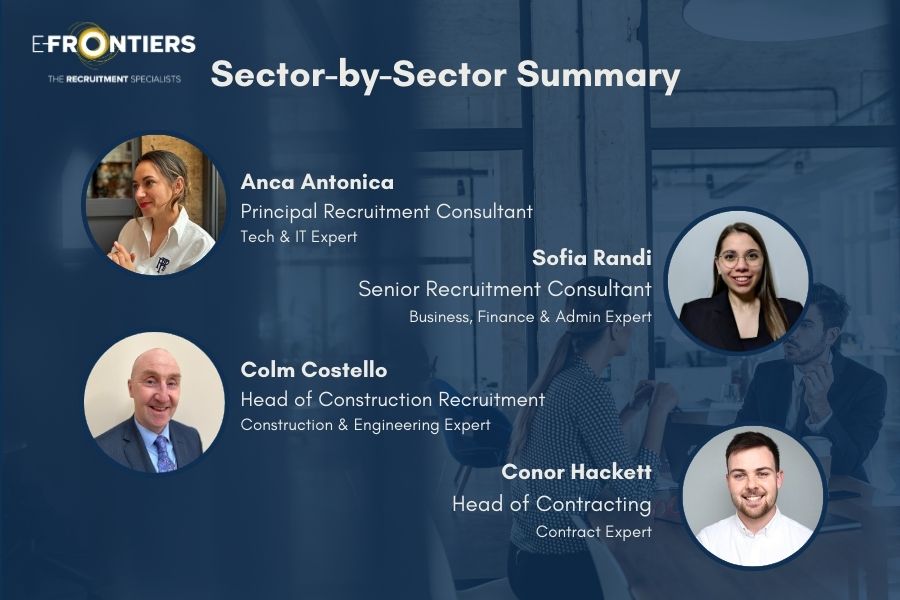
IT
Anca Antonica | Principal IT Recruiter
Demand remains strong across consultancies, fintech, and product companies, particularly for skills in cloud, DevOps, AI, data, and software engineering. Candidates prioritise flexibility, project stability, and technical leadership, while standout employers offer clear career paths, modern tech stacks, and exposure to critical platforms. Skills shortages and slow decision-making in larger firms remain the main challenges. Companies treating engineering and platform teams as long-term investments are attracting and retaining the strongest talent.
Business
Sofia Randi | Senior Recruiter
Steady but cautious growth is expected, with roles becoming broader and more commercially focused. Candidates value flexibility, meaningful work, and progression, and employers that offer hybrid-first setups, faster hiring, and clear career paths stand out. Hiring timelines and mid-to-senior talent shortages remain the main challenges. Companies that move fast, stay flexible, and communicate well attract the best business talent.
Construction
Colm Costello | Head of Construction Recruitment
The market is highly competitive for experienced engineers, site managers, and commercial professionals. Candidates are now more selective, weighing salary, project location, work-life balance, and company culture. Skills shortages at mid-to-senior levels persist, and there is high demand across multiple project types. Recruitment is now a strategic process: early engagement, swift decisions, and partnering with specialist recruiters enhance success.
Contracting
Conor Hackett | Head Of Contracting UKI
Demand is rising as companies prioritise flexibility and strategic project-based hiring, with overall Irish market growth forecast at 6% in 2026. Contractors look for higher rates, remote/hybrid options, and clear project scopes, and they very much value streamlined onboarding and rapid decision-making. Skills shortages – particularly in tech-enabled roles – remain the biggest challenge with 96% of Irish employers reported shortages in 2025. Employers increasingly favour skills-based hiring for short-term, high-value expertise.
Conclusion – Making the most of 2026
The Irish recruitment market in 2026 offers plenty of opportunities, but it also requires a careful and flexible approach. Employment remains strong, demand for specialist skills is high, and candidates are placing more value than ever on flexibility, career progression, and stability.
Even with easing inflation, global factors mean the market can change quickly. Employers who stay close to trends, act fast, and adapt to candidate priorities will be best placed to attract and retain the right talent.
Let’s Talk
If you’d like to discuss any of the trends in this report or chat about your hiring plans for 2026, feel free to contact Nigel Bolger, Commercial Manager. He’d be happy to have a conversation and explore how we can support your team.
Ph: 086 3888147
El mercado tecnológico en España está viviendo una transformación en muchos aspectos, desde nuestro equipo en E-Frontiers, hemos visto que cada vez más empresas requieren perfiles freelancer en el sector IT para sus proyectos.
Esta demanda de talento especializado, la internacionalización de los proyectos y la flexibilidad que ofrece este formato están impulsando una nueva forma de entender la carrera profesional.
Este artículo está dirigido tanto a autónomos o freelancers del sector IT como a perfiles tecnológicos que se están planteando dar el salto, y recoge los aspectos clave que conviene conocer antes de hacerlo.

¿Qué significa ser freelancer IT en España hoy?
Ser freelancer IT implica trabajar por proyectos, prestando servicios tecnológicos a empresas como profesional independiente, en lugar de hacerlo mediante un contrato laboral tradicional.
En España, los perfiles IT más demandados en modalidad freelance suelen ser parecidos a los más demandados en modalidad por cuenta ajena: desarrolladores frontend, backend, fullstack, iOS, React Native/Xamarin, especialistas en cloud, data, ciberseguridad… Aunque destacamos aquellos perfiles estratégicos, demandados de forma puntual en proyectos, como BA, PMO, Agile Managers…
Es importante diferenciar conceptos:
- Autónomo: figura legal y fiscal en España.
- Freelancer: modelo de trabajo basado en proyectos. Para ser freelancer, deberás ser autónomo y firmaras un contrato con otra empresa para ofrecer tus servicios por cuenta propia.
- Contractor: término habitual en entornos internacionales, equivalente al freelance.
En la práctica, la mayoría de freelancers IT en España operan como autónomos y trabajan tanto con empresas nacionales como internacionales.
La cultura de trabajar por proyectos está muy extendida y normalizada en otros países europeos, con especial relevancia en Reino Unido e Irlanda. Esta modalidad es un camino más en las carreras laborales, siendo los perfiles con más experiencia y especializados quienes optan por posiciones de “Contract” con el gran beneficio de cobrar un salario diario, proporcialmente mayor a la nómina mensual, llamado “daily rate”.
Ventajas de ser freelancer IT
El modelo freelance ofrece múltiples beneficios, especialmente en el sector tecnológico:
- Flexibilidad y conciliación: mayor control sobre horarios, proyectos y ubicación. Acceso a proyectos internacionales: muchas empresas buscan talento IT remoto.
- Mayor potencial de ingresos: tarifas alineadas al valor aportado y a la especialización, el poder llevar diferentes proyectos aumenta la retribución.
- Autonomía profesional: posibilidad de elegir proyectos que encajen con tus intereses.
- Especialización: el mercado valora cada vez más perfiles expertos en enornos concretos.
Para muchos profesionales IT, el freelance se convierte en una vía natural de crecimiento y desarrollo profesional.
Retos y desventajas a tener en cuenta
Aunque atractivo, el modelo freelance también implica ciertos retos:
- Ingresos variables y necesidad de planificación financiera.
- Gestión administrativa y fiscal, que recae directamente en el profesional.
- Menor estabilidad frente a un contrato indefinido.
- Ausencia de beneficios tradicionales como vacaciones pagadas o bajas.
- Autogestión constante, tanto del trabajo como del desarrollo profesional.
- Falta de cultura freelance en España en comparación a otros paises.
Conocer estos puntos desde el inicio es clave para tomar una decisión informada.
Cómo destacar como candidato freelance IT
En un mercado competitivo, diferenciarse es fundamental:
- CV y perfil profesional orientados a proyectos, no solo a puestos.
- Portfolio con casos reales, tecnologías utilizadas y resultados obtenidos. Así como repositorios donde se puedan ver los proyectos personales.
- LinkedIn optimizado y marca personal activa.
- Soft skills: comunicación, responsabilidad, autonomía y orientación a resultados.
- Entrevistas para proyectos: suelen ser más técnicas y enfocadas al impacto inmediato.
Las empresas buscan freelancers que aporten valor desde el primer día.
El papel de los recruiters y agencias de reclutamiento
Los recruiters juegan un papel clave en el ecosistema freelance:
- Acceso a proyectos que no siempre están publicados.
- Acompañamiento durante todo el proceso de selección.
- Transparencia en condiciones, tarifas y expectativas.
- Feedback continuo y relaciones a largo plazo.
- Ahorro de tiempo en la búsqueda de oportunidades.
Trabajar con recruiters especializados, como nosotros, permite a los freelancers a mantenerse al tanto de nuevas oportunidades laborales y centrarse en lo más importante: aportar valor en sus proyectos.
Conclusión
Ser freelancer IT en España es una opción cada vez más consolidada y atractiva, pero requiere información, preparación y una visión clara de los objetivos profesionales. Conociendo sus ventajas, retos y el funcionamiento del mercado, es posible construir una carrera sólida y sostenible.
El sector IT sigue ofreciendo grandes oportunidades para quienes apuestan por la especialización, la flexibilidad y el aprendizaje continuo.
Si estas en búsqueda de posiciones en esta modalidad no dudes en contactarnos para poder ayudarte a encontrar tu próximo proyecto.
Si eres un entusiasta de la tecnología, emprendedor, programador o simplemente un apasionado por la innovación, este año estará repleto de eventos tecnológicos que no puedes perderte. Os traemos un listado con Eventos Tecnológicos en España 2026, donde la inteligencia artificial, la transformación digital, el emprendimiento y el desarrollo de software serán protagonistas.
*Fechas y lugares pueden estar sujetos a cambios, por eso os dejamos el link directo a la página web para obtener más información.

Primer trimestre
EmpleaTECH 2026
Transfiere 2026
💡Temática: Tecnología y Big Data
Un foro europeo de ciencia, tecnología e innovación donde empresas, investigadores y administraciones públicas se reúnen para impulsar el desarrollo y la transferencia del conocimiento.
SICUR
💡 Temática: Seguridad General
Un evento organizado en IFEMA entorno a la seguridad en todos los ámbitos incluyendo ciberseguridad.
Digital Summit Latam 2026
💡 Temática: Mundo Digital, Inteligencia Artificial (IA)
Este evento reúne a expertos de América Latina y Europa para discutir los desafíos y oportunidades en la regulación de la IA, inversión en infraestructura digital y el futuro de la tecnología.
TechFest
💡 Temática: Tecnología en general
T3chFest es un festival gratuito que explora desde computación en la nube hasta inteligencia artificial, desarrollo móvil y mucho más. Es una excelente oportunidad para aprender y hacer networking con otros apasionados de la tecnología.
4 Years From Now (4YFN)
💡 Temática: Startups y emprendimiento
El evento de startups del MWC donde emprendedores pueden conectar con inversores y corporaciones tecnológicas para potenciar sus proyectos.
Mobile World Congress (MWC)
💡 Temática: Tecnología móvil
Uno de los eventos más importantes del mundo en cuanto a innovación móvil. Empresas líderes presentan sus últimas novedades en dispositivos, redes y conectividad.
ASLAN
💡 Temática: Inteligencia Artificial, ciberseguridad, redes y conectividad, gestión de datos, cloud y transformación digital
El Congreso & EXPO ASLAN es el mayor evento anual de referencia en España para la industria de la innovación digital, la infraestructura tecnológica y la ciberseguridad.
Segundo trimestre
Codemotion Madrid 2026
💡 Temática: Desarrollo de software
Un evento clave para desarrolladores, con charlas sobre backend, frontend, DevOps e inteligencia artificial.
Net Zero Tech 2026
💡Temática: Energía y sostenibilidad
Un evento clave para el sector energético, enfocado en la transición hacia una economía de carbono cero mediante la innovación tecnológica.
South Summit 2026
💡 Temática: Emprendimiento e innovación
Reúne a startups, inversores y corporaciones con el objetivo de fomentar la innovación y el crecimiento empresarial.
Digital Enterprise Show (DES)
💡 Temática: Transformación digital e inteligencia artificial
Evento enfocado en la digitalización empresarial y las nuevas tendencias en tecnología e IA.
VDS – Valencia
📅 Fecha: 20, 21 y 22 de octubre 2026
📍Ubicación: Valencia
💡 Más información: https://vds.tech/
💡 Temática: Tecnología e innovación
VDS es uno de los principales eventos internacionales de tecnología en Europa, una plataforma que posiciona a Valencia como un hub global de innovación y un puente de negocio entre Europa, América Latina y Estados Unidos.
PyCon España 2026
📅 Fecha: 6, 7 y 8 de noviembre 2026
📍Ubicación: Barcelona
💡 Más información:
💡 Temática: Todo sobre Python
La mayor conferencia nacional de Python, donde cientos de entusiastas, profesionales y empresas se reúnen para compartir conocimientos, inspirarse y hacer comunidad. Habrá: Charlas de alto nivel, talleres prácticos y networking con los mejores del sector.
Madrid Tech Show
💡 Temática: Tecnología en general
Conferencias y exposiciones sobre cloud, ciberseguridad, big data, IA y más. Un evento imprescindible para profesionales del sector tecnológico.
Smart City Expo World Congress
💡 Temática: Tecnología y Ciudades inteligentes
Descubre como la tecnología va a cambiar el futuro de las ciudades donde vivimos.
Eventos concluidos 2025
Mujeres en el mundo tecnológico: E-Frontiers X Women In Tech
📅Fecha: 5 de junio, 16:00 hora peninsultar
📍Ubicación: Online
🔗Más información: Más info y regístrate aquí
💡Temática: DE&I, Mujeres en el sector IT.
Accede a la grabación aquí: Mujeres en el mundo Tech: E-Frontiers X Women in Tech
Durante las últimas semanas, hemos estado organizando junto a Women in Tech® Spain un evento online pensado para abrir conversaciones (tan necesarias!) sobre el papel de la mujer en el sector STEM, compartir experiencias reales y avanzar hacia una industria más inclusiva y diversa.
El 2026 será un año lleno de oportunidades para explorar nuevas tecnologías, hacer networking y aprender de los mejores expertos en diversos sectores. Si estás interesado en la inteligencia artificial, el desarrollo de software, la transformación digital o el emprendimiento, estos eventos son para ti.
El equipo de E-Frontiers Spain estará este primer trimestre en el TechFest y
ASLAN y SICUR para ponerse al día de las tendencias en el mundo digital. Esperamos coincidir con vosotros.
Conoce a los autores de este artículo aquí:
Ernesto Fabbri – Technical Recruiter
Cristina Rafael – Marketing
En la actualidad, las empresas del sector tecnológico se enfrentan a un mercado altamente competitivo y en constante evolución. Para responder a estas demandas, algunas empresas apuestan por contratar personal freelance en el sector IT como una solución estratégica que aporta flexibilidad, eficiencia y acceso a talento especializado.
¿Por qué contratar freelancers en el sector IT?
La contratación de freelancers en el sector IT se ha convertido en una tendencia clave para empresas que buscan adaptarse rápidamente a nuevos proyectos, tecnologías y necesidades del mercado sin asumir compromisos a largo plazo.

Acceso a talento IT especializado
Uno de los principales beneficios de contratar freelancers IT es el acceso inmediato a profesionales altamente cualificados. Desarrolladores, ingenieros de software, especialistas en ciberseguridad, cloud, data o QA pueden incorporarse a proyectos específicos aportando experiencia técnica muy concreta.
Rapidez en los procesos de contratación
En el sector IT, el tiempo es clave. La contratación de freelancers permite reducir significativamente los tiempos de selección e incorporación, asegurando que los proyectos no se retrasen por falta de recursos técnicos.
Flexibilidad y escalabilidad de los equipos
El modelo freelance permite a las empresas IT escalar sus equipos según la carga de trabajo. Esto resulta ideal para proyectos temporales, picos de demanda o fases críticas de desarrollo, sin necesidad de ampliar plantilla de forma permanente.
Mayor enfoque en resultados y productividad
Los freelancers suelen trabajar por objetivos y entregables concretos, lo que fomenta una cultura orientada a resultados y una mayor productividad.
Reducción y optimización de costes
Contratar personal freelance ayuda a optimizar costes operativos, ya que se eliminan gastos asociados a contrataciones permanentes como beneficios sociales, formación continua o procesos administrativos complejos. Las empresas pagan únicamente por los servicios necesarios.
Innovación y nuevas perspectivas
Al colaborar con diferentes empresas y sectores, los profesionales freelance aportan nuevas ideas, metodologías y mejores prácticas que enriquecen a los equipos internos.
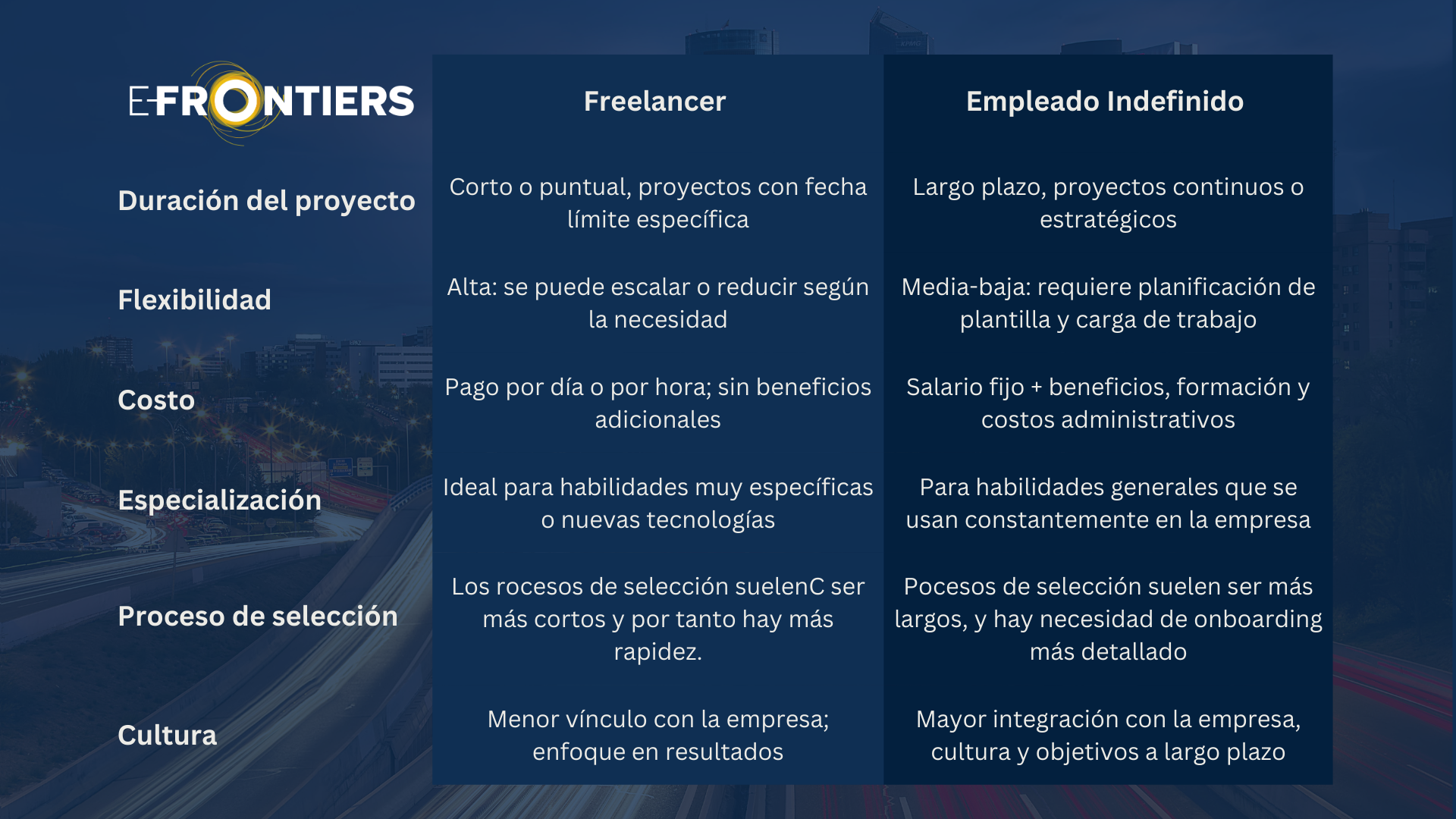
Tabla comparativa de modalidades de contratación.
Si aún no tienes decidido si contratar a un perfil como empleado infinido o como freelancer, te dejamos esta tabla donde comparamos por varios criterios ambas opciones.
¿Cómo puede ayudar E-Frontiers a encontrar talento freelance IT?
En E-Frontiers, somos una agencia de reclutamiento especializada en el sector IT con amplia experiencia conectando empresas con talento tecnológico.
Nuestro enfoque se basa en entender a fondo las necesidades técnicas y de negocio de cada cliente para ofrecer soluciones rápidas y efectivas.
¿Qué aportamos como partner de reclutamiento?
- Acceso a una red consolidada de perfiles IT
- Procesos de selección ágiles y especializados
- Asesoramiento experto sobre modelos de contratación, tarifas de mercado y disponibilidad de talento.
For decades, entry-level jobs in Ireland have been the launchpad for careers – the “training ground” where newcomers learned the ropes, built confidence, and began the climb up the professional ladder. But now, with the growth of AI, the World Economic Forum (WEF) warns, that career ladder is starting to look a little bit different.
“AI is set to reshape the traditional career ladder, with entry-level jobs at risk,” the WEF notes. Across industries like finance, marketing, and journalism, junior staff have historically handled the groundwork – data entry, reporting, coordination, and administrative support. These “first jobs” were once all about learning on the job – but increasingly, AI is taking over some of those tasks.
According to Bloomberg, cited in the WEF’s AI and the Career Ladder feature, AI-powered tools could automate as many roles as they create, particularly white-collar, entry-level ones. The upshot? The job market isn’t shrinking, but the types of roles available are changing fast.
Ireland’s Picture: AI is Changing Work, Not Eliminating it
Ireland’s own data supports this transformation. PwC’s AI Jobs Barometer 2025 reveals just how fast the AI wave is rising:
– 162% increase in job postings for AI-exposed occupations
– 13.9% of AI-related roles are in the ICT sector
– 2.2% of all job ads now require AI-related skills
This doesn’t mean jobs are disappearing — it means they’re evolving.
PwC Ireland highlights that automation can play two roles:
“It can displace people from roles, or it can change the nature of people’s jobs, freeing them from automatable tasks so they can focus on higher value work.”
Encouragingly, right now, Ireland seems to be seeing more of the second effect. Jobs are changing rather than vanishing: data entry clerks are turning into data analysts, admin assistants are shifting into operations roles, and marketing assistants are becoming AI-enabled content coordinators.
The future of work, then, is less about replacement and more about reinvention.
Reshaping Skills: The Irish Workforce in Transition
PwC’s GenAI Business Leaders Survey 2025 underscores just how widespread this change will be.
“73% of Irish business leaders believe AI will require most of their workforce to develop new skills.”
That’s not just a niche concern — it’s happening across industries. AI skills are quickly becoming as important as basic digital literacy. But there’s a silver lining: if you’re willing to learn, there’s opportunity.
Irish CEOs are already optimistic. Half of them — 50% — expect AI to boost profitability within the next 12 months. The AI era, PwC says, is “about value creation with and through workers.” In other words, people are still central – it’s just the way we add value that’s shifting.

What Candidates Can Do Now
So, if entry-level roles are changing shape, how can emerging professionals’ future-proof their careers?
1. Lean into learning – Treat AI as a colleague, not a competitor. Get familiar with the tools used in your field — from data dashboards to workflow automation — and think about how they can make your work easier and more interesting. Check out our blog in upskilling here.
2. Focus on transferable skills – Problem-solving, communication, and critical thinking still matter. AI can handle the numbers, but humans interpret, persuade, and connect.
3. Build adaptability – Career paths aren’t always straight anymore. Sideways moves into analytics, operations, or digital roles can give you new experiences and open doors.
4. Stay curious about business and technology – learn about your industry and how technology is shaping it. Ask questions, read, and find mentors who are embracing AI.
5. Keep growing – AI will keep changing the workplace. Staying open to learning and trying new things will help you stay ahead.
Take Heart: Opportunity Still Outweighs Risk
AI is changing how people start their careers, but it’s not wiping them out. What’s really happening is a shift – some of the old “first jobs” are disappearing, but new roles are opening up, blending human skills with tech.
PwC points out that many roles won’t vanish; they’ll just look different. A data entry clerk might become a data analyst. An admin assistant might focus more on coordination, analysis, or digital tools. The key is to be ready to move with these changes.
For candidates starting out on their career pathways, that means being curious, flexible, and willing to pick up new skills. Irish employers are still looking for people who are keen, reliable, and can work well with technology.
The career ladder might not be as straightforward as it once was, but there are still plenty of ways to climb – you just need to be willing to take a few new paths to get there.
At E-Frontiers, we can help you figure out your next steps – whether that’s finding the right role, building your skills, or understanding how your strengths fit into the changing market. Contact us today www.e-frontiers.ie and on LinkedIn
El bienestar laboral ha pasado de ser un concepto aspiracional a convertirse en un eje estratégico dentro de muchas empresas del sector IT en España. La alta rotación, la dificultad para retener talento y la creciente conciencia sobre la salud mental han llevado a las organizaciones a replantearse su cultura, sus políticas y su manera de cuidar a las personas.
Sin embargo, aunque se han dado pasos importantes, todavía estamos en un punto de transición. El bienestar ya no puede limitarse a beneficios puntuales o acciones aisladas: requiere una mirada más profunda, coherente y sostenida en el tiempo. Se trata de construir entornos donde las personas puedan desarrollarse profesional y emocionalmente, sintiendo que su trabajo tiene propósito y que su empresa realmente se preocupa por ellas.
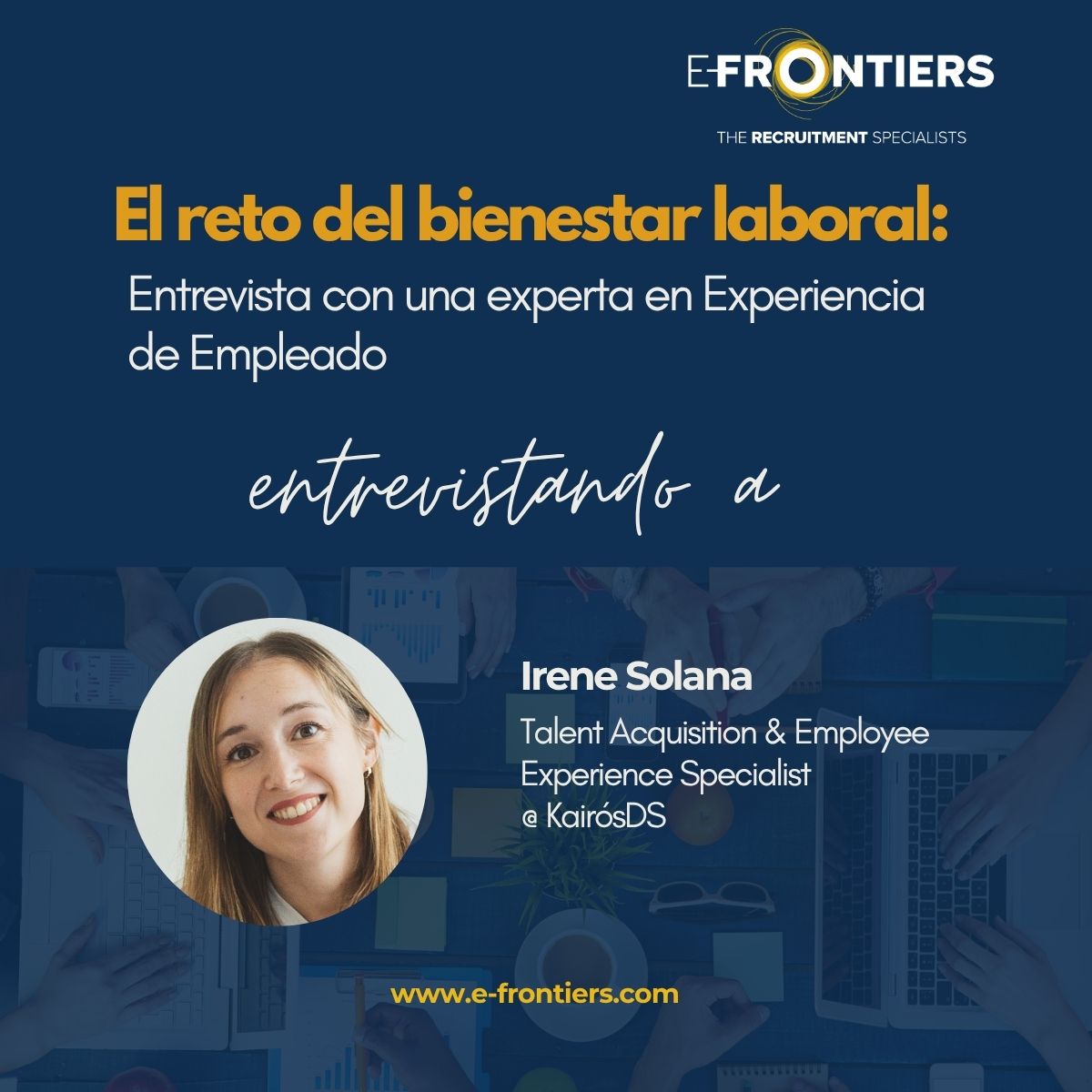
Para entender mejor cómo está evolucionando esta tendencia y cuáles son los retos que todavía quedan por delante, hablamos con Irene Solana, Talent Acquisition & Employee Experience Specialist, quien comparte su visión sobre el momento actual del sector, las claves para implementar programas efectivos y por qué cuidar de las personas es, en realidad, la mejor forma de cuidar de la empresa.
Irene, cuéntanos… ¿Cómo describirías el estado actual del bienestar laboral en las empresas y cuáles son los principales retos?
Creo que ha mejorado mucho respecto a años anteriores. Cada vez más empresas cuidan el bienestar de sus empleados porque entienden que es una forma de fidelizar el talento, algo que hoy cuesta mucho conseguir. Muchas se han puesto las pilas para no quedarse atrás y convertirse en buenos lugares donde trabajar. Aun así, creo que seguimos en un punto de transición. Aunque hay más conciencia, el bienestar todavía se queda en un segundo plano o en acciones aisladas. A veces se confunde solo con beneficios cuando en realidad se trata de cuidar la experiencia y la salud emocional de las personas. El gran reto está en pasar de la teoría a la práctica y en poner el bienestar en el centro de las decisiones directivas. Estamos en un mundo donde cada vez hay más sobrecarga mental, falta de conexión real y liderazgo poco preparado para acompañar emocionalmente a los equipos. El bienestar de las personas no debería ser opcional: cuidar a los empleados es, en realidad, cuidar a la empresa.
Desde tu experiencia, ¿por qué es tan importante que las empresas inviertan en programas de bienestar laboral? ¿Qué beneficios tangibles se pueden experimentar si se apuesta por el bienestar y el cuidado del trabajador?
Pasamos muchas horas en el trabajo y es fundamental que las personas se sientan a gusto, motivadas y felices. Cuando una empresa cuida el bienestar de su gente, no solo mejora el ambiente laboral, también impacta directamente en los resultados. Al final, cuando las personas están bien, todo funciona mejor: hay más compromiso, más creatividad, más proactividad y más sentido de pertenencia. Las empresas que invierten en bienestar lo notan: hay menos rotación, más estabilidad en los equipos y un mejor clima en general. No se trata solo de reducir el estrés o las bajas laborales, sino de construir entornos donde las personas quieran quedarse y dar lo mejor de sí. Cuidar de los empleados no es un gasto, es una inversión necesaria.

¿Qué recomendarías a una empresa que quiere empezar a implementar un plan de bienestar, pero no sabe por dónde comenzar?
Para empezar, muchas veces no hace falta un gran plan ni un presupuesto enorme. A veces basta con dar pasos pequeños: hacer una encuesta de clima para entender cómo están los equipos, lanzar una prueba piloto o revisar aspectos tan básicos como la carga de trabajo, la comunicación o la flexibilidad existente. Lo importante es escuchar a las personas para saber cómo están y qué necesitan. Y, sobre todo, ser coherentes: no tiene sentido hablar de bienestar si luego por ejemplo se premia al que más horas trabaja. El bienestar empieza por el ejemplo de los líderes y por la voluntad real de poner a las personas en el centro.
Desde tu experiencia en selección de talento y experiencia de empleado, ¿qué beneficios o medidas de bienestar valoran más los empleados hoy en día?
Hoy en día, las personas valoran sobre todo la flexibilidad, la posibilidad de teletrabajar, la conciliación y sentirse escuchadas y valoradas. Buscan entornos que respeten su tiempo y su salud mental, donde puedan desconectar de verdad y tener equilibrio entre la vida personal y la profesional. También se aprecian mucho iniciativas que fomentan hábitos saludables —como el acceso a gimnasios o apps de deporte— o disponer de más días de descanso y vacaciones.
Más allá de los beneficios tangibles, lo que más valoran es la confianza, el buen liderazgo y poder trabajar con propósito, en una empresa donde sientan que aportan valor y que se preocupan por su bienestar real.
Por otro lado, ¿crees que hay un impacto real en la atracción y retención de talento?
Si, el impacto en la atracción y fidelización del talento es enorme. Las nuevas generaciones, especialmente, ya no se conforman con cualquier entorno. Buscan empresas que les ofrezcan desarrollo, equilibrio y coherencia entre lo que dicen y lo que hacen. Al final, la gente no se va de las empresas, se va de los entornos que le generan malestar.
Para cerrar, si tuvieras que resumirlo en una frase: ¿qué significa para ti una empresa verdaderamente saludable?
Para mí, una empresa verdaderamente saludable es aquella donde las personas se sienten valoradas, pueden ser ellas mismas y se pueden desarrollar en un entorno de confianza, equilibrio y respeto. Donde el bienestar no se queda en palabras sino que se demuestra con hechos cada día.
Si buscas apoyo en la búsqueda y selección de perfiles tech y de ventas, contáctanos y veamos cómo podemos acompañarte a crear un entorno donde las personas quieran quedarse y crecer.
Employee retention is now mission-critical
In today’s Irish labour market, holding onto your best people is no longer a bonus – it’s a survival imperative. With employee retention rates under pressure and skilled candidates in short supply, the cost of losing a key employee often far outweighs the upfront investment of keeping them. It’s not just the recruitment fee; it’s the time it takes to hire, the dip in productivity while the role is empty, and the knowledge that walks out the door with them.
A recent Microsoft Ireland survey found that almost one in four Irish workers changed jobs in the past year. That’s a staggering amount of movement that is disruptive, costly, and avoidable. It shows how fragile loyalty can be, and why retention can’t just be something businesses hope for and see as a HR concern – it needs to be a real business strategy. (Source: Microsoft Ireland Work Trend Index 2024)
Why people stay: the real reasons behind loyalty
Retention isn’t just a list of policies – it’s psychology plus daily experience. Of course, money matters – but it’s not the full story. Research and our own experience tell us people stay for deeper reasons:
Meaning & Purpose: Employees feel their work matters. When people believe what they do has meaning, they’re far less likely to look elsewhere.
Quality of line management & relationships: They trust their manager. Day-to-day interactions with a manager can make or break loyalty. Support, recognition, and honest conversations keep people grounded. Good managers create clarity, recognition, and development – the practical glue for loyalty.
Fair pay & clear career pathways: They see a future. If pay feels fair and there’s a clear path to progress, employees will often stay even if tempted by outside offers.
Autonomy & Flexibility: Since Covid, flexible working has shifted from a perk to an expectation. If it’s not available, employees are quick to look elsewhere.
See here for further information: CIPD HR practices in Ireland 2025; CIPD workers plan to quit; and Forbes.com What makes employees stay
We have asked our Principal Consultants, Anca Antonica and Conor Hackett, about why candidates stay in their current companies and this is what they said:
“In my experience, tech professionals stay when they feel genuinely challenged and supported, not just managed. Engineers, developers, and architects are loyal to environments where they can influence technical decisions, work with modern tools, and clearly see their impact. When leadership trusts their expertise, communicates a clear vision, and invests in their growth, people feel valued and want to stay.” Anca Antonica, Tech Principal Consultant
“The company has set a clear vision in their goals and also they are clear on what the values of the company are. The people working in the company feel valued and are given responsibilities to help achieve the company goals, hence they feel appreciated. They also are well rewarded for their work and appreciation is shown by the employer when they go above and beyond. “ Conor Hackett, Finance Principal Consultant.
Why people leave: the common triggers
Surveys repeatedly show predictable themes when people explain why they hand in their notice:
– A better salary package elsewhere
– Lack of career opportunities
– Frustration with management or company culture
– Struggles with work-life balance
CIPD research in Ireland found these were the top reasons people gave in 2024, with poor onboarding also popping up – especially among those who quit in their first year.
Supporting the above, here are Conor and Anca’s insights on why candidates leave:
“The opposite of everything I said above! But one reason I see is that their is no clear progression path for people in the role, it is either not defined to them or doesn’t exist. People continuously want to grow and challenge themselves, and if they feel that is not on offer at their company then they tend to leave.” Conor Hackett.
“The main reasons people leave often come down to a lack of growth, outdated technology, or poor flexibility. For IT professionals, feeling stagnant or forced back into rigid office-based models can quickly push them to look elsewhere. In today’s market, flexibility, whether hybrid or remote, is seen as a key part of job satisfaction, not just a perk.” Anca Antonica
Why employee retention is harder in Ireland right now
Several local factors are making retention for employers more challenging right now:
– Labour mobility is still high in certain professions: CSO data shows movement between jobs remains high, especially in technical and professional roles.
– Talent shortages. In IT, engineering, and construction, demand for skilled staff outstrips supply. Counter-offers are common.
– Shifting expectations. Workers increasingly want chances to learn new digital and AI skills, along with flexibility and purpose. Microsoft Ireland survey
“Employee retention is particularly challenging in Ireland at the moment. It’s a highly competitive, candidate-driven market where flexibility, modern tech stacks, and salary expectations drive decisions. We’re also seeing many experienced candidates returning to their home countries due to the housing crisis and high living costs. Employers that can’t adapt to flexible working models or market realities are finding it increasingly hard to keep their best people.” Anca Antonica
“The main reason I am seeing from both clients and candidates is that of remuneration. It is definitely a candidate market, and they are moving for a number of reasons. Majority are either work life balance mainly hybrid/remote working with flexibility and then comes salary/benefits.
Candidates want to be trusted and have that flexibility of working from home. If another company is offering that and their current company is strict in their ways and doesn’t listen to the market or to their employees then they will struggle with retention.” Conor Hackett

What really works: What Irish companies can do to aid employee retention
Based on both research and market experience, these five actions make the biggest difference:
1. Retention begins at recruitment. Get recruitment right from the start. Hiring people who genuinely fit your company and setting realistic expectations prevent early exits.
2. Invest in onboarding. The first 90 days are critical. If new hires feel valued and supported, they’re far more likely to stay.
3. Train your managers to be retention leaders. Train them in giving feedback, having career conversations, and balancing workloads. Poor managers are a top reason people leave. CIPD HR practices in Ireland 2025
4. Be serious about flexibility. Consistent, fair policies on hybrid work or hours are now part of the deal for many staff. CIPD research in Ireland highlights flexible working as a primary retention lever.
5. Show a career path. Make promotions, pay bands, and learning opportunities visible. Short upskilling courses – especially in digital skills – are powerful retention tools. Microsoft Ireland’s research shows many workers want AI/digital upskilling.
6. Measure what matters and act quickly. Track voluntary turnover by team and reason for leaving; use stay interviews (not just exit interviews) to surface issues early.
The new context: Budget 2026 and what it means
Employee retention strategies don’t exist in a vacuum. Government policy also shapes the labour market. The recent Budget 2026 will impact hiring and retention in a few key ways:
– Minimum wage increase. The rise to €14.15 per hour in January 2026 will help lower-paid staff, but it could squeeze pay differentials. Employers will need to adjust pay scales, so experienced staff don’t feel overlooked.
– Tax position of middle earners. With little change in tax relief, mid-to-senior professionals may focus more on non-financial rewards like flexibility, learning, and career development.
– Public sector hiring surge. The 12,500 new public sector jobs will create more competition for talent, especially in admin, finance, HR, and compliance.
– Push for innovation. The increase in the R&D tax credit to 35% will fuel demand for digital technology and engineering skills – adding further pressure to retain people in these high-demand areas.
See Irish Times Report and Reuters for more information on Budget 2026
Why employee retention worth the effort
Keeping your people isn’t just about saving recruitment costs (though that’s significant – studies estimate it can cost from half to double an employee’s annual salary to replace them). It’s also about:
– Higher productivity: experienced teams deliver faster.
– Stronger culture: lower turnover builds trust and stability.
– Better client relationships: continuity helps customers feel secure.
(Source: SHRM research on cost of turnover; CIPD Ireland 2024)
Practical next steps for Irish employers
If you’re not sure where to start, here’s a simple checklist:
– Ask your teams directly: why do they stay, and what might make them leave?
– Audit your pay scales against the market, especially with Budget 2026 changes coming, and close obvious gaps.
– Train managers in the basics of retention skills – coaching, feedback, and career conversations.
– Pilot a structured, flexible working policy and a micro learning program that you can scale.
– Track turnover by team every quarter and act fast on emerging trends.
Conclusion: Employee retention as a competitive edge
In Ireland’s tight market, the easiest hires are rarely the best hires. Constantly replacing people is expensive and draining, and unsettling for the team left behind. The smarter move is to keep the talent you already have.
Pay matters, but retention is also about trust, purpose, growth, and flexibility. Companies that take this seriously will protect their margins, strengthen their culture, and stay ahead of competitors. Retention done well is a true competitive advantage.
At E-Frontiers, we know that attracting the right talent is the key to building high-performing teams. Every day, our conversations with candidates and clients give us a clear view of the evolving talent landscape – and what truly drives successful hires.
If you’re planning for growth in 2026, we can help you connect with the professionals who will make an impact from day one.
For further information, please contact our Commercial Manager
Nigel Bolger nigel.bolger@e-frontiers.ie
The Return Home: Could now be the right time?
If you’re an Irish professional living abroad and thinking about moving home, you’re not alone.
More and more people are making the same decision — bringing back global experience, new perspectives, and a renewed desire to settle and grow their careers in Ireland.
Driven by family ties, better opportunities at home, and the rising cost of living overseas, thousands of Irish professionals are returning each year.
And with demand for skilled people higher than ever, the timing has never been better to make your move.

TOP STATS YOU SHOULD KNOW:
The Numbers Behind the Trend
The Returners
– Over 30,000 Irish nationals returned home in the year to April 2024 – a 17% year-on-year increase (CSO Ireland).
– Returners are typically in their 30s, bringing 10+ years of international experience across sectors like construction, engineering, tech, and finance.
– Economist John FitzGerald, Irish Times, notes a common pattern: “Many young Irish people emigrate in their twenties and return in their thirties. Returnees often bring with them valuable international experience, enhanced skill sets, and a strong desire to settle and progress their careers in Ireland” (Irish Times).
– Returners typically earn 10% more than those who never left, reflecting the value of international experience.
The Market
– Ireland is near full employment (CSO). Unemployment stands at just 4.0%, well below the EU average of 6.1%.
– Shortages are most acute in Construction, Nursing, Engineering, Accounting, and Software Development
(Labour Market Monitor Q2 2025).
– 13% of Irish job seeker interest came from abroad in 2024(Indeed). This is a record high. Applications for work permits also hit a record high last year, with 39,390 permits issued (+27% yoy). 6,500 of these permits were in the IT and Comms tech area.
SPOTLIGHT ON:
Finance & Accounting: A Global Edge at Home
In forecasting trends for 2025, the IFSC.ie expects a sustained influx of expats returning to Ireland.
In finance, returners bring a competitive edge through:
– Exposure to global regulatory environments (London, North America).
– Expertise in financial planning, audit, risk, compliance, and reporting.
– The ambition to join growing Irish firms and contribute long-term.
With mid-to-senior roles in high demand, your international background could allow you to step in quickly, minimise training time, and make an immediate impact.
Why Are People Coming Back?
From our conversations with candidates (and backed by market data), four motivators consistently come up:
1. Family & Lifestyle – raising children closer to extended family, enjoying a better balance at home.
2. Rising Costs Abroad – high housing and childcare costs in cities like London, Sydney, and San Francisco are driving decisions to return.
3. Improved Opportunities in Ireland – Ireland’s economy is strong, with competitive salaries and growing career prospects across sectors.
4. Remote & Hybrid Work – flexibility makes the transition easier and opens more doors for returners.
Construction: Skills Gaps Meet Global Experience
Ireland’s construction sector is facing a major shortage of skilled professionals. That means an opportunity for returners with global project experience.
We’re seeing strong demand for:
– Engineers and Quantity Surveyors returning from the UK, Australia, Canada, and the Middle East.
– Site Managers and Safety Officers with large-scale project expertise.
– Civil and Structural Engineers looking to return for family and quality-of-life reasons.
If you have international construction experience, your skills are highly valued. Employers are eager to hire professionals who can lead and deliver from day one.
Poll Results: Why Our Community Says They’re Returning
We asked our LinkedIn network: What’s the main reason you (or others you know) are choosing to return home to Ireland for work?
👨👩👧 Family & friends – 41%
💼 Career opportunities – 26%
🌍 Quality of life – 20%
💻 Remote/hybrid – 13%
These results reflect what we hear in conversations with candidates every week – that family comes first, but career prospects and lifestyle are also major factors in the decision. Interestingly, while only 13% said remote/hybrid was the main driver, it often acts as an enabler for those motivated by family or lifestyle, making the move feel more achievable and sustainable.
WHAT THE RETURNERS ARE SAYING:
Anca Antonica, Principal Consultant – IT:
“Family and quality of life are the biggest motivators, and remote work has made the move home more practical. Candidates bring back international experience and adaptability. Employers offering hybrid work, relocation support, and clear career progression are the ones standing out.”
Conor Hackett, Principal Consultant – Accounting & Finance:
“Family is the main driver, often starting families or wanting to be closer to home. Opportunities and pay in Ireland don’t always compare to London, but employers are beginning to adapt – offering flexibility and stronger branding. That’s what helps attract returners.”
Paula Coffey, Principal Consultant – Sales & Marketing:
“Many returners come from countries like Australia with excellent work-life balance. Employers here are learning that flexibility is key to making Ireland attractive again.”
Mark Kelly, Senior Consultant – Construction & Engineering
“We’ve seen more construction professionals returning to Ireland this year, drawn by a strong pipeline of housing, commercial, pharma, and tech-driven projects. Many are motivated by family, long-term stability, and the chance to contribute to Ireland’s growing infrastructure.
Returnees bring valuable international experience, having worked on complex builds abroad, exposure to high safety standards, and adaptability to diverse teams – skills that make them immediately effective in Irish projects. Hybrid work can help in roles like design or project management, but on-site work remains key.
If you’re considering a move back, look for employers who highlight clear project pipelines, structured onboarding, competitive packages, and short-term relocation or accommodation support. These factors can make your transition smoother and help you settle quickly into a rewarding career in Ireland’s construction sector.”
Next Steps
Ireland is at full employment, employers are actively looking for skills, and demand is especially strong in construction, finance, engineering, and IT. If you’ve been thinking about moving home, this is a great time to take the next step.
At E-Frontiers, we work every day with Irish professionals planning their return from London, Sydney, Toronto, New York, and beyond. We’d love to help make your move smoother and connect you with opportunities where your skills will be valued.
👉 Thinking of returning? Get in touch — your next career move could be waiting in Ireland.
Contact us today for advice – Alexandra Pop – Recruitment Operations Manager – alexandra.pop@e-frontiers.ie
Need help finding skilled returners for your business?
E-Frontiers is actively working with Irish candidates planning their move back home and has recruiters on the ground across the UK, EU, and the USA.
El bienestar laboral dejó de ser una tendencia para convertirse en una necesidad. No solo mejora la productividad de los equipos, también ayuda a atraer y retener talento, reducir el estrés y crear un ambiente de trabajo más humano.
En este artículo encontrarás consejos prácticos, una mirada a las últimas tendencias y un vistazo a lo que hacemos en E-Frontiers para promover el bienestar en el día a día.
Antes de hablaros de tendencias y consejos, queremos poner unos cuantos datos para reflexionar sobre la importancia del bienestar laboral:

Lo que muestran los datos
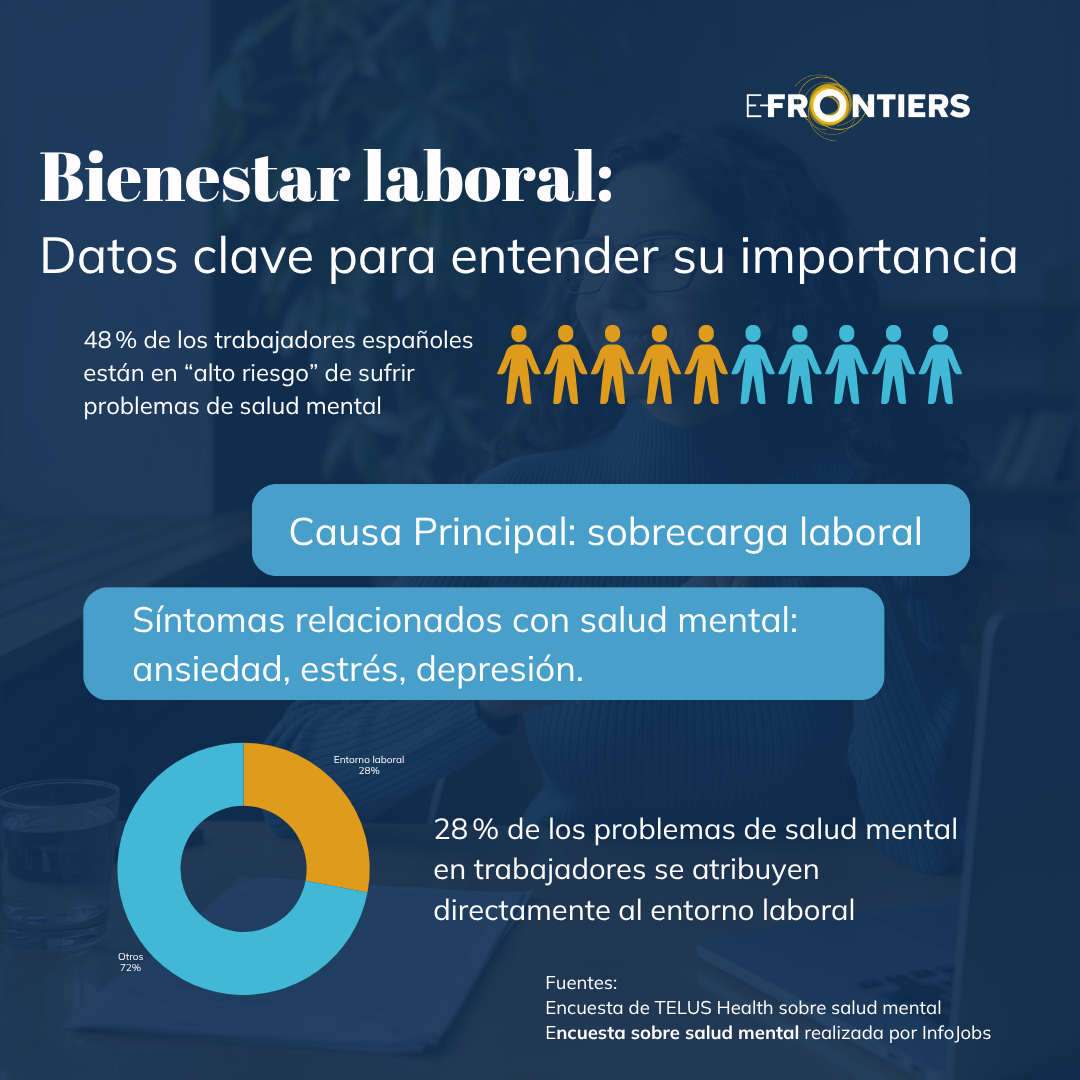
Una encuesta organizada por TELUS Health sobre salud mental, analizó el estado de los trabajadores en seis países europeos y ha esclarecido que el aproximadamente 48 % de los trabajadores españoles están en “alto riesgo” de sufrir problemas de salud mental. Ver más aquí
Hay una fuerte relación con el entorno laboral: 28 % de los problemas de salud mental en trabajadores se atribuyen directamente al entorno laboral (frente al 13 % en 2021).
Síntomas entre los trabajadores: 42 % de los empleados que participaron en la encuesta, ha experimentado síntomas relacionados con salud mental (ansiedad, estrés, depresión).
Siendo la causa principal la sobrecarga laboral: Esta es identificada por el 64 % de los trabajadores afectados como la principal causa de problemas de salud mental.
Tendencias e investigación en bienestar laboral
El mundo del trabajo evoluciona rápido, y con él, la forma en que entendemos el bienestar: por ello ya hay muchas empresas que se han puesto en marcha para conseguir un bienestar para sus empleados. Estas son algunas de las tendencias que las empresas ofrecen:
Derecho a la desconexión digital: Con la llegada del teletrabajo en época de pandemia se hizo evidente la necesidad de desconectarse digitalmente del trabajo al acabar la jornada laboral. Cada vez más empresas protegen a sus trabajadores de largas horas de trabajo. Ya hay países, como España, que incluyen normativas que protegen a los trabajadores fuera de horario laboral. Esto fomenta un mejor equilibrio entre vida personal y profesional. Cumplirlo es obligatorio por ley, pero se ha visto que el bienestar aumenta cuando la cultura apoya esta necesaria desconexión.
Trabajo híbrido y flexibilidad: estudios recientes demuestran que los modelos flexibles aumentan la satisfacción laboral, siempre que existan rutinas claras y comunicación efectiva. Por ello muchas empresas han optado por quedarse con modelos híbridos de teletrabajo donde el empleado pueda afrontar sus días con mayor flexibilidad ayudando a la conciliación y al descanso.
Inversión en programas de salud mental: empresas líderes ya consideran estos programas como una inversión estratégica, no como un gasto. Según investigaciones, cada dólar invertido en salud mental puede generar hasta cuatro de retorno en productividad. Hay plataformas que se encargan de dar apoyo a los trabajadores a nivel integral: psicológico, nutrición, entrenamiento, etc., y por el cual los trabajadores tienen acceso a estos servicios cuando sea necesario.
Consejos prácticos para mejorar el bienestar en el trabajo
Aparte de las tendencias de las que hemos hablado en el apartado anterior, os dejamos algunas ideas para implementar a nivel equipo que pueden ser muy efectivas:
Pausas activas de 5 minutos: Incorporar pequeños descansos para estiramientos o ejercicios de respiración puede aumentar la energía y concentración. Una pausa cada 90 minutos es lo ideal.
Espacios de desconexión digital: Fijar horarios para revisar correos y notificaciones ayuda a reducir la sobrecarga mental. Probar la regla “no mails después de las 18h” puede marcar una diferencia.
Medidas que protejan la conciliación desde la cultura de empresa: las mujeres suelen sufrir más estrés por el rol de cuidadoras que muchas veces tienen en sus casas, teniendo así una mayor carga de trabajo dentro de los hogares. Por ello, la cultura empresarial debe proteger las medidas de conciliación como reducción y ajuste de jornada por cuidado de un menor o familiar, ausencias por enfermedad de hijos, etc.
Ergonomía sencilla en el puesto de trabajo: Ajustar la altura de la silla, mantener la pantalla a la altura de los ojos y apoyar los pies en el suelo son pequeños cambios que reducen dolores musculares.
Mindfulness en la oficina: Dedicar 10 minutos al día a ejercicios de atención plena mejora la gestión del estrés y la claridad mental.
Presupuesto para utilizar en salud: Ya sea seguro médico o una cantidad anual para utilizar en consultas de fisioterapia o psicología.
Presupuesto para material ergonómico si se trabaja desde casa: Ofrecer un presupuesto anual para mejorar el home office y que este sea el más ergonómico posible (pantalla de ordenador, soporte para portátil, silla ergonómica, etc.)
Espacios de charlas entre compañeros: donde fomentar la conexión entre ellos, ya sea café semanal virtual (equipos en remoto) a Team Buildings, etc.
Ofrecer proyectos diversos: Dar la posibilidad de participar en otros proyectos dentro de la empresa para desconectar un poco de funciones más “duras” de cada puesto de trabajo, como puede ser la asistencia a eventos para hacer networking, la organización por parte de los empleados de talleres tech para los demás compañeros, ofrecer voluntariados en horario laboral, creación de un comité de bienestar. Esto puede ayudar a fomenar el aprendizaje de nuevas habilidades y fomenatar el sentimiento de pertenencia.
En nuestra organización creemos que el bienestar laboral debe vivirse todos los días. Algunas de las acciones que hemos implementado son:
Presupuesto para bienestar laboral: ofrecemos paquete de bienestar con un presupuesto para utilizar en fisioterapeutas, psicólogos y nutricionistas. Queremos que nuestro equipo este sano: si ellos crecen, todos crecemos.
Tenemos un equipo de Bienestar dentro de E-Frontiers, quienes se encargan de organizar salidas, Team Buildings, charlas con externos sobre bienestar, etc.
Talleres de equipo: Cada mes tenemos un taller impartido por uno de nuestros miembros del equipo. Puede ser sobre algo que les gusta a nivel personal: un hobbie, un deporte o algo que hayan aprendido para fomentar la unión del equipo.
Reto de movimiento: cada mes proponemos un reto de movimiento, para fomentar el movimiento en el exterior, ya sea dando un paseo o corriendo.
Fomentamos que el equipo se involucre en otras acciones beneficiosas para la empresa más allá del reclutamiento: como puede ser la asistencia a eventos, ferias y conferencias, apoyar a marketing, ofrecer charlas de empleabilidad y voluntariados.
Encuestas de bienestar y revisión de cómo vamos anualmente: medimos periódicamente cómo se sienten nuestros equipos, para ajustar las iniciativas a sus necesidades reales.
A nivel empresa, cuidar de los empleados tiene muchos beneficios, desde una mejor atracción y retención de talento, un aumento de la productividad y sentido de pertenencia, pero también a nivel social y personal estar rodeado de un ambiente laboral sano y equilibrado es clave para que la empresa crezca de manera sana y sostenible.
En un mundo donde los datos se han convertido en el motor de la toma de decisiones empresariales, los Recursos Humanos no podían quedarse atrás. Hoy hablamos de People Analytics, una disciplina que está transformando la manera en que las organizaciones gestionan su talento, alinean a sus equipos con los objetivos de negocio y anticipan los desafíos del futuro laboral.
Para profundizar en este tema, entrevistamos a Alejandro Pino, nuestro Manager quién se ha dedicado en los últimos años aprender sobre People Analytics. En este artículo nos comparte su visión sobre el papel actual de la analítica de personas, sus beneficios reales en las empresas, las competencias que requiere este perfil y las tendencias que marcarán el futuro del área.

¿Cómo definirías People Analytics y cuál es su papel actual en las empresas?
People Analytics es un concepto que se ha ganado fuerza en los últimos años. Yo lo definiría como el uso de datos, tecnologías como la IA y metodologías analíticas para entender mejor a las personas dentro de la organización y así tomar decisiones más estratégicas desde recursos humanos. Hoy en día su papel es clave: ayuda a pasar de la intuición a la evidencia, permitiendo gestionar talento, mejorar la experiencia del empleado, predecir rotación o identificar las situaciones más críticas. En un contexto donde hoy en día absolutamente todo genera datos, People Analytics se convierte en una herramienta imprescindible para alinear a las personas con los objetivos de negocio.
¿Qué soluciones nos puede aportar de manera eficaz la incorporación de People Analytics en un departamento de RRHH?
Nos puede aportar soluciones de muchos tipos pero sobre todo soluciones prácticas. Por ejemplo, modelos predictivos de rotación para anticipar riesgos de fuga de talento, análisis de compromiso para detectar factores que afectan al rendimiento, o segmentación de empleados para personalizar políticas de desarrollo y beneficios. También permite optimizar la contratación, midiendo la efectividad de los canales de reclutamiento y mejorando la calidad de las contrataciones.
Desde tu punto de vista, ¿quién debe liderar esta área? ¿Qué formación se requiere?
Depende de la estructura de cada empresa. Debe ser un área liderada desde Recursos Humanos, pero en estrecha colaboración con Data & Analytics. Lo ideal es un perfil híbrido: alguien con conocimiento profundo en RRHH pero también con capacidad de interpretar datos y traducirlos en acciones. Yo creo que ese doble perfil es clave y una oportunidad de futuro para los profesionales de los recursos humanos, que dejan de lado tareas más administrativas para desempeñar roles más estratégicos.
¿Cómo llegaste al mundo de People Analytics? ¿En qué áreas de tu carrera lo estás aplicando?
Llegué de forma natural desde mi rol en Recursos Humanos. Empecé viendo cómo los datos podían ayudarme a justificar decisiones de selección y retención de talento. También empecé a comprender tendencias que los datos te ayudan a predecir y en consecuencia actuar con tiempo. Poco a poco me fui formando en analítica de datos y en IA aplicada a RRHH. Hoy lo aplico en múltiples áreas: desde mejorar los procesos de reclutamiento con métricas de efectividad, hasta el análisis de KPIs. También en los últimos años me he dedicado a la docencia en esta materia, ayudando a otros profesionales de recursos humanos a saber interpretar los datos, usarlos en su beneficio y a un uso responsable y ético de las nuevas tecnologías como la IA.
¿Cómo crees que deben los departamentos de RRHH adaptarse a las nuevas tendencias de People Analytics?
Los departamentos de Recursos Humanos deben adaptarse a los nuevos tiempos y convertirse en áreas mucho más estratégicas dentro de las organizaciones. Eso implica invertir en formación, en herramientas de analítica, y en fomentar una cultura de decisiones que busque el apoyo del dato. También deben reforzar la ética y la gobernanza, porque no se trata solo de usar datos, sino de hacerlo de manera responsable, cuidando la privacidad de los empleados y la transparencia en las decisiones.
¿Cómo piensas que va a avanzar People Analytics en los próximos años? ¿Nuevas aplicaciones?
Creo que People Analytics evolucionará hacia modelos mucho más predictivos y prescriptivos, apoyados en inteligencia artificial. Veremos aplicaciones en personalización de la experiencia del empleado, planes de carrera diseñados con algoritmos, y análisis en tiempo real del bienestar y la productividad. También es importante destacar que cada vez cobra más relevancia la parte ética y regulatoria, asegurando que las decisiones basadas en datos sean justas, inclusivas y transparentes. Sin duda, es y será una herramienta fundamental para que RRHH sea verdaderamente un socio estratégico del negocio.
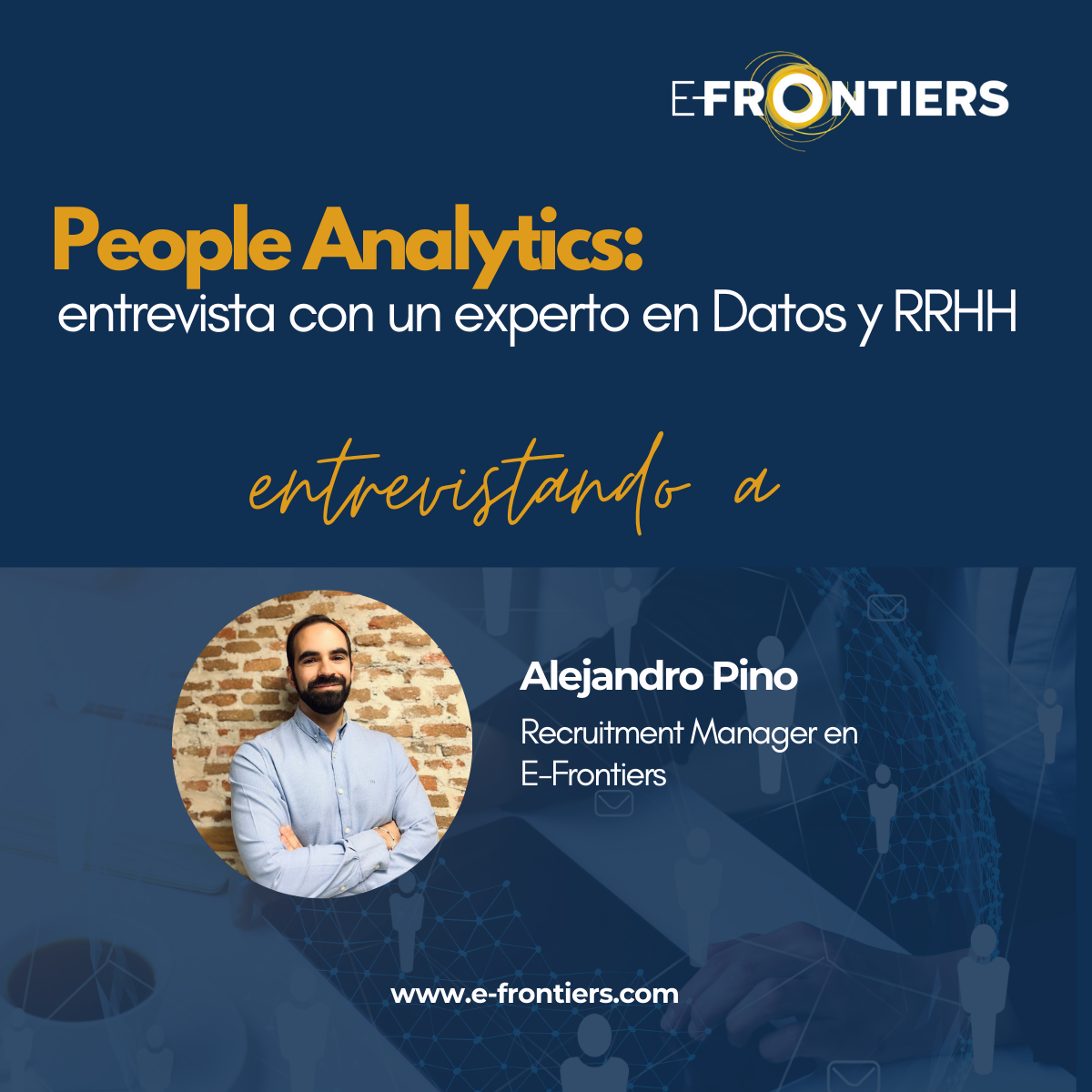
Alejandro Pino es Recruitment Manager en E-Frontiers y cuenta con una amplia trayectoria en el ámbito de los Recursos Humanos. Su experiencia en empresas privadas y como docente, combinada con una visión estratégica y un enfoque analítico, lo convierten en una voz referente en la intersección entre datos y gestión del talento.
El People Analytics ya no es opcional: es clave para gestionar talento con visión estratégica. Las compañías que lo adopten estarán mejor preparadas para atraer, retener y desarrollar a sus equipos. Si quieres llevar tu estrategia de reclutamiento al siguiente nivel, nuestro equipo de expertos en atracción de talento puede ayudarte a integrar soluciones innovadoras y basadas en datos. Contáctanos y descubre cómo podemos encontrar el mejor talento para tu organización.
