• Submit Resume
  • Submit Job
  • +353 (1)6854000
  • info@e-frontiers.ie
  • facebook-icon linkdin-icon twitter-icon twitter-icon
Back

Industry Insights

Interviews: How to Answer the Questions Everyone Dreads

Got an IT interview coming up? Here’s how to prepare: what employers really want and how to handle interview questions that can leave even experienced candidates stuck.

Getting invited to an interview is a good sign. Your CV has done its job. The employer has looked at your experience and decided there is enough of a match to spend some time getting to know you.

Now comes the slightly trickier part: convincing them that you’re the right person for the role.

For IT professionals, that can mean a mixture of technical questions, problem-solving scenarios, competency questions and plenty of questions about your experience, communication and how you work with others.

And then there are the small questions that everyone seems to dread.

“Tell me about yourself.”

“What’s your biggest weakness?”

“Why are you leaving your current role?”

And, inevitably:

“Do you have any questions for us?”

Knowing your technology is one thing. Being able to talk confidently about your experience is another.

The good news? Interviewing is a skill. And like most skills, it gets better with a bit of preparation.

What are employers really looking for?

An interview isn’t just about checking whether you know your Java from your JavaScript or your AWS from your Azure.

Employers want to understand how you think, how you work and what you can bring to the team.

So don’t think of an interview as an exercise in repeating your CV.

Think of it as your chance to prove the experience behind it.

Prepare your examples, not a script

One of the biggest mistakes candidates make is trying to prepare a perfect answer for every possible interview question.

Don’t.

Instead, think of five or six good examples from your career that show different skills.

For example:

– A technically difficult project

– A problem you solved

– Something that went wrong

– A successful project or achievement

– A difficult stakeholder or team situation

– A time you had to learn something quickly

– A time you took ownership or led something

You can use these examples to answer lots of different questions.

For competency-based questions, STAR is a useful way to structure your answer

Situation – What was happening?

Task – What did you need to achieve?

Action – What did you actually do?

Result – What happened?


It’s useful, particularly for questions beginning with:

“Tell me about a time when…”


But importantly: don’t make it sound like you’re using STAR.

Just tell the story naturally.

And pay particular attention to the A — Action.


IT projects are usually team efforts, so you’ll tend to naturally talk about “we”. But the interviewer needs to know what you did. Use enough detail to make your contribution and the outcome clear.

And the interview questions everyone dreads

“Tell me about yourself.”

Don’t panic. They’re not asking for your life story. Don’t start with your Leaving Cert results!

They’re looking for a short professional summary.

A good structure is:

Where you’ve worked → what you’re doing now → what you’re looking for next.

For example:

“I’ve been working in software development for around seven years, mainly across Java and cloud-based applications. I started in a smaller development team before moving into larger enterprise projects. In my current role, I’m focused heavily on backend development and AWS, and I’ve also taken on some mentoring responsibility. I’m now looking for a role where I can continue developing technically while taking on more responsibility within the wider team.”

Aim for around 60–90 seconds.


Why are you looking to leave your current role?”

This one needs a little diplomacy.

Even if the real answer is “because I can’t stand my manager”, that’s not the version you want to give.

Keep it positive and focus on what you’re moving towards.

For example:

“I’ve learned a lot in my current role, but I’m now looking for a new technical challenge and the opportunity to develop further in a certain area.”

Or:

“My role has changed quite a bit over the last year, and I’m now looking for something closer to the type of development work I’d like to focus on long term.”

You don’t need to pretend everything about your current job is perfect. Just keep the conversation professional.


“Why do you want to work for us?”

This is where a little research goes a long way.

Avoid:

“It’s a great company and the role looks interesting.”

Instead, connect something you’ve learned about the company or role with your own experience.

For example:

“I was particularly interested in the role because of the company’s move towards cloud-based platforms. That’s an area I’ve been focusing on over the last couple of years, and the opportunity to work on that at a larger scale really appeals to me.”

You don’t have to pretend it’s your lifelong dream to work there.

Just show that you’ve thought about why this role makes sense for you.

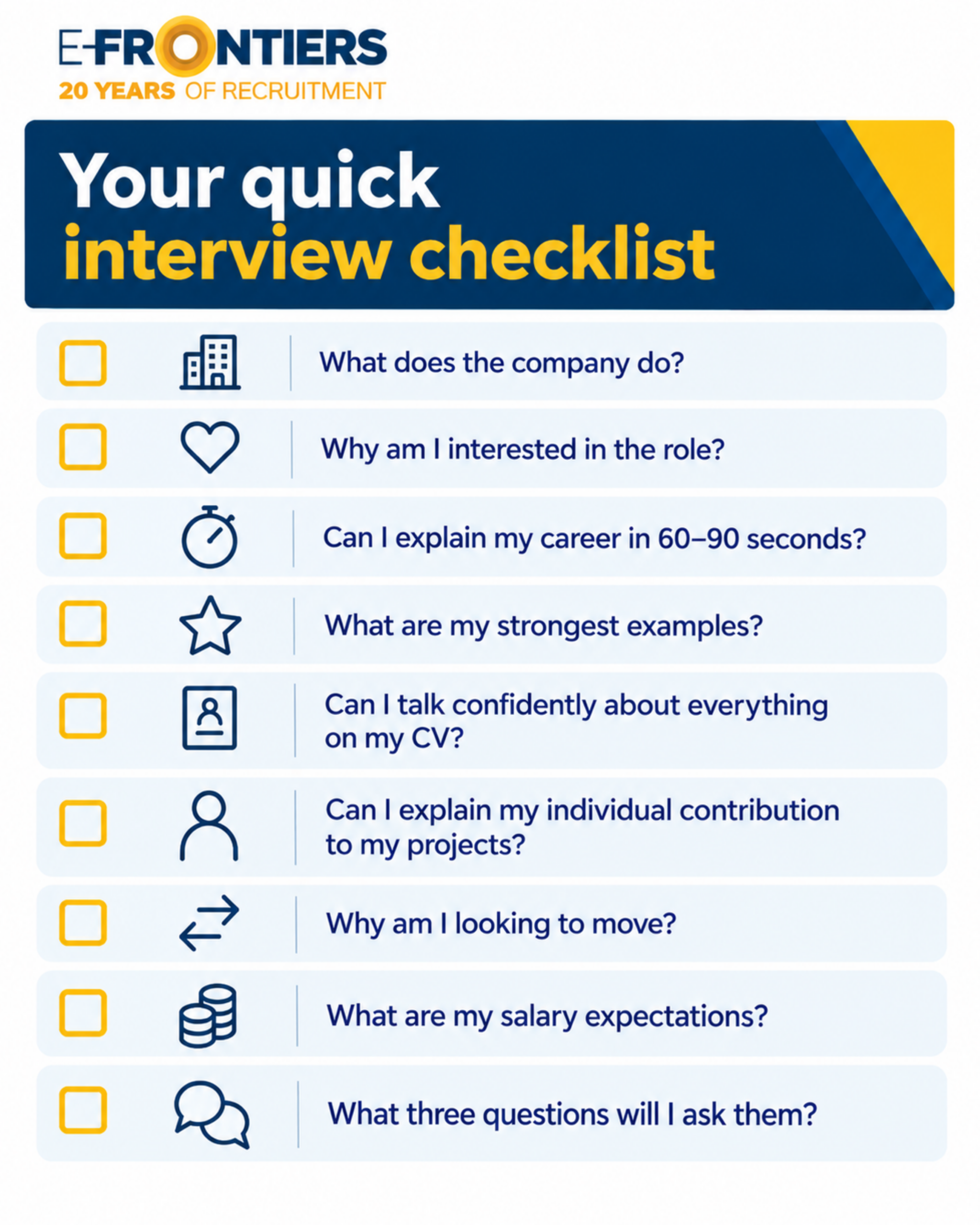
Use our handy checklists below before your interview!
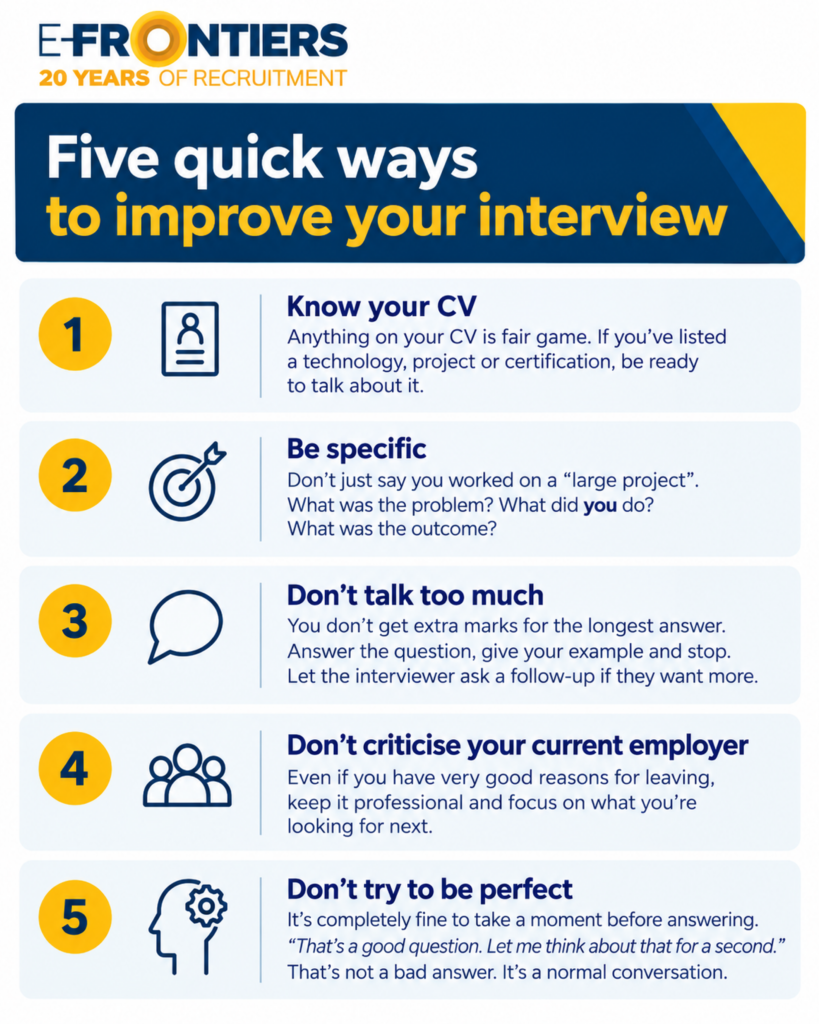
5 ways to improve your interview

“What’s your biggest weakness?”

How to turn a negative into a positive!

Please don’t automatically say: “I’m a perfectionist.”

Instead, choose something genuine that isn’t fundamental to the role and explain what you’re doing about it.

For example:

“Earlier in my career, I wasn’t particularly confident presenting to larger groups. I was comfortable communicating within a technical team, but presenting to senior stakeholders was something I found more difficult. I’ve deliberately taken on more presentation opportunities over the last couple of years and it’s something I’m much more comfortable with now.”

The trick is:

Weakness → awareness → action → improvement.

That’s much more convincing than pretending you have no weaknesses.


“Tell me about a time you failed.”

Don’t say:

“I can’t think of one.”

Nobody expects you to have had a perfect career.

Choose something genuine but manageable – for example, a project that ran over time, a technical decision that had to be changed, or a mistake that taught you something.

The important part isn’t the failure itself.

It’s what you did afterwards and what you learned from it.


“Tell me about a conflict you’ve had at work.”

Here, the interviewer just wants to know how you handle disagreement.

It could be a technical disagreement, conflicting project priorities, or a difficult stakeholder.

Focus on what you did to move things forward.

For example:

“We had different views on the best technical approach to take for a project. So, I suggested we go back to the requirements and test both of our approaches against them. That gave us a focus to work towards…”

That’s a much better answer than:

“We disagreed but eventually sorted it out.”


What if you don’t know the answer to a technical question?

Don’t bluff.

If you haven’t worked with a particular technology, say so.

For example:

“I haven’t worked directly with that technology, but I have worked extensively with …, which has some similarities.”

That’s a perfectly reasonable answer.

And if you’re given a technical problem that you can’t immediately solve, talk through your thinking.

Explain what you’d check, what information you’d need, and how you’d approach the problem.

Sometimes the interviewer is interested in how you think, not just whether you can produce the answer immediately.


“What are your salary expectations?”

Have a realistic range in mind before the interview, based on the role, your experience, and the current market.

If asked, give a range rather than locking yourself into one figure, and consider the full package – including benefits, bonus, pension, and flexibility.

You could say: “Based on the role and my experience, I’d be looking in the region of €X to €Y, although I’m open to discussing the overall package.


Don’t underestimate the final question

“Do you have any questions for us?”

Never answer this with:

“No, I think you’ve covered everything.”

Have a few questions ready.

For an IT role, you could ask:

“What would you want the person in this role to have achieved after six months?”

“What are the main technical challenges the team is working on at the moment?”

“Can you tell me a little about the team I’d be joining?”

“What are the plans for the technology environment over the next 12–18 months?”

“How do you support technical development and progression?”

And remember, this part works both ways. You’re interviewing them too.


Finally, don’t forget the person behind the CV

An interview isn’t an exam where every question has one perfect answer.

The employer really just wants to understand what you’ve done, how you approach problems, how you work with people, and whether you can contribute to their team.

So, prepare a few strong examples, know your CV, and be clear about your own contribution. You don’t need to know everything – the important thing is being able to explain what you know, how you think, and how you would approach the problem.

Your CV gets you through the door.

The interview is your chance to bring it to life.

If you’re preparing for an IT interview, speak to the E-Frontiers team. Our recruitment consultants work with candidates across IT and technology and can give you insight into the role, the company, and the interview process before you take that next step.

Please Contact:

Anca Antonica | Principal Recruitment Consultant | IT & Technology

https://e-frontiers.ie/

author avatar
Colette MacNamara

More Insights All Posts

View our industry experts opinion on all things recruitment, salaries, working from home and everything in between.