• Submit Resume
  • Submit Job
  • +353 (1)6854000
  • info@e-frontiers.ie
  • facebook-icon linkdin-icon twitter-icon twitter-icon
Back

Industry Insights

The Irish Recruitment Market – a look ahead to 2026

Introduction – Looking Ahead to 2026 

As we move into 2026, the Irish jobs market continues to show strength, but it’s operating in a world that feels far from predictable. Employment levels are strong, but global events, economic uncertainty, and fast-changing technology are shaping how businesses hire and plan their teams. Understanding where the market is headed – and what candidates want – is more important than ever. 

Current Irish Jobs Market

One of steady growth  

Employment Levels & Unemployment 

Ireland’s labour market finished 2025 with record employment, with approximately 2.82 million people in work and unemployment near 5.0%, one of the lowest rates in the EU, compared with 6.4% in the euro area and 6.0% in the EU.  

Employer Hiring Outlook

Surveys continue to show positive hiring intentions for 2026, with nearly one in four employers expecting to increase hiring in the year ahead and particularly strong confidence in the technology and construction sectors.  Irish Jobs –RTE article  

43% of employers plan to increase staff numbers, 39% expect no change, and just 14% anticipate reductions. Uncertainty remains low, with only 4% unsure of their hiring plans. Manpower Group Survey

Inflation

The annual average inflation rate in Ireland was about 2.2% in 2025, with food and services continuing to drive price increases. Consumer Price Index December 2025 – Central Statistics Office.  Forecasts expect inflation to average close to 2% in 2026. In the UK, Inflation remains above target, rising to around 3.4% in late 2025, though the Bank of England expects it to move closer to its 2% goal from April onwards. 

What Candidates Care About in 2026

Candidates’ priorities continue to evolve: 

Salary and compensation remain the top motivators, closely followed by work-life balance and role stability. Technical Skills Most Highly Sought-after Skills by Employers – Irish Tech News 

Opportunities for skills development and clear career progression are increasingly important, particularly in tech driven sectors. 

Remote and hybrid working continue to influence decisions: 41% of candidates now rule out roles without flexible options, highlighting how embedded flexibility has become in candidate expectations. IrishJobs salary and benefits trends for 2026 – IrishJobs Recruiter News 

Recruitment Market Trends

Insights from the Hiring Lab-Ireland-jobs-hiring-trends-report: 

 -Irish job postings are down from their post-pandemic peak but remain 7% above pre-pandemic levels. 

 -Job losses have remained limited, and unemployment is expected to stay near its current level of 5% in 2026. 

 -A tight labour market will keep wages rising in some sectors, so employers will need to compete as candidates expect real pay increases.  

 -Competitive pay, along with non-monetary benefits like flexibility and career progression, remains key to attracting and keeping talent.  

 -In 2025, postings mentioning remote or hybrid work hit a record 19.4% by December. 

 -Youth unemployment is rising: the rate for 15–24-year-olds reached 14% in December, the highest since mid-2021. 

 -By 7 June 2026, EU countries must implement the Pay Transparency Directive to help close the gender pay gap and support equal pay. EU Pay Transparency Directive 

 -Immigration will remain an important channel for labour, while AI adoption is reshaping how businesses structure and balance teams. 

In-Demand Skills

According to recent Irish Jobs research: 

– 69% of employers report difficulty finding candidates with the right skills. Median time to hire is 10 weeks. Technical Skills Most Highly Sought-after Skills by Employers – Irish Tech News 

– Technology and specialist digital skills: AI, data analytics, cybersecurity, cloud platforms, and software engineering remain among the most in-demand skills, with 30% of employers now prioritising technical skills. 

– Technical trades and industry expertise continue to be highly sought after across construction and engineering. 

– Employers increasingly value candidates who combine technical expertise with strong soft skills, such as leadership, problem-solving, and collaboration.  

– Construction remains the strongest hiring sector, with eight of the ten most in-demand roles in 2025 linked to the industry, including project managers, site managers, supervisors, and quantity surveyors. 

– Accountants were the second most in-demand profession, with demand increasing by 39% in 2025. 

Insights from our Recruitment Specialists  

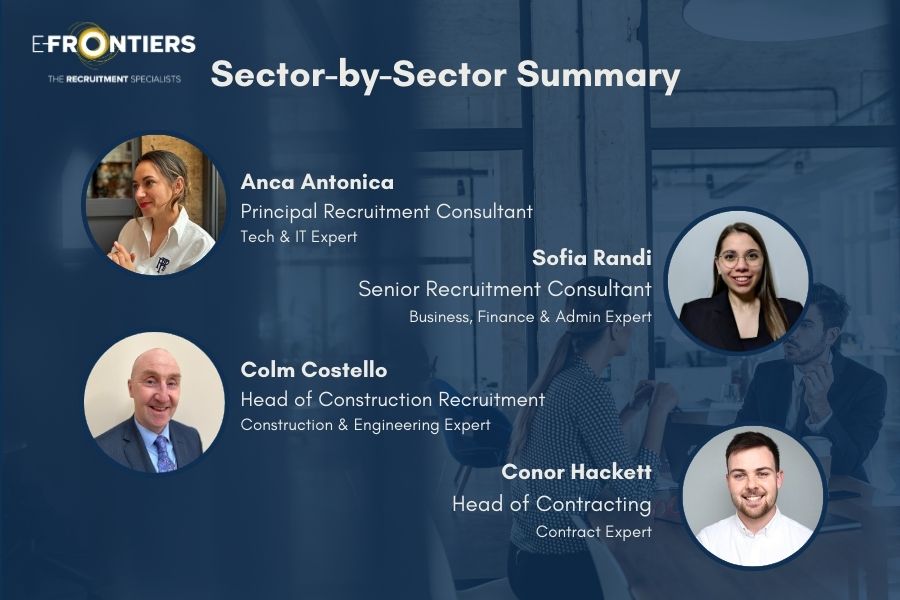
Alongside broader market trends, our recruiters share what they’re seeing on the ground – from hiring patterns to emerging candidate priorities, and sector challenges. 

IT

Anca Antonica | Principal IT Recruiter 

Demand remains strong across consultancies, fintech, and product companies, particularly for skills in cloud, DevOps, AI, data, and software engineering. Candidates prioritise flexibility, project stability, and technical leadership, while standout employers offer clear career paths, modern tech stacks, and exposure to critical platforms. Skills shortages and slow decision-making in larger firms remain the main challenges. Companies treating engineering and platform teams as long-term investments are attracting and retaining the strongest talent. 

Business 

Sofia Randi | Senior Recruiter 

Steady but cautious growth is expected, with roles becoming broader and more commercially focused. Candidates value flexibility, meaningful work, and progression, and employers that offer hybrid-first setups, faster hiring, and clear career paths stand out. Hiring timelines and mid-to-senior talent shortages remain the main challenges. Companies that move fast, stay flexible, and communicate well attract the best business talent. 

Construction

Colm Costello | Head of Construction Recruitment 

The market is highly competitive for experienced engineers, site managers, and commercial professionals. Candidates are now more selective, weighing salary, project location, work-life balance, and company culture. Skills shortages at mid-to-senior levels persist, and there is high demand across multiple project types. Recruitment is now a strategic process: early engagement, swift decisions, and partnering with specialist recruiters enhance success. 

Contracting

Conor Hackett | Head Of Contracting UKI 

Demand is rising as companies prioritise flexibility and strategic project-based hiring, with overall Irish market growth forecast at 6% in 2026. Contractors look for higher rates, remote/hybrid options, and clear project scopes, and they very much value streamlined onboarding and rapid decision-making. Skills shortages – particularly in tech-enabled roles – remain the biggest challenge with 96% of Irish employers reported shortages in 2025.  Employers increasingly favour skills-based hiring for short-term, high-value expertise. 

Conclusion – Making the most of 2026 

The Irish recruitment market in 2026 offers plenty of opportunities, but it also requires a careful and flexible approach. Employment remains strong, demand for specialist skills is high, and candidates are placing more value than ever on flexibility, career progression, and stability. 

Even with easing inflation, global factors mean the market can change quickly. Employers who stay close to trends, act fast, and adapt to candidate priorities will be best placed to attract and retain the right talent. 

Let’s Talk 

If you’d like to discuss any of the trends in this report or chat about your hiring plans for 2026, feel free to contact Nigel Bolger, Commercial Manager. He’d be happy to have a conversation and explore how we can support your team. 

Nigel.bolger@e-frontiers.ie 

Ph: 086 3888147  

author avatar
Cristina Rafael

More Insights All Posts

View our industry experts opinion on all things recruitment, salaries, working from home and everything in between.