



The rise of hybrid working as a key job seeker demand
Hybrid working has become more and more ingrained as a benefit that many candidates will demand when seeking a new role. It has evolved into a coveted benefit for job seekers and in many cases, candidates will put a tangible value on this benefit by valuing it as much as, if not more than, a higher salary.
As the workforce landscape continues to adapt, employers are faced with the challenge of striking the right balance between remote and in-office work. Many employers are looking to increase the number of days their employees return to the office to build a culture, enhance team collaboration, or simply keep up with what’s going on through informal chats with colleagues.
To that end, what is the status of hybrid working/working from home almost four years on from the outbreak of Covid?
Big Tech’s response to hybrid working
In September 2023, Meta paid £149 million (€171 million) to break its lease on a major London development near Regent’s Park. This was reported as being due to increased levels of hybrid working as well as part of a cost-cutting exercise. The news is the latest sign of Big Tech’s determination to control costs by scaling back its office footprint as more staff work from home. The tech contraction has hit cities such as San Francisco that rely heavily on tech companies. Office tenants and European markets including Dublin and London have not been spared.
Indeed, there are other more specific examples of companies embracing Hybrid working models with open arms. For example, in a recent radio advertisement, one of the Big4 consultancy firms promotes a unique hybrid working benefit, allowing employees to work abroad for up to 20 days during the summer months. Conversely, certain Financial Services companies advocate for a more traditional approach, requiring employees to be present in the office for four or five days each week.
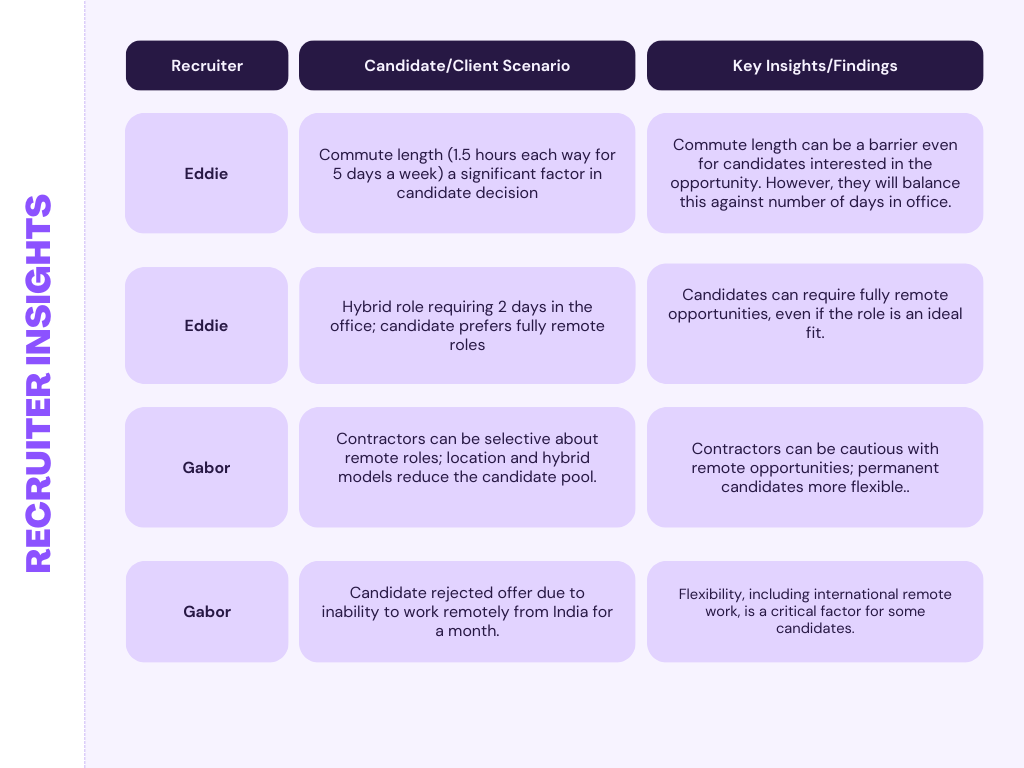

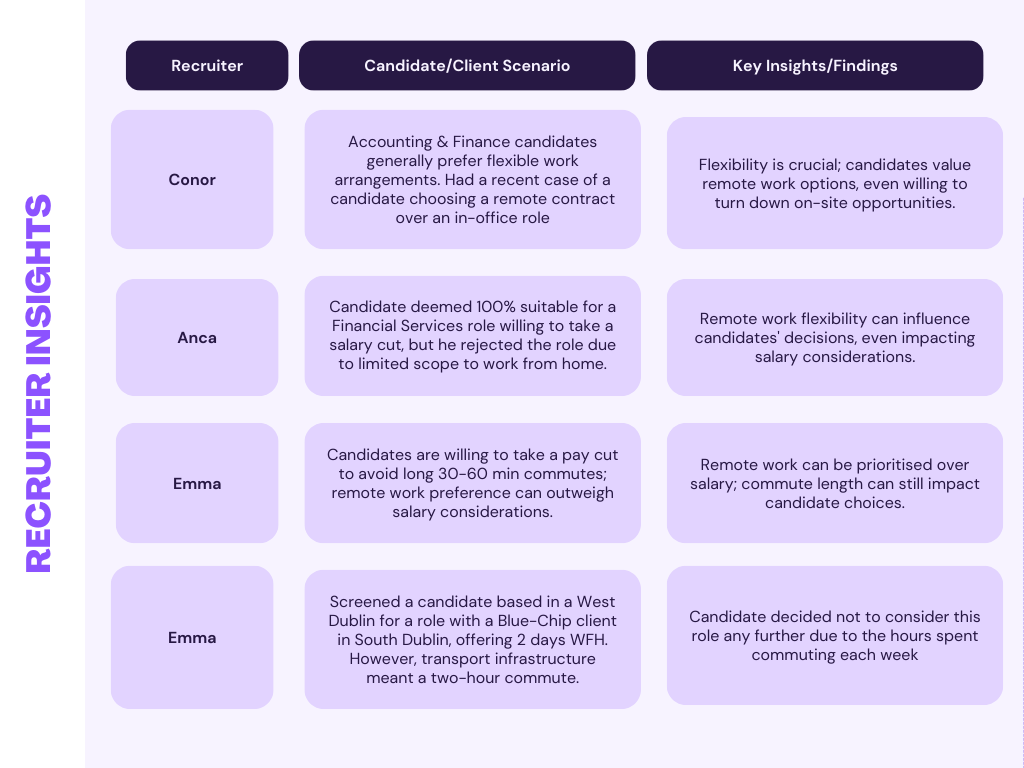
Hybrid working’s influence on recruitment and retention strategies
So, whether an organisation embraces or resists the evolving working environment, its ‘Working from Home’ policy significantly influences recruitment and retention strategies. Real-life examples gathered from our team of recruitment consultants shed light on the practical implications for companies seeking to attract and retain top talent in this dynamic landscape.
Conclusion
In conclusion, we are seeing that more and more candidates are requesting flexible Hybrid working models as a basic benefit when considering new roles with many forward-looking employers open to considering employee demands.
Embracing this as an employer can give a distinct advantage when attracting staff. These benefits range from expanding the pool of applicants from diverse locations, tapping into specialised and niche skillsets, and delivering a better work-life balance to staff. Additionally, offering hybrid work options becomes a compelling benefit in situations where there may be constraints on salary.
Author Nigel Bolger is the Commercial Manager at E-Frontiers.
Please feel free to get in touch with our commercial team to discuss your recruitment needs:
IRE: Nigel Bolger : nigel.bolger@e-frontiers.ie (m: 00353 86 3888147)
UK: Kenneth O’ Connor : kenneth.oconnor@e-frontiers.com (m: 0044 740 365 1213)

In the ever-evolving landscape of jobs and new career opportunities, where competition for top-tier talent is fierce, having a robust employer brand is a game-changer. In today’s world, it is critical to the success of an organisation as it plays a key role in attracting new talent to the company. It’s not just about finding the right people; it’s about making your company the irresistible choice for the best professionals. Let’s investigate the strategic world of employer branding and explore how you can stand out in the competitive job market.

1. Know Your Identity:
Start by understanding and defining your company’s identity. What sets you apart? Identify your core values, mission, and the unique aspects of your workplace culture. For potential employees, having this knowledge, will increase the number of applicants, and help in attracting the best fit. A positive employer brand can contribute to employee satisfaction, engagement, and loyalty, and reduce staff turnover rates.
Engagement and productivity are known to rise when your employees feel connected to your brand and understand their part in the overall company vision.
2. Showcase Company Culture:
Potential candidates want to envision their day-to-day in your workplace. Highlight your company culture through employee testimonials, office photos, and glimpses into team activities. A positive, inclusive, and supportive culture can be a powerful draw for prospective employees. From experience we know that job seekers look for employers that offer a good balance between work and personal life and genuinely care for their employees and their wellbeing.
3. Craft a Compelling Story:
Every brand has a story, and so should your employer brand. Share your journey, milestones, and the impact your business has had. Make it relatable and inspiring to resonate with potential candidates.
4. Leverage Online Platforms:
In the digital age, your online presence matters. Optimise your company website and social media channels to reflect your employer brand. Be consistent with your messaging across platforms as this creates a cohesive and memorable image for followers.
5. Employee Value Proposition (EVP):
Define and communicate your Employee Value Proposition. What unique benefits and opportunities does your company offer to employees? Whether it’s professional development, a flexible work environment, office perks, or wellness programs, make the benefits and advantages of working for your company well known.

6. Engage in Thought Leadership:<
Position your company as an industry leader by sharing insights, trends, and knowledge. This not only attracts top talent but also lends credibility to your brand and establishes your business as a go-to source in the field.
7. Prioritise Diversity and Inclusion:
Inclusive workplaces are attractive to a diverse pool of candidates. Showcase your commitment to diversity through initiatives, policies, and success stories within your organisation.
8. Employee Recognition Programs:
Implement and showcase employee recognition programs. Acknowledging and celebrating achievements creates a positive work environment and signals to potential candidates that their contributions are valued. When candidates feel valued, it serves to enhance your company’s reputation. Companies can do this through learning programs, feedback channels, rewards, and opportunities for career growth.
9. Seamless Recruitment Process:
The recruitment process is the first interaction the company will have with a potential employee, and it is critical. A positive candidate experience is an integral part of your employer brand. Make it smooth, transparent, and engaging to create a positive impression for prospective candidates. Streamline the process, provide timely feedback, and ensure a smooth transition from application to onboarding.
10. Monitor and Adapt:
Nothing stays the same forever. Regularly assess the effectiveness of your employer branding strategies. Building a brand is an ongoing process and is affected by outside influences and industry trends. Seek feedback from current employees and candidates and be open to adapting your approach.
In today’s environment, your employer brand is your secret weapon. By strategically showcasing your company’s identity, culture, and values, you create a magnet for top-tier talent.
Use your recruitment partner to your advantage. Recruiters can have significant influence and play a pivotal role in the hiring process.
It’s essential to acquaint your partnered recruiters with your company values and culture. They can sway candidates’ choices and use their connections to identify ideal matches from their pool of passive candidates.
As your recruitment firm, at E-Frontiers, we work with you, highlighting your employer brand in the talent market. As 2024 approaches, we encourage you to enhance your brand and see the difference it will make.
Get in touch with us to see how we can help you gain better insights into the priorities of candidates in the current jobs market.

If you have gone through the process of applying for a new job in recent times, then you will know that the landscape of interviewing has undergone a huge transformation. This is largely driven by the change in work dynamics due to the pandemic, coupled with advancements in technology. The traditional in-person interview, once the undisputed standard, and the only real way to secure a new job, now shares the stage with remote video interviews.
The assumption may have been that all would revert to ‘normal’ once we got back on our feet after the pandemic, but that had not been the case. Much like the office vs remote working conundrum, it would seem increasingly evident that remote interviews are here to stay in the evolving world of recruitment and hiring.
This raises the questions of which is the better approach and which do candidates prefer?
In a recent LinkedIn poll of 474 candidates who were asked what their interview preference was, a resounding 55% responded with the choice of ‘Remote video is the way to go’. This coupled with a strong response of 30% for the choice of ‘In-Person only for the final stage’, means a whopping 85% prefer remote video interviews. ‘Always in-person is best’ scored just 15%. Certainly food for thought for clients.
Let’s take a more in-depth look at the pros and cons:
In-person interviews have long been considered the gold standard for evaluating candidates. Not only can they assess the candidates’ qualifications, but they offer a personal touch, allowing candidates and interviewers to establish a direct, immediate connection. Perfect for showcasing soft skills.


In-person interviews also offer an insight into the company’s culture and environment, giving candidates a genuine feel for the company and potential new colleagues and thus helping to gauge compatibility. However, in-person interviews can be logistically challenging and simply not feasible for candidates who live in different locations or countries.
On the other hand, remote interviews are convenient and accessible thus offering undeniable advantages. They save time and resources and enable access to a much wider pool of talent simply due to not having any geographical constraints. They can also be less intimidating for some candidates, allowing them to showcase their skills without the anxiety often associated with face-to-face interactions.
At E-Frontiers, we recently conducted some research into this and asked the question ‘what do candidates prefer?’
Our team of recruiters report similar experiences to the above findings:
John Ryan, Technical Recruiter, reports that ‘candidates are still very keen to do remote interviews, purely for convenience as much as anything else. But, when it gets to the 2nd stage and they are onsite interviews, they are happy to attend, meet potential new employers, and see the site’.
Similarly, Eddie McAndrew, Recruitment Consultant for engineering and customer success roles at E-Frontiers, has found with recent roles that ‘2 stage interviews have proved most popular. The first stage is via teams, with the second onsite. It is rare that an offer will come without the client meeting the candidate face to face. Candidates prefer Teams interviews but generally for second stage interviews they are always comfortable with onsite, as they usually want to get a feel for the office and get to meet who they will be working for’.
This research tells us that the ideal approach for clients is not a one-size-fits-all solution. While the nature of the role, the industry, and personal preferences must be considered, a hybrid model that combines in-person and remote interviews seems to be the most promising path forward. And I think is the best solution for clients to ensure good hires.
Certainly, initial screening rounds and tech assessments can take place remotely and clients not already doing this should consider moving towards it. This works in accommodating obvious candidate preferences for video and works in favour of the client by casting a wider net to a broader talent pool and bringing efficiencies and inclusivity to their hiring process. In-person interviews can then be reserved for the final critical stages, where cultural fit and deeper personal evaluations are important.
Conclusion
The changing landscape of interviewing highlights the importance of flexibility and adaptability in the hiring process. Employers should adopt a flexible approach and consider a mix of both in-person and remote interviews, offering candidates genuine options. By embracing this diversity in interview formats, organisations can ensure they are making the best and most informed hiring decisions.


Feel free to get in touch with our commercial team to discuss your recruitment and resourcing needs:
IRE: Nigel Bolger : nigel.bolger@e-frontiers.ie (m: 00353 86 3888147)
UK: Kenneth O’ Connor : kenneth.oconnor@e-frontiers.com (m: 0044 740 365 1213)

Python is the 2nd most popular coding language, taking over the old reliables such as Java and .Net. Octoverse reported in 2022 that Python continues to see a surge in its usage across GitHub, experiencing a remarkable 22.5% year-over-year increase. This is no surprise given the advantages Python has.
-It’s easy to learn
-has an impressive library
-It is such a versatile language with a vast spectrum of applications, from Web Development to Automation, Machine Learning, Data Science, and AI


But more importantly, Python has a strong community and fosters collaboration. PyCon conferences are famous around the world with hundreds of Pythonistas attending every year. E-Frontiers has been a regular sponsor of PyCon Spain over the years, but this year we have moved our focus closer to home.
Our Recruitment Operations Manager, Alexandra Pop, has recently attended PyCon Ireland as a speaker. PyCon Ireland was organised by Python Ireland, and it’s now a fixture in the calendar for November. This year’s conference took place at Radisson Blu and the chairperson, Nicolas Laurance, put together a great team of staff and volunteers that delivered an excellent 2 days of networking, workshops, and talks.
PyCon Ireland 2023 featured an extensive and diverse range of talks, covering various Python-related topics. Insights on architecting dashboards and exploring AWS automation. Real-world applications of AI with AWS SageMaker. From Python’s latest updates and improvements to its applications in Quantum Computing and AI, the conference had something for everyone.
Important topics such as Python education, AI Biases were also addressed, and there was a mix of workshops where new and experienced Pythonista came together to share and collaborate.
It was interesting to see that the community is collaborating and making advancements in the areas that Python is lacking, such as improving speed and performance. It’s safe to say that the popularity trend will continue.
Alexandra spoke with a few of the attendees about the latest applications in AI, the trends that they are seeing, and the challenges that they are experiencing. The consensus is that while AI is growing and the buzz around it makes it a must-have for a lot of organisations out there, it is very hard to implement and adopt it in a way that will improve productivity and efficiency unless data quality is not there. The advice from the Python community is before adopting and implementing AI, make sure you know exactly what issue you are looking to solve and review your data first.
One of the final talks of the conference was delivered by Alexandra, and the focus was on applying Python coding principles to a job application, from CV writing to the interview. The session was very successful with a mix of graduate and senior engineers attending and taking great interest in how to approach the job search in the Irish Market and what the best ways are to showcase your skills to a potential employer. You can view Alexandra’s presentation here, and the talk will soon be uploaded on the Python Ireland Youtube channel.
It has been a great experience to meet and talk with the Python talent in Ireland. It’s great to see this area growing, and graduates taking a big interest, it is for sure one with a bright future.
Thinking about a new job?
The typical pathway to finding a new job involves anything from 5-12 steps. Yes, you read that right, up to 12 steps! And let’s face it, most of these steps are far from enjoyable for you as the candidate. At E-Frontiers, we can take the pain out of the recruitment process for you when looking for a new job. Our goal is to make the recruitment journey as seamless and stress-free as possible for you. We value your time and strive to provide a positive and transparent experience at every step. This really is the main reason you need to consider working with one of our recruiters for your next new job search.

The difficult part
You are probably already familiar with the drill. A huge amount of time is spent trawling through job ads online, working your contacts and network. Seemingly never-ending rounds of CVs and applications, sent out with very little in return.
Trying to decipher cryptic job specs to determine who the job in question is looking for, you or perhaps indeed a superhuman. It’s time-consuming, stressful, and sometimes overwhelming, and it’s all too easy to give up too soon before you’ve gotten near to landing your dream job or getting your foot onto the next rung of the career ladder.
Make it easier for yourself!
The value we bring to the recruitment process? Simple. We can cut through the noise and do it in 4 steps for you!
Let’s simplify the recruitment process. With continuous communication and support throughout from E-Frontiers, we can reduce this process to 4 steps. Meet, Chat & Plan; Evaluate Opportunities; Interview Stage; Onboarding!
As the recruiter, we know the client and what they are looking for. Your recruiter will have the real low down on whether you are in with a decent shot at securing the position– answering the all-important question ‘Where am I in the running?’. You can then decide whether to invest more time and energy in this application or cut your losses and move on to the next opportunity.
Keep your options open
There are many opportunities out there and it can be easy to miss out on the best and most suitable of them as you concentrate all your time on one option. Your recruiter can avoid this pitfall by planning and thinking ahead for you.
We look at other suitable roles and opportunities as they arise and will apply and start the process on your behalf. This means you have the time to focus on one process at a time, without getting frazzled and stressed about the ‘what ifs’.
How E-Frontiers can help
You can conduct your job search the hard way as just described above, or the easy way. So, what happens with the easy way? Our recruiter will put the time in for you. While you concentrate on your day-to-day, your recruiter will do the leg work for you. The background research. The detailed job applications. The due diligence on whether the position and company are a good cultural fit for you.
We will give you direction and ideas on upskilling, based on what your peers in the same industry are investing in. You will receive lots of CV advice, and we know that making the appropriate CV changes and improvements BEFORE the job application will hugely increase your chances of getting an audience with the client.
Use your recruiter to your advantage
Your recruiter is your ally. Meet up for a coffee and chat and take advantage of their resources and their knowledge of the position and client. We want you to succeed and will do everything we can to make it happen. Quite often, client interview processes can be longwinded, going the route of stop, start and stop again, and are generally fraught with difficulties and stress. Your recruiter will be on hand to support you through this on a daily and weekly basis, giving meaningful feedback and providing you with a genuine insight into what is going on with the client. This way you don’t feel alone in the process or feel like there’s no hope and give up.
Help is always at hand
If you are shortlisted for the interview stage and need help, you have the option of using the services of an interview coach. We will help with coaching you on the questions and answers to consider, and give you inside tips on what the client is looking for so you can then tailor your responses accordingly. We’ll give you proper feedback after each stage and further advice and insights for the next stage.
Conclusion
And once you secure the role, our support doesn’t end there. We are on hand to help you with your negotiations on benefits, salary, and your total package and onboarding experience. The lines of communication always remain open, and we are a phone call away if you need our expertise at any stage, now, or indeed into the future when the time is right to consider your next move.
Contact any member of our team today to discuss options for your next career move.
Did you know that only 1 in 8 candidates manage to get past the first interview? Securing a job interview is a crucial milestone in pursuing your dream job. However, even the most talented candidates can sometimes stumble and make mistakes during the interview process, resulting in rejection.
We have collected feedback from over 690 first interviews conducted across Ireland this year. Here, we highlight some common mistakes our clients have pointed out as the reasons for rejecting candidates. To help you avoid these pitfalls, our recruiters offer valuable advice and insights. So let’s take a dive into the most common mistakes candidates make in an interview.

1. Inability to expand on technical skills.
The core aspect of the interview process for IT roles primarily revolves around assessing your technical expertise. Whether or not you are tasked with a preliminary technical exercise, it remains crucial to proficiently articulate and showcase your skills and problem-solving approaches.
Advice: Give examples…
A valuable guideline to follow is that if a particular skill is listed on your CV, you should be capable of explaining when and how you’ve applied that skill, as well as demonstrating the depth of your knowledge in that domain. The best way to do that is by giving a few examples of projects where you’ve applied it and the thought process behind using the technology of choice.
2. Inability to discuss experience
Candidates who struggle to articulate their past experience, fail to impress employers. A good idea would be to apply the STAR method when putting together your answer. That will touch on the situation, task, action, and result of the skill you are looking to prove your experience in.
Advice: Use the STAR Method…
For example, if you are asked to outline your experience in API integrations, you should start by summarising your experience and then proceed into giving details about:
-Situation- Projects that involved API
-Task- Your responsibility on the project in respect to API
-Action- How did you go about completing your tasks
-Result- what was your contribution to the project
You need to find the right balance between giving a detailed answer and talking too much, but practice makes perfect. Write your answer down and make sure to assign the time to prepare before the interview.
3. Negative remarks about previous employers
If you are one of the unlucky ones and have experienced a bad working environment or a manager that you clashed with, I’m sorry you had to go through that. I know, we are all human, and frustrations and emotions can play a part in some situations. However, there is a place and time for giving out about your previous employer or colleagues, but during an interview is not the place. Keep that discussion for your closer acquaintances and focus on opportunities for career progression, learning and development, and exploring new challenges.
Advice: A new opportunity awaits…
Think about the interview as an opportunity to start a new positive experience and this all starts at the interview stage. Negative remarks will only damage that clean slate. If you do need to address a previous conflict, the best way to go about it is to focus on acknowledging your mistakes and the lessons learned. The other party is not being interviewed here, you are!
4. Culture fit and interest
Would you accept an offer from a company you have no interest in? Or if there is a misalignment between their values and yours?
It’s a two-way street and as much as you need to impress in an interview, it’s important that you get a good feel about the company and the culture to ensure that it’s a place where you would actually like to work. In preparation for your interview, you should review their values, and check their social pages and Glassdoor reviews to try and get a feel of what they are as an employer.
Advice: Ask the right questions…
But, don’t stop there, remember, you need to show interest. How to do that you ask? By asking questions! What is it like working for you? How do you give back to the community? How do you support your employees with their career development goals? What will onboarding look like? Their answer will give you a sense of how they treat their employees and what the day-to-day will look like.
Advice: Demonstrate your research…
Another great way to show you’ve done your research and that you are keen is to reference the things you know about the employer. For example, ‘I saw you are branching out into AI, that is so interesting, I’m very passionate about that field and would love the opportunity to be part of that initiative.’
Conclusion
Interview failures can often stem from these common mistakes made by candidates. By addressing these, candidates will greatly improve their chances of success. Our recruiters play a crucial role in guiding candidates to avoid these common pitfalls, to be prepared, and to thus optimize their interview performance.
Please don’t hesitate to reach out to us and our team of recruiters for interview help and career advice.
.

Preparing your CV can be a daunting challenge no matter how much experience you have in your chosen field.
Once the decision is made to start looking at the market the prospect of putting together a CV can be enough to make you change your mind!
Before you begin
Before you even begin I always advise candidates to spend some time looking at different job specifications. This allows you to focus on the type of role you are looking for.
Taylor your CV to apply to different companies
When it comes to submitting your CV, one size doesn’t fit all but it’s important to spend some time putting together a core document. This may be time consuming initially but will be worth it in the end.
Tailor your CV to each position that you’re applying for, reflecting the language used and highlighting the experience that is directly relevant to the role.
How many pages?
It doesn’t have to be two pages but the most important information should all appear on the front page.
I’m a big fan of a “Professional Profile”, a short paragraph at the beginning that summarises the information below. It should briefly list years of experience, professional qualifications and industry experience as well as providing a few lines of a career summary. This allows the reader to get a feel for the applicant but should be interesting enough to encourage them to read on.
When you’ve been in the workplace for over 20 years it can seem hard to reduce a wealth of experience to a few pages. A CV is a door opener and should hit the right notes, these can then be expanded on in an interview.
Important details
If you’re looking for permanent employment your two most recent roles are the most relevant. Briefly introduce the company and then describe your role there by title followed by bullet points. The information should be easy to read, if the type is small and the document is densely written it’s unlikely that someone will battle through.
It should almost feel like the relevant information is jumping off the page rather than something that has to be combed through with a magnifying glass. Try to remember that it’s likely your CV will be one of many readers that day and you want it to be easy on the eye!
Earlier or more junior roles don’t need to be included in any great detail. The only exception I’d make to this point is to say that if the industry or work experience is directly relevant to the role you want, then include it.
The same goes for hobbies and interests. A brief mention is fine but if it’s not relevant to the role then it’s not so important that you were captain of the school’s debating team!
Questions – Answers
Use the CV to answer any questions that may arise on reading. If you have a gap in your career a few lines explaining it is better than hoping that the missing year won’t be noticed!
References
I don’t think that references should be included on a CV. Your referees can make the difference between whether or not you get a role. If they’ve received 10 calls to talk about how wonderful you are they may not be so patient when the important call comes.
Remember, you may be or may have been in a hiring position. Think about what you want to see from a CV. Taking the time to write an interesting and relevant document is actually a form of interview preparation! It focusses the mind and allows you to mentally prepare for questions that may arise when you’re face to face.
Do not hesitate to reach out to us. Send us your CV, our recruiters will contact you if they find a job that suits you the best and supports you through the interview process.
Good luck with the search!

If you find yourself facing a layoff or affected by a layoff, here are some steps you can follow to navigate this challenging period successfully.
Process the news
Allow yourself time to process the news. Experiencing a layoff can be distressing, and it’s normal to feel upset or anxious about it.
Reflect on your tenure at the company.
Make a list of what you enjoyed, what you didn’t, and the lessons you learned. These insights can serve as a starting point for identifying your next career path.
Think about your financial situation
Evaluate your financial situation and, if needed, apply for unemployment benefits. This can provide some financial stability while you search for a new job and prevent you from hastily accepting an unsuitable role.
Update your CV and online profiles
Update your CV and LinkedIn profile, emphasizing your skills and achievements from your previous job. Tailor your application materials to suit the types of positions you are now interested in pursuing.
Reach out to your network
Including friends, family, former colleagues, and trusted recruiters. Inform them that you’re actively seeking new job opportunities and inquire if they have any leads or referrals. Attend industry-related events like job fairs, workshops, and Meetups.
Start your job search
Actively apply for jobs by utilizing online job boards, social media, and company websites, and engaging the assistance of a recruiter. A recruiter can help streamline your job search process and cut through the noise.
What about upskilling?
Consider upskilling if there are gaps in your skillset that are currently in demand in the job market. Take relevant courses or obtain certifications to enhance your qualifications.
Remember that a layoff does not define your worth or abilities.
Patience and perseverance will eventually yield positive outcomes. Seize this opportunity to reassess your career goals and find a job that aligns with your aspirations.
The E-Frontiers team will be delighted to assist you in the search for new professional challenges.
If you or your friends want to learn more about the IT opportunities in Spain, check for it on our job page, or feel free to say hi to Teresa via her LinkedIn or teresa.quintana@e-frontiers.ie.
Teresa Quintana Niñerola | Technical Recruiter
In a recent webinar hosted by Anca Antonica and Paula Coffey from E-Frontiers Recruitment Agency, technology enthusiasts and industry professionals had the privilege of gaining valuable insights from Paul Lynch, the Co-founder of Showtime Analytics. This captivating webinar took participants on a journey through Paul’s extensive career in tech entrepreneurship and his experience in revolutionising the cinema industry through data analytics. Let’s dive into the highlights of this engaging discussion.

Exploring Paul’s career
Paul’s journey in technology began at a young age, influenced by his father’s role as a software developer. Growing up with computers in his household, Paul’s fascination with technology drove him to attend coding schools and develop his skills in building flash games and applications. His early exposure to technology laid a solid foundation for his future endeavours.
Starting his career at Vision, a consultancy firm, Paul gained a wealth of experience working across various industries. He highlighted the advantages of working in consultancy, where he had the opportunity to reinvent himself with each new client. This exposure allowed him to learn from talented individuals and strengthen his technical and business acumen.
Paul’s career path took an exciting turn when he joined Acceleration, a product-focused company within Vision. This experience made him realise his passion for working on innovative products, which led him and his co-founder, Richie, to establish Skupe Net—a global classified ads venture. While the ideas were promising, Paul acknowledged that the company faced challenges in implementation and eventually pivoted to focus on the lucrative motor industry.
Embracing the Value of Failure
During his career journey, Paul had a profound realisation about the importance of embracing failure and learning from it. A job interview that emphasised the need for a “fail fast” approach shaped his perspective. This valuable advice inspired him to constantly assess the value his initiatives provided to customers and iterate accordingly.
The Birth of Showtime Analytics
Paul’s passion for data analytics and an opportunity within his family’s cinema business sparked the birth of Showtime Analytics. Recognizing the data-rich nature of the cinema industry, Paul and his team aimed to provide actionable insights by consolidating and leveraging data assets. Their efforts quickly positioned Showtime Analytics as a leading player in the cinema data realm, working closely with cinemas and now expanding to collaborate with studios.
Paul Lynch’s webinar presentation illuminated the transformative power of data analytics in the cinema industry. His personal journey showcased the importance of early exposure to technology, embracing failure as a catalyst for growth, and the incredible potential of data-driven decision-making. As the co-founder of Showtime Analytics, Paul continues to drive innovation and empower the cinema industry with actionable insights derived from data.
Relationships between Showtime Analytics and E-Frontiers
Paul mentioned the relationship between Showtime Analytics and E-Frontiers recruitment has been mutually beneficial. Showtime Analytics values the screening and recruitment services provided by E-Frontiers, ensuring a more efficient hiring process. Additionally, E-Frontiers’ insights into various markets and their expanding technical talent pool have proven invaluable to Showtime Analytics. This partnership has facilitated the expansion of Showtime Analytics’ QA team in Spain and the exploration of new markets and countries. The collaboration between these two companies has fostered growth and success for both parties. Showtime Analytics expresses gratitude for E-Frontiers’ contributions and acknowledges their positive impact on their operations.
The webinar left participants inspired and eager to explore the limitless possibilities of data analytics in their respective fields. It served as a reminder that by harnessing the power of data, industries can unlock new opportunities, make informed decisions, and stay ahead in the ever-evolving digital landscape.
If you’re seeking growth and need top talent, don’t hesitate to contact us or explore our services as a premier recruitment agency. We operate internationally, with experienced recruitment teams based in Ireland, Spain, the UK, and the US.
According to the data 2021 of the Federal Reserve, LinkedIn is one of the most powerful platforms for job seekers to connect directly with recruiters and hiring managers in their industry. Recruiters often reach out to potential candidates who haven’t applied for their jobs yet by sending InMails. It’s always a good idea to accept InMails from recruiters, even if you are not interested in the job or connecting with them.

Don’t worry about your privacy
It’s understandable why job seekers decline InMails from recruiters. They are afraid that they may be spammed in the future. However, LinkedIn has policy measures that protect the user’s privacy and prevent harassment. If you decline an InMail, the recruiter won’t be able to keep contacting you repeatedly in the future.
Stay connected for future opportunities
By accepting the InMails from recruiters, you can politely decline the job offer but still stay connected with them for potential opportunities in the future. If your circumstances change or the recruiter has a different job that matches you, you will still be able to message them even if you are not a first connection.
Think long-term
With the current economic climate being uncertain, it’s worth being kind to recruiters and thinking long-term. Even if you are not in a job right now, you never know what opportunities may arise in the future. By replying to the InMails from recruiters and staying connected, you will have a better chance of staying informed about potential job openings and industry trends.
A polite decline can go a long way in building relationships and opening doors for future opportunities.
If you or your friends want to learn more about the IT opportunities in Spain, check for it on our job page, or feel free to say hi to Teresa via her LinkedIn or teresa.quintana@e-frontiers.ie.
Teresa Quintana Niñerola | Lead Technical Recruiter
