


As we reach the halfway mark of 2025, Ireland’s economy is still in relatively good shape. The latest European Commission Economic Forecast for Ireland outlines a picture of continued growth, low inflation, steady employment, and a resilient labour market. But global issues like trade tensions and tariffs could impact things in the coming months. Here’s a summary of what’s been happening and what to watch out for next.
Strong Job Market
Ireland’s job market is in a healthy place:
- Unemployment stayed low at 4.3% in 2024 and 2025, with a small rise to 4.4% expected in 2026.
- More people are working – nearly 2.8 million people were employed in early 2025, up 3.3% from the same time last year.
- While job openings are starting to level off, notably in the IT and Science areas, and hiring is expected to slow a little over time, job openings still remain 8% above pre pandemic figures according to a recent report from Indeed

Remote and Hybrid Work Is Here to Stay
Even though many companies are pushing staff on a to return to the office, remote and hybrid jobs are still popular. According to research by Indeed:
- By the end of 2024, 17.5% of job ads offered remote or hybrid work – over 4 times higher than before the pandemic.
Sectors offering the most flexible jobs include:
- Arts & Entertainment (50%)
- Media & Communications (43%)
- Insurance (43%)
- Software Development (41%)
Inflation Staying Low
Prices are staying steady, which is good news:
- Inflation was just 1.3% in 2024 and is expected to stay low – 1.6% in 2025 and 1.4% in 2026.
- Falling prices for energy and goods are helping, even though food and services have gone up.
Economy Growing, But Slowing Down Slightly
Ireland’s economy grew by 1.2% in 2024 and is expected to grow by 3.4% in 2025, slowing slightly to 2.5% in 2026.
- Growth is being driven by strong exports, especially in pharma and tech.
- However, global trade issues – like new tariffs – could slow things down.
Trade Tensions Could Cause Problems
Ireland’s economy depends heavily on exports, especially to the U.S. That means changes to trade rules or tariffs can have a big impact.
- With U.S.–EU trade talks showing signs of strain and the possibility of 30% tariffs on EU goods back on the table, Ireland could face serious economic headwinds. If tariffs in the range of 10–20% are implemented, Ireland’s growth may slow to around 2%, and between 25,000 and 80,000 jobs could be at risk – particularly across tech, pharma, and manufacturing. Listen to more here
- The outcome of these trade negotiations could have real consequences for business confidence. If talks break down, we may see companies pulling back on hiring and investment due to increased uncertainty and cost pressures.
Sector-by-Sector Summary
Tech & IT
The tech job market is strong, with unemployment at 4.3%.
There’s growing demand for skills in AI, machine learning, cybersecurity, and cloud computing.
A recent survey by Nucamp showed machine learning skills are up 383% in demand.
Outlook: Positive, but global trade issues could slow growth.
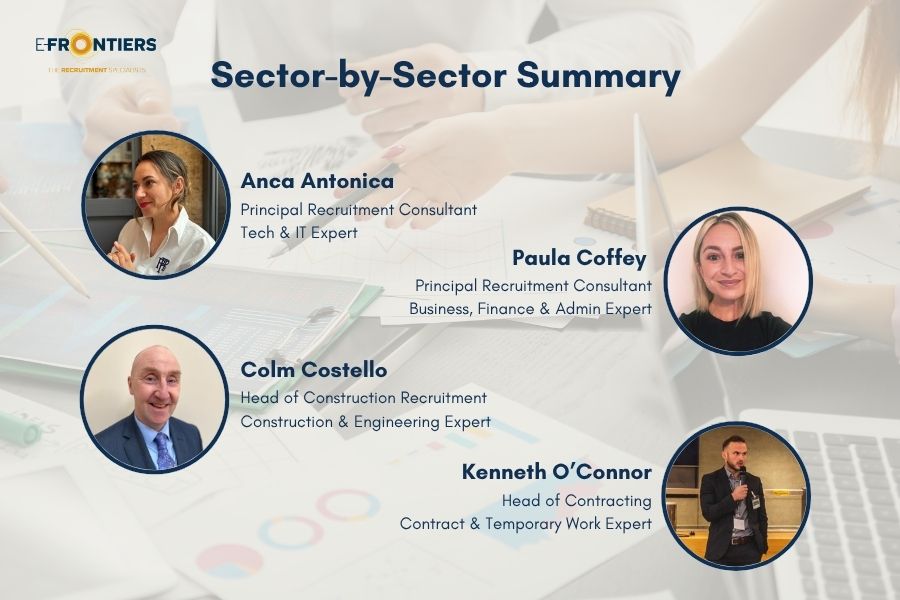
Our Principal Recruitment Consultant in IT, Anca Antonica, celebrates 10 years at E-Frontiers this month. She is sharing her insights based on what she’s observed this first half of the year:
“The first half of 2025 showed more resilience than many expected.” She noted that while some sectors remained cautious, especially early in Q1, we saw a steady increase in hiring confidence across tech roles – particularly in fintech, public sector digital transformation, and contract positions. There’s been strong demand for developers (Java, .NET, Full Stack), DevOps specialists, and integration experts with platforms like Celigo or Workday. Clients are balancing the need to control costs with the urgency to deliver on strategic tech projects, especially cloud migrations and AI/automation initiatives.
From her experience during Q1 and Q2 2025, candidates are increasingly focused on flexibility – hybrid or remote-first options are still top of mind. Many also ask about team structure, company values, and stability, showing a shift from just chasing salary. Regarding companies, those that stand out are offering clear progression paths, strong onboarding processes, and involvement in high-impact projects. A growing number are also highlighting upskilling opportunities (AI/ML, cloud certs), which resonates well with more tech-driven talent.
Focusing on the near future, she thinks the sector will face some challenges: skills shortages are becoming more acute in specific areas like AI, advanced cloud engineering, and data governance. Some companies are still navigating the return-to-office debate, which can limit their candidate pool. There’s also increasing competition from remote-first international employers offering Dublin-level salaries without the commute, so local companies need to sharpen their employer branding.
Her core insight for clients: “Speed of engagement is everything. The best candidates are often off the market in under two weeks. Clients who streamline interviews, offer clarity on projects and progression, and move decisively are consistently winning the top talent. That agility, combined with a clear EVP (Employee Value Proposition), is what makes all the difference right now.”
Outlook: Cautiously optimistic. Demand for mid-to-senior IT professionals – especially in cloud, cybersecurity, and ERP (SAP, Dynamics 365) – is expected to stay strong. Contract roles will grow, with private sector hiring likely to pick up in Q4 if economic conditions remain stable.
Construction & Engineering
According to a recent report from Research and Markets.com Irish Construction shows strong signs of growth:
- The industry is expected to grow by 3.3% in 2025, and by 4.8% annually from 2026 to 2029.
- Planning permissions increased by 2.2% in 2024, after a drop of 7.4% in 2023, showing renewed momentum.
- Major public investment is planned:
- €713 million allocated for roads in 2025.
- €600 million in loans from Bank of Ireland to help build 4,000 homes by 2028.
- The government housing targets include:
- 41,000 homes in 2025
- 43,000 in 2026
- 303,000 homes by 2030
Outlook: Positive, but persistent labour shortages and supply issues remain a challenge.
This is echoed by our Head of Recruitment for Construction, Colm Costello, who shared his experience of the first half of the year and expectations for the months ahead:
H1 2025 Performance: Colm noted that the first half of 2025 went well overall, particularly considering that our Construction desk is still relatively new. Demand for talent was strong, and a solid pipeline of roles was built. That said, sourcing suitable candidates continues to be the main challenge – a familiar theme across the sector.
Outlook for H2 2025: Looking ahead to the second half of the year, Colm is optimistic. While the summer months may bring a brief slowdown, Q3 is traditionally the busiest time for construction recruitment, and expectations are high for similar momentum this year. Although a dip is typically seen in Q4, the team is already forward-planning to minimise any disruption.`
Candidate Priorities & What Employers Need to Offer: When it comes to candidate preferences, hybrid working has become a standard expectation – especially among Quantity Surveyors and Estimators. Candidates already enjoying hybrid setups are reluctant to consider new roles that don’t offer similar flexibility. Still, it’s salary that remains the number one motivator when candidates consider a move.
Sector Risks on the Horizon: Colm also flagged a few emerging risks. The sector is currently driven by residential, pharmaceutical, and data centre projects. The housing shortage will likely keep residential activity high, but potential changes in U.S. foreign policy – such as new tariffs – could lead American companies to scale back investment in Ireland’s Pharma and Data Centre space. Another ongoing challenge is the highly competitive recruitment market, with many agencies chasing a limited talent pool.
His key takeaway for clients? “Flexibility and competitive salaries are absolutely essential if you want to attract – and more importantly, retain – the best candidates in today’s tight construction market.”
Business, Finance & Admin
Key Trends:
Roles such as fundraisers, compliance managers, and learning specialists are in high demand.
Growth is being fuelled by regulatory change, new technologies, and a focus on learning and development.
Hiring remains steady despite broader market uncertainty.
Flexibility and company culture are major decision-making factors for candidates.
AI is reshaping traditional business support roles, creating a need for continuous upskilling.
Our Principal Consultant in Sales & Marketing, Paula Coffey, shared her observations on the first half of the year and her expectations for what lies ahead:
She noted that H1 2025 didn’t quite meet expectations. Activity was slower than hoped, with fewer open roles and longer decision-making cycles across the board. That said, Paula remains cautiously optimistic about the second half of the year – “Summer tends to bring a boost in business support recruitment, and I’m already seeing early signs of renewed momentum”.
Candidates continue to prioritise flexibility and workplace culture above all else. Hybrid working is now considered the baseline, and companies that can offer more than just remote options -such as strong internal values and employee wellbeing initiatives – stand out the most.
Looking ahead, one of the key risks is the ongoing disruption caused by AI. Many traditional support roles are evolving, and candidates must be proactive in keeping up with trends and technology to stay relevant.
Paula’s key message to clients is simple: “top candidates are being lost to slow hiring processes.” In a competitive market, she believes clear communication and fast decision-making are essential to securing the best talent.
Outlook: Demand is expected to remain steady, especially for roles connected to regulatory functions, learning and development, and business transformation.
Contract & Temporary Work
- Contract roles remain in demand, supported by:
- Strong immigration numbers
- Continued hybrid working
- Sector-specific growth in tech, finance, and construction
- While forecasts don’t separate contract roles, all signs point to continued need.
- Outlook: Optimistic. Contracting should grow, especially in busy sectors. Risks remain if business confidence is affected by global trade issues.
Our Head of Contracting, Kenneth O’Connor, shared his observations on the first half of the year and what he thinks about the rest of 2025:
He noted that we had a good start to the year and the market, in the contracting industry, has exceeded his expectations. This has been across sectors for us, but activity is continuing to increase.
At the moment, both companies and candidates are seeing that more flexibility is key for agreements to be made on both sides.
When it comes to risks and challenges on the horizon, he points to the usual suspects – Artificial Intelligence, potential tariffs, and broader market uncertainty. However, he believes that with uncertainty comes opportunity, as companies increasingly explore shorter-term, flexible solutions to meet their resource needs.
Kenny’s key message for his clients is that engaging contractors for short-term solutions provides a lot of value.
Outlook: He remains optimistic and expects continued growth. While some uncertainty still lingers, many clients are turning to the contractor model as a flexible hiring solution in the current climate. “We anticipate a slow but steady rise in activity across the contracting sector,” he says.
Final Thoughts
Ireland’s economy continues to show strength, with growth projected across key sectors. While hiring may ease slightly, demand remains healthy -particularly in tech, construction, and contracting.
Flexible work is no longer a perk but a priority, and companies offering hybrid or remote-first models continue to attract top talent.
Contracting and infrastructure investment present exciting opportunities, especially as businesses seek agile solutions in an evolving landscape.
However, global trade uncertainties – including tariffs and geopolitical shifts – pose risks, particularly for export-driven industries.
Across the board, our consultants agree: challenges lie ahead, but so do opportunities. The key will be adaptability, speed, and a strong value proposition for both clients and candidates.
We’d love to hear from you— How did Q1 and Q2 go for your business? What challenges or opportunities do you see on the horizon? What are your expectations for the rest of 2025?
For further recruitment insights, please check out our Industry insights section on our website.
Need to scale fast? See how E-Frontiers delivered a compliant, high-performing engineering squad in just 14 days for a global fintech facing tight delivery deadlines.
Client Overview
A leading global fintech enterprise with over 25,000 employees worldwide launched a major greenfield initiative to enhance its European digital payments infrastructure.
The programme was centred in Ireland and required specialist engineering squads to be operational within tight delivery windows to meet Q2 development goals for a greenfield project.

The Challenge
The client needed to:
– Rapidly build a full squad of senior Java microservices engineers.
– Start onboarding within 10 business days from project kick-off.
– Ensure all contractors were compliant, reference-checked, and onboarded to enterprise security and tooling protocols.
Complicating the situation:
– The client’s internal recruitment was already at capacity.
– The technology stack was highly specific (Java, Spring Boot, AWS Lambda, Docker, Kubernetes, GitHub Actions).
– Project delays could cost up to €250k per sprint in lost development velocity.
Our Approach
We assigned a 3-person delivery team (1 Account Manager + 2 Principal Recruiters) who ran a structured sprint-based recruitment workflow:
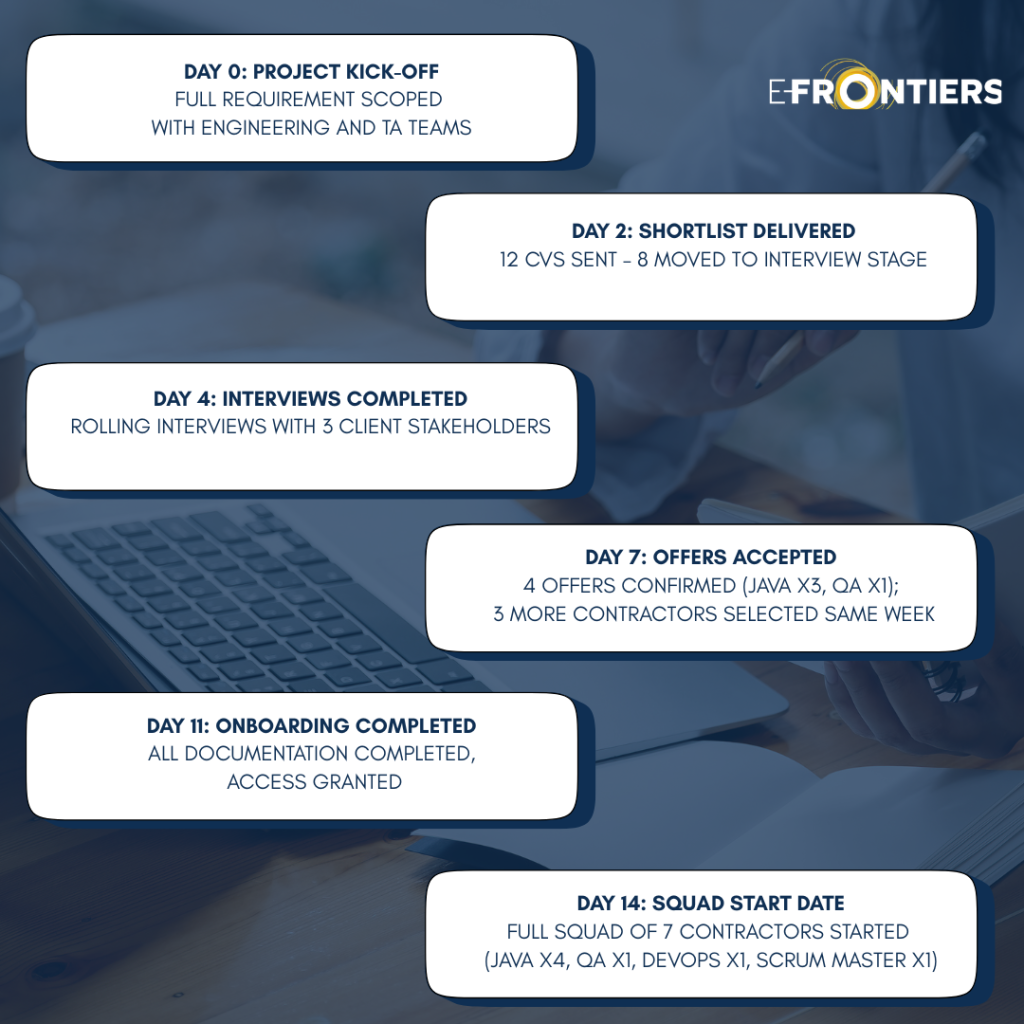
– Day 0 (Project Kick-off): Requirements gathered via live session with engineering leadership and TA partner.
– Day 1–2: Candidate pool activation via Contractor Database, network, contract market penetration.
– Day 3: 12 qualified CVs submitted.
– Day 4–6: Rolling interviews scheduled across 8 shortlisted candidates.
– Day 7: First 4 offers made and accepted.
– Day 8–9: Compliance + onboarding prep (ID verification, tax checks, background screening).
– Day 10: Equipment shipped / VPN access confirmed.
– Day 14: Full team started on-site and remote.
The Results
– 7 contractors onboarded in 14 calendar days — ahead of the client’s 3-week target.
– Zero offer rejections, 100% retention post first 3 sprints.
– Client sprint velocity achieved in week 1, contributing directly to a successful MVP delivery.
– Saved the client an estimated €80,000+ vs. typical agency time-to-hire lag (~30 days).
– Created a repeatable squad delivery model for future team builds in Q3 and Q4.
Key Takeaways
– A 14-day time-to-value is achievable with specialist contract delivery models.
– Structured shortlisting, automated outreach, and pre-qualified talent pools cut hiring timelines dramatically.
– When onboarding is managed by the recruitment partner, internal teams save dozens of hours.
Need to scale a team in weeks, not months?
Contact us to learn how our specialist contracting solutions can help you build and onboard technical squads with precision and speed.
This case study was written by Kenneth O’Connor, Head of Contracting for Ireland and the UK at E-Frontiers.
Como especialistas en selección de talento, estamos convencidos de que la diversidad no es solo una cuestión de justicia social, sino una gran herramienta de innovación para las empresas. Sin embargo, el sector tecnológico todavía enfrenta importantes retos para ser realmente inclusivo, especialmente en cuanto a la representación de mujeres, colectivo LGTBI+ y profesionales neurodivergentes.
Hoy queremos compartir algunas ideas y buenas prácticas para que las empresas puedan avanzar hacia entornos laborales más inclusivos y diversos. También os invitamos a ver (o escuchar a modo podcast) la grabación de nuestro evento del pasado 5 de Junio con Women in Tech, donde abordamos el papel de la mujer en la industria tecnológica y donde las panelistas nos hablan sobre liderazgo, iniciativas de diversidad y conciliación para atraer y retener talento femenino y referentes.

Diversidad de género: más mujeres en el sector IT
Las mujeres representan una minoría en muchos equipos tecnológicos. España, está algo por encima de la media en comparación con el resto de Europa, pero aún hay un largo camino para llegar esa paridad. Para cambiar esta realidad:
Revisa el lenguaje en las ofertas de empleo: evita sesgos de género con herramientas como Gender Decoder o Textio.
Visibilidad y liderazgo: apoya a mujeres en roles de liderazgo, dales voz en eventos y paneles. Como comentó Patricia Arboleda (Presidenta de Women in Tech Spain) en el evento, es necesario formar a las mujeres no solo en competencias técnicas, sino también en soft skills como negociación, estrategias para delegar, liderazgo, etc.
Mentoría y desarrollo: fomenta programas de mentoría y capacitación para mujeres en tech.
Conciliación real: ofrece flexibilidad horaria y teletrabajo, especialmente importante para muchas familias en etapas de crianza.
Discapacidades físicas: actualiza tu entorno
También se pueden dar casos de personas con diversas incapacidades físicas, siendo las más comunes visuales o de movimiento.
Adapta el entorno de trabajo: rampas, ascensores, espacios amplios y herramientas con tecnología accesible que permitan a las personas trabajar con normalidad.
Flexibilidad de teletrabajo y de horario: Muchas de estas personas a menudo tienen problemas para acudir a sus centros de trabajo por diversos motivos. Permitir una flexibilidad en cuanto a su ubicación daría lugar a una mayor facilidad para ellos de ejercer sus tareas diarias.
Igualdad de oportunidades: Las personas con discapacidad física deberían poder participar en procesos de selección, formación o promoción en las mismas condiciones que cualquier otra. A veces solo hace falta adaptar una entrevista o una prueba.
Inclusión de la comunidad LGTBI+
Muchas personas LGTBI+ aún temen mostrarse abiertamente en el trabajo. Las empresas pueden:
Crear espacios seguros: formar a los equipos sobre diversidad y respeto, y establecer canales de denuncia seguros.
Celebrar la diversidad: visibiliza fechas como el Orgullo y a lo largo del año, con acciones auténticas, no solo campañas estéticas.
Políticas inclusivas: asegúrate de que los beneficios de la empresa (por ejemplo, seguros médicos o permisos familiares) contemplen a todo tipo de familias y parejas.
Neurodivergencias: el valor de pensar diferente
Personas con autismo, TDAH, dislexia u otras condiciones neurodivergentes pueden aportar enfoques únicos. Para ser inclusivos:
Entrevistas adaptadas: permite formatos alternativos a la entrevista tradicional si es necesario.
Ambientes de trabajo adecuados: reduce ruidos, ajusta iluminación o da acceso a herramientas que favorezcan la concentración.
Flexibilidad en la gestión del trabajo: no todos trabajan igual, y eso puede ser una fortaleza.
¿Por dónde empezar? Guía práctica para empresas
Adoptar una cultura diversa e inclusiva requiere compromiso a largo plazo y acciones concretas. Estas son algunas claves para empezar (o avanzar) con una estrategia de diversidad real y efectiva:
Realiza un diagnóstico interno
Como con cualquier otro proyecto, antes de planificar y actuar, es fundamental conocer el punto de partida. Estas son algunas de las preguntas con las que puedes empezar:
-¿Qué nivel de diversidad hay actualmente en tu plantilla (género, identidad, orientación, neurodivergencia, etc.)?
-¿Cómo se sienten las personas en cuanto a inclusión y seguridad psicológica?
-¿Existen procesos o barreras que estén limitando la participación de ciertos colectivos?
Utiliza encuestas internas anónimas, entrevistas individuales, análisis de datos de RRHH segmentado. Incluso hay empresas externas que se dedican a hacer estos análisis y recibir directamente los datos.
Define objetivos claros y medibles
No se trata solo de “diversificar por diversificar”, sino de establecer metas que tengan impacto:
-¿Quieres aumentar el porcentaje de mujeres en roles técnicos o directivos?
-¿Buscas contratar talento neurodivergente o formar un comité de diversidad?
-¿Te interesa implementar políticas que garanticen igualdad real para personas LGTBI+?
En base a los datos obtenidos previamente, un objetivo concreto podría ser: “Aumentar un 15% la representación femenina en puestos de desarrollo en los próximos 12 meses”.
Revisa tus procesos de selección y promoción
Durante el proceso de atracción y selección de talento pueden colarse muchos sesgos incoscientes. Para evitarlo pudes utilizar estas estratégias:
-Utiliza CVs ciegos o software de análisis para identificar sesgos.
-Asegúrate de tener paneles de entrevistas diversos y de que estos estén formados en buenas prácticas durante las entrevistas (qué preguntas no hacer)
-Pregunta de forma estructurada para valorar habilidades, no afinidades personales.
-En cuanto a la promoción: Promueve la igualdad de oportunidades de promoción interna, con criterios objetivos y transparentes.
Crea espacios seguros
Muchas personas no comparten sus experiencias por miedo o desconfianza. Por ello generar confianza es clave, en este sentido puedes:
-Establecer canales seguros de comunicación (incluso anónimos).
-Crear grupos de afinidad o redes de empleados (ej. red LGTBI+, mujeres tech, etc.).
Capacita a tu equipo y liderazgo
La diversidad sin inclusión es solo es una medida superficial. Es necesario que la propia cultura empresarial lo integre. Estas son algunas estrategias que se pueden llevar a cabo para ayudar con la integración de la diversidad e inclusión:
-Forma a managers, líderes de equipo y al equipos en sesgos inconscientes, liderazgo inclusivo y lenguaje respetuoso.
-Crea espacios donde los empleados puedan aprender sobre realidades que quizás no conocen (charlas, eventos, recursos internos).
Evalúa, mejora y celebra
La diversidad es un camino continuo. Evalúa regularmente el progreso, ajusta tus estrategias y celebra los logros:
-Publica informes internos de avance.
-Reconoce el trabajo de los equipos o empleados que impulsan la inclusión.
-Aprende de los errores y adapta tus políticas con humildad y apertura.
Haz de la diversidad una parte de tu marca empleadora
Los candidatos tech cada vez valoran más los entornos diversos e inclusivos. Comunica de forma auténtica:
-Comparte historias reales de empleados.
-Muestra tu compromiso con datos, iniciativas y resultados.
-Sé coherente: la diversidad no debe ser solo parte del marketing, sino del ADN de tu cultura.
¿Necesitas apoyo?
Desde E-Frontiers, estamos aquí para ayudarte a encontrar el talento tech que no solo cumpla con las habilidades técnicas, sino que también aporte a una cultura más rica, humana y creativa.
Si quieres saber más sobre nuestros servicios o necesitas ayuda para buscar perfiles para tu equipo, ¡no dudes en contactarnos! Estamos aquí para ayudarte.
AI is no longer the future, it’s here, it’s now. And although you may not fully understand its origins or scope (learn more from Statista.com here) you are probably already a little fed up hearing about it.
Thanks to AI, we can now source, screen, and shortlist candidates faster than ever. From smart systems that scan CVs, to scheduling tools and chatbots that talk to candidates 24/7, it’s fair to say the game has changed. And that’s a good thing, mostly.
But while the machines are getting smarter, one thing hasn’t changed: the importance of the human touch. When it comes to finding the right hire, it still takes a recruiter with intuition, empathy, and a bit of gut instinct to get it right.
Finding the Balance
For those of us working across Tech, Construction, and Business Support here in Ireland, it’s now about striking the right balance – leveraging all the efficiency AI gives us, without losing sight of the relationships, conversations, and soft skills that make people thrive in a role.
The Power of AI in Modern Recruitment
AI has genuinely transformed how we work.
We use it to:
– Screen CVs in seconds
– Identify skills matches
– Predict offer acceptance
– Analyse talent trends with LinkedIn Talent Insights
– Run AI-powered coding and certification checks
– Use chatbots to streamline first-round screening
And It’s Working
The Irish recruitment market is showing cautious but steady growth (see more from Irish Jobs.ie here) – up 5% quarter on quarter for Q1, with standout areas like:
Sales: +28%
Healthcare: +16%
This means we need to be more efficient than ever with our time and tools. But as automation does more of the heavy lifting, it raises an important question:
What are we doing with the time we save?
AI Can’t Replace Empathy (and That’s a Good Thing)
For all its clever algorithms, AI still can’t read between the lines.
It doesn’t know when a gap in a CV reflects a personal challenge overcome.
It can’t sense passion, energy, or cultural fit from keywords alone. It might overlook a strong candidate who simply didn’t include the exact phrasing a machine is looking for.
In The Real World
The best developers aren’t always the flashiest on paper.
In Construction, leadership on-site can’t be measured by an algorithm.
And in a Business Support role, you need someone who can read a room, handle a tough call, or support a team when things get busy. AI can’t assess those moments—but we can.
A brilliant software developer may not shine in a video screening but would thrive in a real-world, collaborative team. AI might miss that.
A project manager’s calm under pressure doesn’t show on a CV scan.
As recruiters, we know when to lean in, ask the right questions, and spot those gems that a machine might miss.

Why Soft Skills Matter More Than Ever
In today’s job market, soft skills aren’t just nice to have – they’re critical.
Read more insights on this in a recent article from Silcon Republic here.
Traits like:
– Communication
– Emotional intelligence
– Teamwork
– Resilience
– Adaptability
These are the traits that help people navigate change, manage relationships, and ultimately stay and succeed in a role long term.
That’s where skills-based hiring comes into play. More and more companies are moving away from just hiring based on job titles or education history, and instead asking:
“What can this person actually do?”
According to LinkedIn’s research in their report on ‘The Future of Recruiting 2025’:
– 93% of talent acquisition professionals believe accurately assessing a candidate’s skills is key to making quality hires.
– Companies using more skills-based searches are 12% more likely to land the right person.
Of course, really getting to know someone’s skillset – especially their soft skills – takes time. But this is where AI has started helping in a meaningful way.
Recruiters who’ve adopted GAI tools say the time saved often goes back into better candidate assessment:
– 35% of recruiters using GAI tools say the time saved goes into screening candidates more thoroughly
– 26% use it specifically to evaluate soft skills
– 70% expect hiring efficiency to improve
– 33% expect quality of hire to increase
AI helps us do the technical work faster – so we can spend more time understanding the person behind the profile.
The Recruiter’s Role in the Age of AI
So where do recruiters fit in now?
Right where we’ve always been – in the middle, connecting the dots.
AI might show us who’s available, but it takes human insight to know who’s right. That takes instinct, experience, and conversations that build trust.
At E-Frontiers, we use AI and automation to support our process – but we don’t outsource our judgment. Whether it’s a Systems Architect, a Safety Officer, or a Customer Support Lead, it’s our job to look beyond the data and understand the bigger picture.
Because recruitment isn’t just about filling roles.
It is always about the people. It’s about potential. And that’s something no machine can fully grasp.
Conclusion: Embracing AI, Keeping It Human
The future of recruitment is clearly tech-enabled, and that’s something to be welcomed.
AI is helping us work smarter, move faster, and deliver better results for our clients and candidates.
But let’s not forget that recruitment is still a people business.
Here in Ireland, especially, where hiring is often about relationships, referrals, and long-term cultural fit, soft skills will always matter.
AI can find the right CV. But it’s still up to us to find the right person.
If you would like help in your search for the right hire, please get in touch with us today.
Nigel Bolger Commercial Manager
+353 86 3888147
Nigel.bolger@e-frontiers.ie
.
Con la transformación digital, el marketing ha pasado de ser un área operativa a convertirse en un pilar estratégico para el crecimiento de las empresas. En España, este cambio se refleja en la alta demanda de perfiles especializados en marketing digital, capaces de generar impacto real en los resultados del negocio.
En E–Frontiers Spain, trabajamos de cerca con empresas que buscan reforzar o construir sus equipos de marketing, aportando no solo candidatos, sino también consultoría experta sobre el tipo de talento que realmente se ajusta a cada reto.
¿Qué perfiles están buscando las empresas en España?
Desde startups hasta grandes corporaciones, los equipos de marketing se están transformando. Estos son los perfiles más demandados por nuestros clientes:
Especialistas en SEO/SEM: optimización técnica, estrategia de contenidos y campañas de pago orientadas a resultados.
Digital Marketing Managers: liderazgo en campañas omnicanal, análisis de performance y coordinación de equipos internos o externos.
Performance Marketers: expertos en conversión, testing A/B, attribution modeling y retorno de inversión.
Content Strategists / Copywriters: contenido enfocado a conversión y posicionamiento SEO.
CRM & Email Marketing Specialists: automatización, segmentación y fidelización del cliente.
Social Media Managers: reputación de marca, engagement y manejo de campañas en redes.
Growth Hackers: perfiles híbridos, orientados al crecimiento mediante experimentación, datos y tecnología.
¿Qué buscan hoy las empresas en sus futuros profesionales de marketing digital?
Más allá del CV, nuestros clientes valoran:
Capacidad de análisis y visión estratégica.
Dominio de herramientas como GA4, HubSpot, Salesforce, Meta Ads, Looker Studio.
Fluidez en inglés y experiencia en entornos internacionales.
Proactividad, pensamiento creativo y orientación al negocio.
Flexibilidad para entornos híbridos o 100% remotos.
El reto no es solo encontrar talento, sino atraer y convencer a candidatos de alto nivel, muchos de los cuales no están activamente en búsqueda.

¿Por qué elegir E-Frontiers para tus procesos de selección?
En E-Frontiers, reclutamos con propósito. Nuestro equipo, no solo está especializado en el mercado español, también en el internacional y conoce las tendencias, los salarios y las skills más demandadas. Te ayudamos a definir mejor el perfil que necesitas y te conectamos con candidatos validados, alineados con tu cultura y tus objetivos.
Ofrecemos:
Asesoría personalizada y rápida.
Candidatos activos y pasivos.
Acceso a una red internacional de profesionales digitales.
Procesos adaptados al ritmo de cada cliente.
When it comes to hiring, it’s easy to focus on the obvious: salaries, job specs, and start dates. But the real cost of a full-time hire often goes much deeper—especially when you factor in onboarding time, overheads, and long-term commitments. That’s where contracting can be a game-changer.
In fast-moving sectors like tech and IT, bringing in contractors isn’t just about cost—it’s about flexibility, speed, and getting the right skills exactly when you need them. And when you partner with the right agency, the process becomes even easier.
At E-Frontiers, we’ve spent the last 19 years helping companies build high-performing contract teams. We know what works, and more importantly, how to make it work for you.
Full-Time Hires Come with Hidden Costs
It’s not just the salary—there’s also employer taxes, pensions, insurance, equipment, training, holiday pay, and more. In the UK, National Insurance adds 15% on top of a salary. In Ireland, PRSI is 11.15% (for weekly earnings above €527). Add benefits and onboarding time, and the true cost can be significantly higher than expected.

Why Contractors Make Financial Sense
Here’s what you get with a contractor:
Minimal overheads – They handle their own tax, insurance, pensions, etc.
Work done = money spent – You pay only for productive time signed off by you.
Faster, leaner hiring – Most contract placements happen within days, not weeks – We placed a contractor within 24 hours for a tech client recently.
And when you partner with us, you’re not starting from scratch every time—we already know your business, your hiring style, and your ideal candidate. That means faster turnarounds, stronger matches, and less admin for you.
Example: One of our clients recently saved over 30% by hiring two contractors for a 6-month data transformation project rather than onboarding two permanent team members. The result? A completed project ahead of schedule, and no long-term overheads.
Contractors Give You Room to Move
Whether it’s launching a new product, filling a gap, or responding to a sudden shift in business needs—contractors give you the ability to scale your team immediately. In todays world where value of time is continually increasing standing up a resource or team quickly can save loads in the long term. At the end of the day you want the result and delivery without the stress of recruitment.
Test the Fit, Reduce the Risk
Every hire carries some level of uncertainty. Contractors allow you to trial skillsets and cultural fit before making longer-term decisions. Think of it as a risk-free way to get the best talent on board—quickly and confidently.
What the Market’s Telling Us
Here’s a look at what’s happening out there:
Rising daily rates – Contractor rates in Ireland rose 5% from 2022 to 2024, reflecting demand.
Shift in hiring trends – 45% of tech roles in 2024 were contract or project-based (up from 30% the year before).
Remote talent is the norm – Companies are tapping into skilled contractors globally.
Contracting motivations vary – Millennials and Gen Z are drawn to flexibility and higher pay, Boomers and Gen X value autonomy and impact.
Specialist skills are in demand – From cloud engineers to data architects, contractors are often the fastest way to access niche expertise.
Addressing Common Concerns
“Will they feel part of the team?”
Absolutely—especially if you onboard them right. Including contractors in team meetings, Slack threads, and planning sessions builds connection and encourages collaboration from day one.
“What about confidentiality and data security?”
Standard contractor agreements cover all the legal bases—IP, confidentiality, GDPR. We take care of this for you.
“Are they as committed as full-time staff?”
In our experience, most contractors are career professionals. They rely on repeat business and referrals, so they’re deeply motivated to deliver quality work and results.
Why Partner with E-Frontiers?
Here’s the real value: when you work with us long term, we become an extension of your hiring team. We already understand your processes, your team structure, and your preferences. That means:
Faster turnarounds on every role
Tailored shortlists—no time wasted
Market insights and contractor availability at your fingertips
Support with onboarding, contracts, and renewals—fully managed
We’re not just filling roles—we’re helping you build a flexible, scalable workforce that grows with your business.
Final Thoughts
In today’s tech-driven world, hiring contractors isn’t just a cost-saving strategy—it’s a smart way to stay nimble, competitive, and ahead of the curve. The right contractors, brought in at the right time, can transform the pace and quality of your delivery.
If you’re looking to explore contracting—or want a partner who can take the stress out of it—get in touch with us at E-Frontiers. We’re here to make it simple, seamless, and successful.
Contact Kenneth O’Connor, Head of Contracting, to discuss how we can help.
Attracting and keeping great employees in 2025 isn’t just about offering the highest salary. Of course, salary matters—there’s no denying that—but people are looking for more. They want a workplace where they feel valued, supported, and motivated to grow. They are looking for a culture that supports their growth, values their contributions, and keeps them engaged.
Our recruiters speak with candidates every day, and one thing is clear: a competitive salary alone won’t stop employees from looking elsewhere if they don’t feel connected to and invested in their workplace. In this article, we share key insights on what makes employees stay and practical ways companies can build a company culture that retains top talent.

What we found
Staying connected with professionals allows us to gather valuable insights that benefit both us and our clients. When speaking with passive candidates—those not actively seeking a new role—they often highlight key factors beyond salary that keep them committed to their current positions. Here are some of the most common reasons they choose to stay:
Career Progression & Growth Opportunities – A well-structured career development plan is crucial. Employees stay where they see a future. Many professionals who are not considering new opportunities cite their reason as having a promotion on the horizon, or an exciting new project lined up within their current company.
Bonuses & Stock Options – Financial incentives like bonuses and stock options are strong motivators, with many professionals staying put until they receive these rewards.
Work-Life Balance – Flexibility matters. Flexible working arrangements, including remote and hybrid work options, are now a top priority. Many candidates are reluctant to move, even for higher pay – if their current role gives them the balance they need. This can be through remote work, hybrid options, or flexible hours.
Company Culture & Team Relationships – A positive work environment, strong team connections, and open communication with peers and managers play a significant role in job satisfaction and retention. Candidates often mention these factors as reasons for their loyalty to their employer.
Shared Values and Social Impact – Employees want to work for companies whose values align with their own and that stand for something beyond just business. When a company actively supports causes like sustainability, community initiatives (CSR), and promotes a diverse, fair, and inclusive workplace (DEI), employees feel a stronger connection. Seeing their employer make a real effort in these areas gives them a sense of purpose and belonging, making them more likely to stay.
The benefits for business
Investing in company culture, along with initiatives like Corporate Social Responsibility (CSR) and Diversity, Equity, and Inclusion (DEI), shows a company’s commitment to both its employees and society. Studies have shown that a strong focus on these areas not only boosts employee satisfaction and improves retention but also improves business performance.
In fact, it is proven that companies with more diverse and inclusive environments outperform their peers. In 2024, studies by LinkedIn and Volrcol reported that organisations with inclusive cultures experience a 22% increase in profitability and a 21% increase in productivity (Gallup Study).
Companies with the highest gender diversity are 25% more likely to outperform their competitors financially. Those with the highest ethnic diversity see an even greater boost, with a 36% higher chance of financial success. This proves that investing in diversity isn’t just the right thing to do—it also delivers strong business results.
How to create a workplace where employees want to stay
Creating a workplace that employees want to be part of takes more than just competitive pay—it requires a strong, people-first culture. By focusing on these key areas, companies can build environments where employees are engaged, motivated, and less likely to look elsewhere.
Foster a Strong Sense of Purpose
People are more engaged when they understand how their work contributes to a bigger goal and that their work matters.
Make sure employees understand how their contributions help achieve the company’s goals.
When they see the bigger picture and feel their efforts make a real impact, motivation and job satisfaction naturally increase.
Support Growth and Continuous Learning
Professional growth is a priority for employees in any field. Employees want to grow and develop. Provide learning opportunities such as:
– Training programs (online courses, workshops, certifications)
– Mentorship initiatives
– Opportunities to attend industry conferences and networking events
– Internal knowledge-sharing sessions
When employees see a clear path for learning and career growth, they’re far more likely to stay. Investing in employee development shows the company’s commitment to their future and strengthens retention.
Make Work-Life Balance a Priority
Burnout is a real issue and a challenge across industries. Overwhelmed employees are more likely to leave. Supporting work-life balance leads to happier, more productive employees. Consider:
– Flexible work arrangements – remote work, hybrid models, flexible hours
– Generous paid time-off policies that encourage real breaks
– Well-being programs like mental health support, wellness initiatives, or gym memberships
A healthy work-life balance fosters long-term commitment and reduces turnover.
Recognise and Reward Your Team
People thrive when they feel valued. Employees who feel appreciated are more likely to stay engaged. Build a culture of recognition by:
– Celebrating achievements in meetings, newsletters or internal platforms
– Offering performance-based incentives such as bonuses, career growth opportunities or extra perks
– Providing regular feedback and check-ins to support growth and transparency
When employees know their work is seen and appreciated, they’re more likely to stick around.
Build a Truly Inclusive Workplace
Diverse teams bring fresh ideas, better collaboration, and stronger results. To create a culture where everyone feels valued:
– Actively recruiting from diverse talent pools
– Offer unconscious bias training to promote fair decision-making
– Support employee resource groups and diversity initiatives
– Ensure leadership opportunities are accessible and open to all
An inclusive workplace isn’t just the right thing to do—it also leads to higher engagement and loyalty.
Pay Fairly and Offer Great Benefits
Salary isn’t everything, but fair and competitive pay is a must. Regularly review compensation to stay in line with industry standards and offer:
– Strong benefits such as health insurance, retirement plans, and bonuses
– Performance-based incentives that reward great work
– Extra perks like professional development budgets, childcare support, or wellness benefits
When employees feel financially secure and valued, they’re more likely to stay.
Give Employees Ownership and Trust
Micromanagement kills creativity and motivation. Instead, empower employees by:
– Trusting them to make decisions
– Allowing flexibility in how they approach their work tasks
– Encouraging innovation, initiative, and new ideas
When employees feel trusted and in control of their work, they’re more engaged, accountable, and motivated to grow.
Create a Collaborative and Connected Workplace
A strong sense of community makes work more enjoyable and boosts engagement. Build team connections through:
– Team-building activities that will strengthen relationships
– Social events like lunches, outings, or casual get-togethers
– Encouraging collaboration across teams, departments, and regions
When employees feel part of a supportive and social workplace, they’re more likely to stay. This environment enhances morale and overall workplace happiness.
Communicate Openly & Transparently
Employees want to feel informed and heard. Foster a culture of open communication by:
– Sharing company updates regularly so employees understand the bigger picture
– Encouraging leadership to be approachable and accessible
– Creating spaces where employees can voice ideas, concerns, and feedback
Open-door policies and a culture where feedback flows both ways can make a big difference in retention. When employees feel their voices matter and they’re kept in the loop, they’re more likely to stay engaged and committed.
Conclusion
Building a workplace that retains top talent goes beyond just offering competitive salaries. When employees feel a sense of purpose, have opportunities to grow, enjoy work-life balance, and feel recognised, included, and trusted, they’re much more likely to stay and thrive. By focusing on these areas, companies can create an environment where employees feel valued, motivated, and engaged for the long term.
If you’d like to explore ways to enhance your company’s employee engagement strategies, reach out to us today!
En un mundo cada vez más comprometido con la sostenibilidad, el sector energético se encuentra en plena transformación. La transición hacia fuentes de energía renovables y la descarbonización de la industria han generado una demanda creciente de profesionales especializados capaces de liderar este cambio.
La innovación y la inversión en energías limpias están redefiniendo el panorama laboral, impulsando la creación de nuevos roles y la evolución de los perfiles tradicionales. Sin embargo, atraer y retener talento cualificado sigue siendo uno de los mayores desafíos para las empresas del sector.
En este contexto, el papel de los especialistas en talento es fundamental. No solo deben identificar a los profesionales con las habilidades técnicas adecuadas, sino también a aquellos que compartan la visión de un futuro más sostenible y puedan adaptarse a un entorno en constante cambio.
Para profundizar en estos retos y oportunidades, hemos entrevistado a Patricia León, Partner en NRG, experta en el sector energético.

¿Cómo describirías el estado actual del sector energético en España? ¿Cuáles son sus principales retos?
El sector energético en España está en plena transformación. Durante años estuvo dominado por unas pocas grandes utilities y centrales convencionales, pero en los últimos tiempos ha evolucionado hacia un modelo más descentralizado, con un peso creciente de las energías renovables. Esto ha permitido reducir la dependencia energética del exterior, pero también ha generado nuevos desafíos.
Uno de los principales retos es garantizar la sostenibilidad económica del sector. La proliferación de renovables ha llevado a que, en determinados momentos, la sobreoferta de generación provoque una caída de precios en el mercado mayorista, dificultando la recuperación de la inversión para muchas instalaciones. Si los precios bajos se mantienen de manera prolongada, esto podría desincentivar la entrada de nuevos proyectos.
Además, la creciente presencia de energía solar ha reducido la capacidad firme del sistema, es decir, la cantidad de energía disponible de manera estable en cualquier momento. Para abordar esta situación, es imprescindible invertir en almacenamiento y flexibilidad. En este sentido, el almacenamiento hidráulico y las baterías jugarán un papel clave a corto plazo, mientras que tecnologías alternativas irán ganando peso en el futuro. Asimismo, las centrales de ciclo combinado seguirán siendo necesarias para cubrir la demanda en momentos de baja producción renovable.
¿Qué tipo de profesionales consideráis que están más demandados en el sector energético?
Históricamente, el sector energético ha estado liderado por ingenieros industriales, de minas y energéticos, y su papel sigue siendo fundamental. No obstante, en los últimos años, la demanda de talento ha evolucionado significativamente, reflejando la transformación del sector.
Cada vez es mayor la necesidad de profesionales especializados en tecnología y digitalización. La analítica avanzada, la inteligencia artificial y la optimización de redes energéticas están adquiriendo un protagonismo clave en la gestión eficiente de los recursos.
Otro perfil en auge es el de expertos en eficiencia energética y mercados energéticos. Dado que la regulación desempeña un papel crucial en la transición energética, las empresas buscan profesionales con un profundo conocimiento del marco normativo, capaces de adaptarse a un entorno en constante evolución.
Asimismo, está aumentando la demanda de economistas y abogados especializados en el sector energético

Patricia León es Partner en NRG y cuenta con una sólida trayectoria en el sector energético, tanto a nivel nacional como internacional. Su profundo conocimiento del sector y enfoque estratégico la convierten en una voz experta en la transformación hacia un modelo energético más eficiente y sostenible.
¿Qué papel crees que jugará el almacenamiento energético y el hidrógeno verde en el futuro del país? ¿Y los CAES?
El almacenamiento será un pilar fundamental en el nuevo modelo energético. Sin él, sería imposible garantizar una transición razonable hacia un sistema más basado en renovables.
En el corto plazo, el almacenamiento hidráulico y las baterías serán las soluciones más aplicables, ya que permiten gestionar la intermitencia de la generación solar y eólica. A más largo plazo, podrían entrar en juego nuevas tecnologías de almacenamiento que aún están en desarrollo.
En cuanto al hidrógeno verde, se ha apostado fuertemente por él en los últimos años, pero sigue enfrentando dos grandes problemas: su alto coste de producción y la dificultad de garantizar una generación renovable continua para su producción. La energía eólica y solar no generan de forma uniforme en todas las horas, lo que complica la viabilidad del hidrógeno verde como sustituto del metano en el corto y medio plazo.
Por otro lado, los CAES (Certificados de Ahorro Energético) y el Fondo Nacional de Eficiencia Energética jugarán un papel muy relevante. La obligación de los comercializadores de gas y productos petrolíferos de aportar recursos al fondo de eficiencia incentivará la inversión en medidas que reduzcan el consumo energético. Esto no solo ayudará a mejorar la eficiencia, sino que también actuará como un catalizador para el cambio de paradigma en el sector, impulsando la adopción de soluciones más sostenibles.
¿Qué obstáculos económicos encuentran las empresas españolas para invertir en energías renovables?
Las empresas que quieren invertir en renovables en España se encuentran con dos grandes desafíos económicos.
El primero es la incertidumbre en los ingresos futuros. En el caso de la energía solar, por ejemplo, cuando hay una gran generación y la oferta supera la demanda, los precios pueden llegar a ser incluso negativos. Esto obliga en muchos casos a parar la generación, lo que hace que las instalaciones tengan dificultades para recuperar su inversión.
El segundo obstáculo es la falta de sensibilización de la demanda con lo renovable. En muchos casos, tanto la industria como los consumidores priorizan el precio sobre el origen de la energía que consumen. Esto ha provocado una caída en el valor de las garantías de origen, que certifican que la electricidad es 100% renovable. Sin una revalorización de estos certificados, el incentivo para invertir en renovables se reduce, ya que no hay un beneficio económico claro para los productores más allá del propio mercado mayorista.
Estos factores hacen que muchas empresas se lo piensen dos veces antes de acometer nuevas inversiones en energías renovables, ya que los riesgos financieros pueden ser elevados si no se encuentran mecanismos que estabilicen los ingresos.
¿Cuál es el principal reto al que se enfrentan las empresas del sector para retener el talento?
Muchos perfiles con habilidades clave, especialmente en tecnología y datos, están optando por sectores que perciben como más dinámicos o con mayores expectativas salariales. Para competir en este terreno, las empresas del sector deben ofrecer planes de formación atractivos, oportunidades de desarrollo profesional y condiciones laborales competitivas.
Además, la rápida evolución de las tecnologías y la regulación energética exige que los profesionales se mantengan en constante aprendizaje. Las empresas que no inviertan en formación y actualización de sus empleados corren el riesgo de perder talento en favor de compañías que sí apuesten por el desarrollo de sus equipos.
Para retener talento en el sector energético, las empresas deben ser capaces de ofrecer estabilidad, oportunidades de crecimiento y un entorno atractivo donde los profesionales puedan desarrollar sus habilidades y adaptarse a los cambios constantes del mercado.
Autor del artículo: Ana Martín Romero, Senior Recruitment Consultant en E-Frontiers Spain.
No dudes en contar con nosotros si estás buscando ayuda en Recruitment. Puedes agendar una llamada con Alejandro Pino, Recruitment Manager, aquí.
Durante los últimos años hemos visto como Portugal ha ido creciendo exponencialmente en el mercado IT a nivel Europeo. Las facilidades fiscales y la incorporación del Visado Nómada Digital en 2022 han puesto a nuestro país vecino en el ojo de inversores y empresas tecnológicas para comenzar sus operaciones allí.
Esto ha supuesto un crecimiento de grandes núcleos como Lisboa o Porto, pero el crecimiento está siendo significativo en otras ciudades más pequeñas del país luso.
¿Cuáles son las mejores ciudades de Portugal para trabajar o montar mi empresa?
Si buscas expandir tu negocio tecnológico en Portugal o contratar talento IT, es clave conocer las ciudades que lideran este crecimiento. Como agencia de reclutamiento expertos en el mercado IT en Portugal, compartimos aquí los que consideramos los principales hubs tecnológicos para empresas y profesionales del sector.

Lisboa
Lisboa, una ciudad con una fuerte proyección internacional, es la opción número uno para inversores que quieren comenzar sus operaciones en Portugal.
Desde 1991, Lisboa alberga LisPolis, el hub tecnológico por excelencia en Portugal, con más de 120 empresas, desde startups emergentes hasta grandes multinacionales. La capital lusa también es sede de eventos tecnológicos de gran impacto, como el Web Summit, que atrae a miles de profesionales del sector.
Porto
Porto es la segunda ciudad más importante de Portugal. Con un histórico aporte a su PIB del sector turístico, está intentando explotar nuevas formas de crecimiento en la región.
Porto aporta la modernidad y multiculturalidad de Lisboa, pero a una escala menor, siendo actualmente preferida por nuevos residentes dado su menor coste de vida en comparación con Lisboa.
En Porto también encontramos una de las principales universidades del país, fortaleciendo la formación de nuevos profesionales y dando un atractivo extra a la ciudad.
Coimbra
Coimbra es conocida por su prestigiosa Universidad de Coimbra, lo que la convierte en un entorno ideal para negocios de investigación y desarrollo.
Cada año, la universidad gradúa a miles de profesionales en ingeniería, ciencia y desarrollo de software, proporcionando una cantera de talento altamente cualificado. En 2011 se inauguró Coimbra iParque, un complejo de más de 150.000 metros cuadrados que alberga startups y grandes empresas tecnológicas.
Aveiro
Al igual que Porto, Aveiro siempre se ha mantenido como ciudad turística, pero desde hace un par de décadas están intentando actualizar su fuente de ingresos. En el año 2009 se funda, de la mano de la Universidad de Aveiro, el PCI, un parque tecnológico con la idea de atraer nuevos negocios a la región, contando a día de hoy con más de 40 startups en su proyecto de incubadoras, llevando a cabo más de 150 proyectos de investigación.
Braga
Braga, situada cerca de Porto y de la frontera con España, se ha convertido en un punto clave para inversores que buscan operar en ambos países de la Península Ibérica.
En 2014 se lanzó InvestBraga, una iniciativa pública para atraer inversión y fomentar el crecimiento empresarial. Dentro de este programa destaca Startup Braga, que apoya la creación de empresas tecnológicas con alto potencial en mercados internacionales.
E-Frontiers: el socio estratégico para tu empresa en Portugal
Con el crecimiento del sector IT en Portugal, la demanda de talento cualificado es cada vez mayor. Como agencia de reclutamiento expertos en el mercado IT en Portugal, ayudamos a empresas a encontrar a los mejores profesionales del sector.
Si buscas expandir tu equipo en Portugal, nuestros recruiters pueden ayudarte a conectar con talento altamente cualificado en las principales ciudades tecnológicas del país.
Contáctanos y descubre cómo podemos ayudarte a encontrar los mejores profesionales IT en Portugal
Alejandro Pino Alamillo – Recruitment Manager @E-Frontiers Spain alejandro.pino@e-frontiers.ie
Conoce al autor de este artículo aquí: Alfonso Moreiras – Senior IT Recruiter
El hidrógeno verde está ganando protagonismo como uno de los pilares fundamentales en la transición energética global. Gracias a su capacidad para descarbonizar sectores clave, se está posicionando como un actor esencial en la lucha contra el cambio climático y la evolución hacia un modelo energético sostenible. Este avance presenta una gran demanda de perfiles especializados en hidrógeno verde que puedan impulsar el crecimiento de esta industria, lo que representa una excelente oportunidad para aquellos que buscan ser parte de esta transformación.
¿Qué es el Hidrógeno Verde?
El hidrógeno verde se obtiene mediante electrólisis del agua, un proceso que separa el hidrógeno del oxígeno utilizando electricidad de fuentes renovables como la solar y la eólica. Al no generar emisiones contaminantes, es una alternativa clave para la descarbonización y el aprovechamiento eficiente de energía limpia.
Sus principales ventajas incluyen cero emisiones de carbono, versatilidad en su uso y la posibilidad de almacenar energía renovable para su uso posterior. Sin embargo, enfrenta desafíos como su alto costo, infraestructura limitada y la necesidad de mejorar su eficiencia energética.
¿Por qué es clave el Hidrógeno en la Transición Energética?
El hidrógeno verde no solo es un vector energético limpio, sino también una tecnología de almacenamiento y transporte de energía clave para garantizar una transición energética efectiva. Su versatilidad y múltiples aplicaciones lo hacen indispensable para la industria energética, lo que genera una creciente necesidad de profesionales especializados en hidrógeno verde que puedan apoyar su desarrollo y despliegue.
Oportunidades Profesionales en el Sector del Hidrógeno Verde
A medida que el hidrógeno verde se consolida como una fuente clave en el mix energético, las oportunidades profesionales en este sector siguen creciendo. Los perfiles relacionados con la energía renovable, la ingeniería y el desarrollo tecnológico tienen la oportunidad de integrarse en proyectos innovadores que marcan la pauta hacia un futuro libre de carbono.
El mercado laboral en la industria del hidrógeno verde está experimentando una expansión constante, lo que significa que las personas con habilidades específicas en este campo tienen una alta demanda. Si estás interesado en ser parte de esta revolución energética, ahora es el momento perfecto para especializarte en este sector.

Perfiles Profesionales Demandados en la Industria del Hidrógeno
La industria del hidrógeno verde está en plena expansión, y con ello, la demanda de talento especializado sigue en aumento. Las empresas que apuestan por esta fuente de energía limpia buscan profesionales capaces de enfrentar los desafíos de producción, almacenamiento y distribución.
Uno de los perfiles más demandados es el de Ingeniero de Procesos, responsable de optimizar la producción de hidrógeno mediante electrólisis, asegurando eficiencia y sostenibilidad. Junto a ellos, los Especialistas en Energías Renovables desempeñan un papel clave al integrar fuentes como la solar y la eólica en el proceso, maximizando su rendimiento.
El almacenamiento y transporte del hidrógeno es un reto crucial, por lo que los Ingenieros en Infraestructura y Almacenamiento son esenciales para desarrollar soluciones seguras y eficientes. Asimismo, el sector necesita Expertos en I+D, quienes trabajan en innovaciones tecnológicas para mejorar la eficiencia y reducir costos en toda la cadena de valor del hidrógeno.
Desde el punto de vista financiero, perfiles como Analistas de Mercados Energéticos, Traders, Analistas Cuantitativos y Consultores de Riesgos son fundamentales para evaluar tendencias, gestionar inversiones y garantizar la estabilidad del sector en un mercado en constante evolución.
El Futuro del Hidrógeno y la Búsqueda de Talento
El hidrógeno verde está llamado a transformar el panorama energético mundial, y las oportunidades de carrera para perfiles especializados son cada vez mayores. Si eres un profesional con experiencia en energías renovables, ingeniería o desarrollo tecnológico, este es el momento de involucrarte en el futuro de la energía sostenible.
En E-Frontiers, contamos con amplia experiencia reclutando talento para proyectos de energía renovable, y podemos ayudarte a encontrar tu próximo desafío en el sector del hidrógeno verde. Si eres un profesional interesado en trabajar en este campo, o si tu empresa necesita talento especializado en hidrógeno para impulsar sus proyectos, ¡estamos aquí para ayudarte!
Contáctanos para explorar cómo podemos ayudarte a conectar con los mejores candidatos o los proyectos más innovadores en la industria del hidrógeno.
Conoce a la autora de este artículo – Ana Martín Senior Recruitment Consultant
Alejandro Pino Alamillo – Recruitment Manager Spain – Agenda una llamada sin compromiso aquí
