


En un mundo donde los datos se han convertido en el motor de la toma de decisiones empresariales, los Recursos Humanos no podían quedarse atrás. Hoy hablamos de People Analytics, una disciplina que está transformando la manera en que las organizaciones gestionan su talento, alinean a sus equipos con los objetivos de negocio y anticipan los desafíos del futuro laboral.
Para profundizar en este tema, entrevistamos a Alejandro Pino, nuestro Manager quién se ha dedicado en los últimos años aprender sobre People Analytics. En este artículo nos comparte su visión sobre el papel actual de la analítica de personas, sus beneficios reales en las empresas, las competencias que requiere este perfil y las tendencias que marcarán el futuro del área.

¿Cómo definirías People Analytics y cuál es su papel actual en las empresas?
People Analytics es un concepto que se ha ganado fuerza en los últimos años. Yo lo definiría como el uso de datos, tecnologías como la IA y metodologías analíticas para entender mejor a las personas dentro de la organización y así tomar decisiones más estratégicas desde recursos humanos. Hoy en día su papel es clave: ayuda a pasar de la intuición a la evidencia, permitiendo gestionar talento, mejorar la experiencia del empleado, predecir rotación o identificar las situaciones más críticas. En un contexto donde hoy en día absolutamente todo genera datos, People Analytics se convierte en una herramienta imprescindible para alinear a las personas con los objetivos de negocio.
¿Qué soluciones nos puede aportar de manera eficaz la incorporación de People Analytics en un departamento de RRHH?
Nos puede aportar soluciones de muchos tipos pero sobre todo soluciones prácticas. Por ejemplo, modelos predictivos de rotación para anticipar riesgos de fuga de talento, análisis de compromiso para detectar factores que afectan al rendimiento, o segmentación de empleados para personalizar políticas de desarrollo y beneficios. También permite optimizar la contratación, midiendo la efectividad de los canales de reclutamiento y mejorando la calidad de las contrataciones.
Desde tu punto de vista, ¿quién debe liderar esta área? ¿Qué formación se requiere?
Depende de la estructura de cada empresa. Debe ser un área liderada desde Recursos Humanos, pero en estrecha colaboración con Data & Analytics. Lo ideal es un perfil híbrido: alguien con conocimiento profundo en RRHH pero también con capacidad de interpretar datos y traducirlos en acciones. Yo creo que ese doble perfil es clave y una oportunidad de futuro para los profesionales de los recursos humanos, que dejan de lado tareas más administrativas para desempeñar roles más estratégicos.
¿Cómo llegaste al mundo de People Analytics? ¿En qué áreas de tu carrera lo estás aplicando?
Llegué de forma natural desde mi rol en Recursos Humanos. Empecé viendo cómo los datos podían ayudarme a justificar decisiones de selección y retención de talento. También empecé a comprender tendencias que los datos te ayudan a predecir y en consecuencia actuar con tiempo. Poco a poco me fui formando en analítica de datos y en IA aplicada a RRHH. Hoy lo aplico en múltiples áreas: desde mejorar los procesos de reclutamiento con métricas de efectividad, hasta el análisis de KPIs. También en los últimos años me he dedicado a la docencia en esta materia, ayudando a otros profesionales de recursos humanos a saber interpretar los datos, usarlos en su beneficio y a un uso responsable y ético de las nuevas tecnologías como la IA.
¿Cómo crees que deben los departamentos de RRHH adaptarse a las nuevas tendencias de People Analytics?
Los departamentos de Recursos Humanos deben adaptarse a los nuevos tiempos y convertirse en áreas mucho más estratégicas dentro de las organizaciones. Eso implica invertir en formación, en herramientas de analítica, y en fomentar una cultura de decisiones que busque el apoyo del dato. También deben reforzar la ética y la gobernanza, porque no se trata solo de usar datos, sino de hacerlo de manera responsable, cuidando la privacidad de los empleados y la transparencia en las decisiones.
¿Cómo piensas que va a avanzar People Analytics en los próximos años? ¿Nuevas aplicaciones?
Creo que People Analytics evolucionará hacia modelos mucho más predictivos y prescriptivos, apoyados en inteligencia artificial. Veremos aplicaciones en personalización de la experiencia del empleado, planes de carrera diseñados con algoritmos, y análisis en tiempo real del bienestar y la productividad. También es importante destacar que cada vez cobra más relevancia la parte ética y regulatoria, asegurando que las decisiones basadas en datos sean justas, inclusivas y transparentes. Sin duda, es y será una herramienta fundamental para que RRHH sea verdaderamente un socio estratégico del negocio.
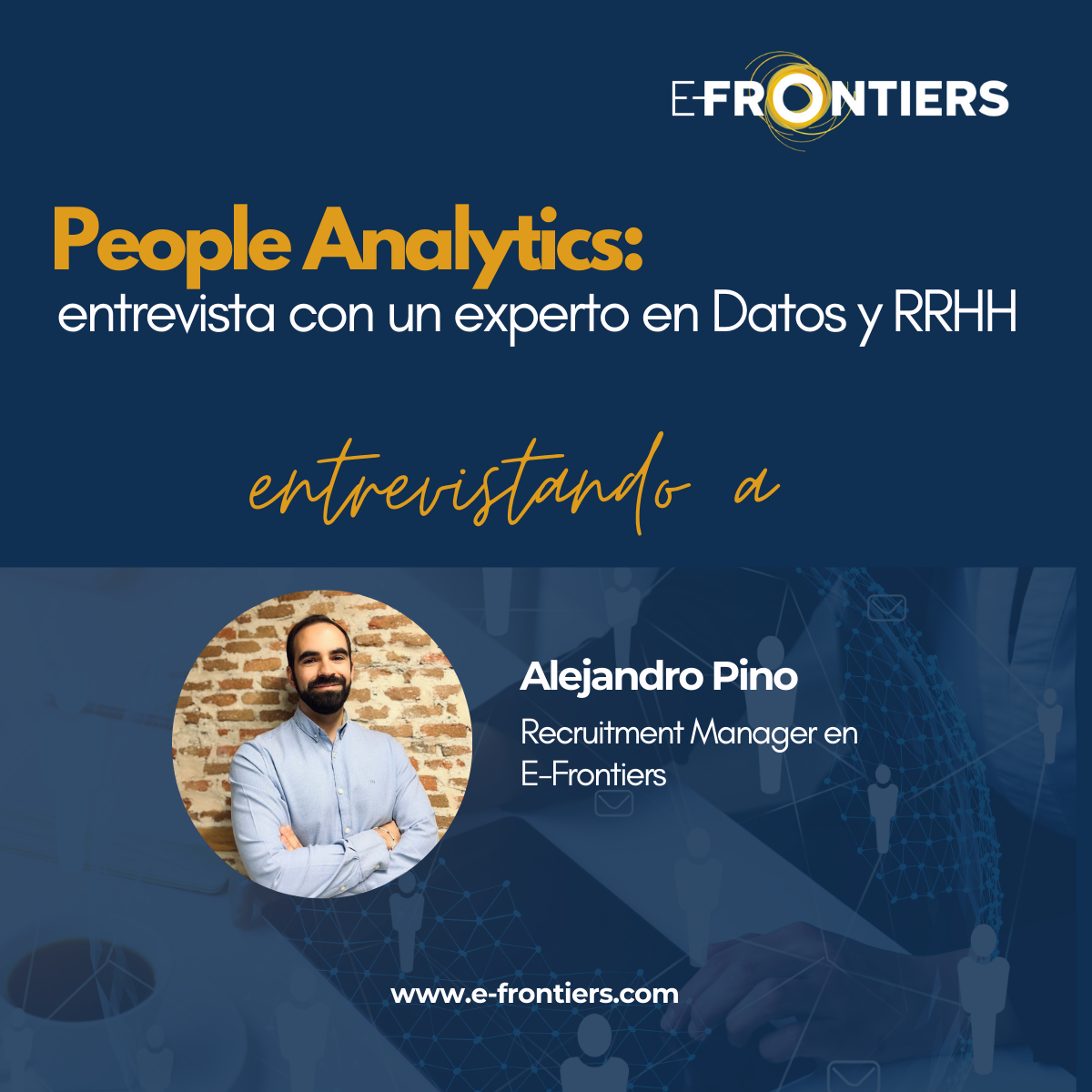
Alejandro Pino es Recruitment Manager en E-Frontiers y cuenta con una amplia trayectoria en el ámbito de los Recursos Humanos. Su experiencia en empresas privadas y como docente, combinada con una visión estratégica y un enfoque analítico, lo convierten en una voz referente en la intersección entre datos y gestión del talento.
El People Analytics ya no es opcional: es clave para gestionar talento con visión estratégica. Las compañías que lo adopten estarán mejor preparadas para atraer, retener y desarrollar a sus equipos. Si quieres llevar tu estrategia de reclutamiento al siguiente nivel, nuestro equipo de expertos en atracción de talento puede ayudarte a integrar soluciones innovadoras y basadas en datos. Contáctanos y descubre cómo podemos encontrar el mejor talento para tu organización.
El auge de los datos en España
En 2025, el sector de los datos en España está viviendo un momento único. Con una demanda creciente de soluciones basadas en datos, el país se ha convertido en un hub estratégico para centros de datos y talento digital. Esta transformación no solo está impulsando la innovación tecnológica, sino también una gran necesidad de profesionales especializados.
Desde perfiles técnicos como data engineers y científicos de datos, hasta roles estratégicos en gobernanza, visualización y analítica de negocio, el mercado está lleno de oportunidades para quienes quieren crecer en este campo.
En nuestro día a día como recruiters, podemos ver que hay una alta demanda de estos perfiles, con una simple búsqueda en LinkedIn, podemos ver que hay alrededor de 900 posiciones abiertas ahora mismo solo en España (Julio 2025).
En este blog os queremos dejar las tecnologías que están marcando el camino en este campo y a los perfiles más demandados actualmente.

Tecnologías que están redefiniendo el talento
Desde nuestro equipo, estamos observando que las empresas están invirtiendo en tecnologías que requieren nuevas habilidades y conocimientos. Algunas de las más destacadas son:
Inteligencia Artificial y Machine Learning: Se utilizan para automatizar procesos, predecir comportamientos y tomar decisiones en tiempo real y que están cada vez más integradas en procesos de negocio.
Data Fabric y Data Mesh: Es una arquitectura que permite acceder, integrar y gestionar datos de múltiples fuentes de forma unificada, facilitando la gobernanza de datos. Aquí se demandan perfiles con visión arquitectónica y experiencia en integración.
Blockchain aplicado a datos: Usado para verificar la integridad y trazabilidad de los datos, especialmente en entornos donde la información es muy sensible y la confianza es clave, como por ejemplo en banca.
Privacidad y gobernanza: Con regulaciones como el GDPR, las empresas están invirtiendo en tecnologías que aseguren la protección, trazabilidad y uso ético de los datos y por ello hay una demanda de profesionales con conocimientos y experiencia en cumplimiento normativo y ética del dato.
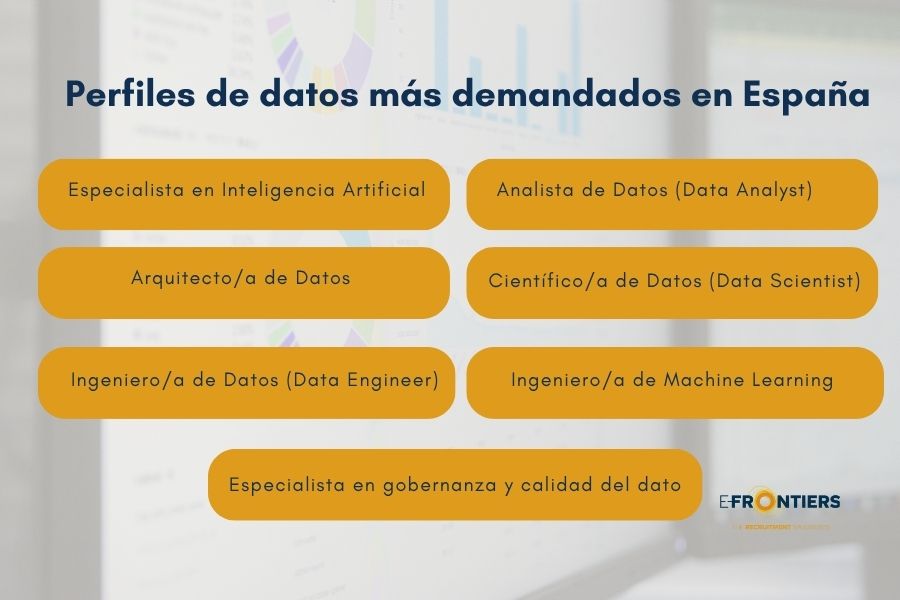
Perfiles de datos más demandados en España
Herramientas que más demandadas
En los procesos de selección, cada vez es más común que las empresas valoren experiencia con herramientas específicas. Algunas de las más demandadas en España son:
Power BI, Tableau, Qlik Sense, para la visualización y análisis.
Databricks, Vertex AI, Azure ML, utilizado en ciencia de datos y en Machine Learning.
Talend, Astera, Apache NiFi, para la integración y calidad de datos.
Snowflake, BigQuery que son plataformas cloud.
Siendo candidato, conocer estas herramientas puede suponer una mejora en la empleabilidad permitiendo destacar en entrevistas y procesos técnicos.
¿Qué significa esto para tu empresa y cómo podemos colaborar?
En este entorno tan competitivo, atraer y retener talento especializado en datos se ha convertido en un factor clave para el éxito empresarial. Las tecnologías avanzan rápido, y contar con los perfiles adecuados marca la diferencia entre liderar la transformación digital o quedarse atrás.
Desde E-Frontiers, ayudamos a nuestros clientes a identificar no solo las habilidades técnicas necesarias, sino también el potencial humano que encaja con su cultura, visión y ritmo de crecimiento. Entendemos el lenguaje del dato, conocemos las herramientas, y sabemos dónde encontrar a los profesionales que pueden marcar la diferencia.
Si tu empresa está creciendo en el ámbito del dato, estamos aquí para ayudarte a construir el equipo que lo hará posible.
Free and Paid Courses That Are Truly Worth It
In the world of tech, standing still means falling behind. Tools evolve, languages change, and companies are constantly looking for professionals who stay up to date. Upskilling is no longer optional—it’s essential for anyone looking to grow and stand out in the IT sector.
Whether you’re just starting out or looking to specialise in areas like cloud computing, artificial intelligence, web development, or cybersecurity, there are fantastic platforms out there (many of them free!) to help you on your journey.
As recruiters, we encourage our candidates to keep learning, adding new skills and knowledge to their toolbox to advance in their careers.
In this article, we’re sharing a curated list of the best places to learn, practise, and get certified, with free and premium options.

Free or Freemium Platforms
freeCodeCamp
One of the most active learning communities out there. Offers hundreds of hours of hands-on content in web development, JavaScript, Python, data science, and more.
https://www.freecodecamp.org
The Odin Project
Great for those wanting to learn fullstack development from scratch, with a project-based approach.
https://www.theodinproject.com
CS50 by Harvard (edX)
The world’s most famous introduction to computer science. Builds strong fundamentals in computing.
https://cs50.harvard.edu
Google Digital Garage
Free Google courses on digital skills, marketing, AI fundamentals, and more.
https://learndigital.withgoogle.com
MIT OpenCourseWare
Complete university-level courses from MIT, available online for free. Great for those seeking academic depth.
https://ocw.mit.edu
OpenSAP
Free SAP and digital skills courses, focused on practical and business applications.
https://open.sap.com
Paid Platforms or Premium Plans
Udemy
One of the largest libraries out there, offering affordable courses in every IT area.
Pluralsight
Focused on technology, cloud, and development. Ideal for technical profiles looking to go deeper.
LinkedIn Learning
Regularly updated courses with a focus on both tech skills and professional soft skills.
Coursera Plus
A subscription that gives you access to courses from top universities like Stanford, Duke, and Google. Includes certifications.
🔗 https://www.coursera.org
DataCamp and Codecademy
Specialised in programming, data analysis, SQL, and data science. Interactive and well-structured.
🔗 https://www.datacamp.com | https://www.codecademy.com
A Cloud Guru / Cloud Academy
Perfect for those looking to get certified in AWS, Azure, or Google Cloud. Guided learning paths and real-world labs.
🔗 https://acloudguru.com
Bonus: Alternative Resources & Communities
GitHub Learning Lab – Learn by building real projects on GitHub.
Dev.to / Hashnode / Medium – Tech blogs written by developers, for developers.
YouTube – Channels like Traversy Media, Fireship, and Tech with Tim offer high-quality, free content.
Discord & Slack Communities – Join topic-specific communities by language, stack or field to share knowledge and find opportunities.
How to Choose the Right Course
Define your goal: Are you changing careers, landing your first job, or aiming for a promotion?
Check reviews and feedback: Not all courses are created equal.
Prioritise real-world practice: Theory alone won’t take you far.
Join a community: Learning with others makes it faster—and more fun.
Let’s Chat
Technical knowledge is more accessible than ever. A university degree is no longer a prerequisite to begin – or progress – in the IT sector. What truly matters is your ability to learn, adapt, and apply your skills effectively.
Do you have a platform you’d recommend? Are you exploring new career opportunities? Get in touch — we’d be happy to connect.
As we reach the halfway mark of 2025, Ireland’s economy is still in relatively good shape. The latest European Commission Economic Forecast for Ireland outlines a picture of continued growth, low inflation, steady employment, and a resilient labour market. But global issues like trade tensions and tariffs could impact things in the coming months. Here’s a summary of what’s been happening and what to watch out for next.
Strong Job Market
Ireland’s job market is in a healthy place:
- Unemployment stayed low at 4.3% in 2024 and 2025, with a small rise to 4.4% expected in 2026.
- More people are working – nearly 2.8 million people were employed in early 2025, up 3.3% from the same time last year.
- While job openings are starting to level off, notably in the IT and Science areas, and hiring is expected to slow a little over time, job openings still remain 8% above pre pandemic figures according to a recent report from Indeed

Remote and Hybrid Work Is Here to Stay
Even though many companies are pushing staff on a to return to the office, remote and hybrid jobs are still popular. According to research by Indeed:
- By the end of 2024, 17.5% of job ads offered remote or hybrid work – over 4 times higher than before the pandemic.
Sectors offering the most flexible jobs include:
- Arts & Entertainment (50%)
- Media & Communications (43%)
- Insurance (43%)
- Software Development (41%)
Inflation Staying Low
Prices are staying steady, which is good news:
- Inflation was just 1.3% in 2024 and is expected to stay low – 1.6% in 2025 and 1.4% in 2026.
- Falling prices for energy and goods are helping, even though food and services have gone up.
Economy Growing, But Slowing Down Slightly
Ireland’s economy grew by 1.2% in 2024 and is expected to grow by 3.4% in 2025, slowing slightly to 2.5% in 2026.
- Growth is being driven by strong exports, especially in pharma and tech.
- However, global trade issues – like new tariffs – could slow things down.
Trade Tensions Could Cause Problems
Ireland’s economy depends heavily on exports, especially to the U.S. That means changes to trade rules or tariffs can have a big impact.
- With U.S.–EU trade talks showing signs of strain and the possibility of 30% tariffs on EU goods back on the table, Ireland could face serious economic headwinds. If tariffs in the range of 10–20% are implemented, Ireland’s growth may slow to around 2%, and between 25,000 and 80,000 jobs could be at risk – particularly across tech, pharma, and manufacturing. Listen to more here
- The outcome of these trade negotiations could have real consequences for business confidence. If talks break down, we may see companies pulling back on hiring and investment due to increased uncertainty and cost pressures.
Sector-by-Sector Summary
Tech & IT
The tech job market is strong, with unemployment at 4.3%.
There’s growing demand for skills in AI, machine learning, cybersecurity, and cloud computing.
A recent survey by Nucamp showed machine learning skills are up 383% in demand.
Outlook: Positive, but global trade issues could slow growth.
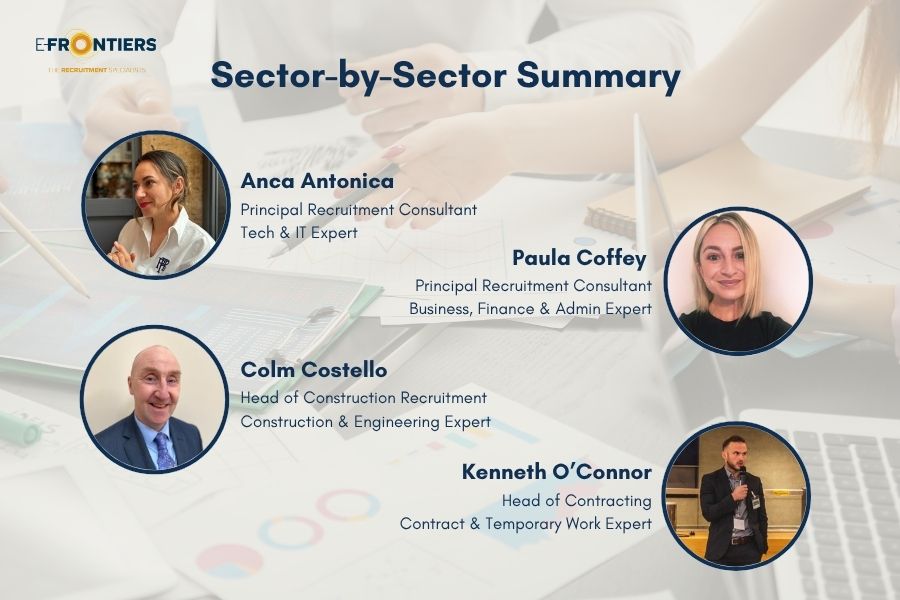
Our Principal Recruitment Consultant in IT, Anca Antonica, celebrates 10 years at E-Frontiers this month. She is sharing her insights based on what she’s observed this first half of the year:
“The first half of 2025 showed more resilience than many expected.” She noted that while some sectors remained cautious, especially early in Q1, we saw a steady increase in hiring confidence across tech roles – particularly in fintech, public sector digital transformation, and contract positions. There’s been strong demand for developers (Java, .NET, Full Stack), DevOps specialists, and integration experts with platforms like Celigo or Workday. Clients are balancing the need to control costs with the urgency to deliver on strategic tech projects, especially cloud migrations and AI/automation initiatives.
From her experience during Q1 and Q2 2025, candidates are increasingly focused on flexibility – hybrid or remote-first options are still top of mind. Many also ask about team structure, company values, and stability, showing a shift from just chasing salary. Regarding companies, those that stand out are offering clear progression paths, strong onboarding processes, and involvement in high-impact projects. A growing number are also highlighting upskilling opportunities (AI/ML, cloud certs), which resonates well with more tech-driven talent.
Focusing on the near future, she thinks the sector will face some challenges: skills shortages are becoming more acute in specific areas like AI, advanced cloud engineering, and data governance. Some companies are still navigating the return-to-office debate, which can limit their candidate pool. There’s also increasing competition from remote-first international employers offering Dublin-level salaries without the commute, so local companies need to sharpen their employer branding.
Her core insight for clients: “Speed of engagement is everything. The best candidates are often off the market in under two weeks. Clients who streamline interviews, offer clarity on projects and progression, and move decisively are consistently winning the top talent. That agility, combined with a clear EVP (Employee Value Proposition), is what makes all the difference right now.”
Outlook: Cautiously optimistic. Demand for mid-to-senior IT professionals – especially in cloud, cybersecurity, and ERP (SAP, Dynamics 365) – is expected to stay strong. Contract roles will grow, with private sector hiring likely to pick up in Q4 if economic conditions remain stable.
Construction & Engineering
According to a recent report from Research and Markets.com Irish Construction shows strong signs of growth:
- The industry is expected to grow by 3.3% in 2025, and by 4.8% annually from 2026 to 2029.
- Planning permissions increased by 2.2% in 2024, after a drop of 7.4% in 2023, showing renewed momentum.
- Major public investment is planned:
- €713 million allocated for roads in 2025.
- €600 million in loans from Bank of Ireland to help build 4,000 homes by 2028.
- The government housing targets include:
- 41,000 homes in 2025
- 43,000 in 2026
- 303,000 homes by 2030
Outlook: Positive, but persistent labour shortages and supply issues remain a challenge.
This is echoed by our Head of Recruitment for Construction, Colm Costello, who shared his experience of the first half of the year and expectations for the months ahead:
H1 2025 Performance: Colm noted that the first half of 2025 went well overall, particularly considering that our Construction desk is still relatively new. Demand for talent was strong, and a solid pipeline of roles was built. That said, sourcing suitable candidates continues to be the main challenge – a familiar theme across the sector.
Outlook for H2 2025: Looking ahead to the second half of the year, Colm is optimistic. While the summer months may bring a brief slowdown, Q3 is traditionally the busiest time for construction recruitment, and expectations are high for similar momentum this year. Although a dip is typically seen in Q4, the team is already forward-planning to minimise any disruption.`
Candidate Priorities & What Employers Need to Offer: When it comes to candidate preferences, hybrid working has become a standard expectation – especially among Quantity Surveyors and Estimators. Candidates already enjoying hybrid setups are reluctant to consider new roles that don’t offer similar flexibility. Still, it’s salary that remains the number one motivator when candidates consider a move.
Sector Risks on the Horizon: Colm also flagged a few emerging risks. The sector is currently driven by residential, pharmaceutical, and data centre projects. The housing shortage will likely keep residential activity high, but potential changes in U.S. foreign policy – such as new tariffs – could lead American companies to scale back investment in Ireland’s Pharma and Data Centre space. Another ongoing challenge is the highly competitive recruitment market, with many agencies chasing a limited talent pool.
His key takeaway for clients? “Flexibility and competitive salaries are absolutely essential if you want to attract – and more importantly, retain – the best candidates in today’s tight construction market.”
Business, Finance & Admin
Key Trends:
Roles such as fundraisers, compliance managers, and learning specialists are in high demand.
Growth is being fuelled by regulatory change, new technologies, and a focus on learning and development.
Hiring remains steady despite broader market uncertainty.
Flexibility and company culture are major decision-making factors for candidates.
AI is reshaping traditional business support roles, creating a need for continuous upskilling.
Our Principal Consultant in Sales & Marketing, Paula Coffey, shared her observations on the first half of the year and her expectations for what lies ahead:
She noted that H1 2025 didn’t quite meet expectations. Activity was slower than hoped, with fewer open roles and longer decision-making cycles across the board. That said, Paula remains cautiously optimistic about the second half of the year – “Summer tends to bring a boost in business support recruitment, and I’m already seeing early signs of renewed momentum”.
Candidates continue to prioritise flexibility and workplace culture above all else. Hybrid working is now considered the baseline, and companies that can offer more than just remote options -such as strong internal values and employee wellbeing initiatives – stand out the most.
Looking ahead, one of the key risks is the ongoing disruption caused by AI. Many traditional support roles are evolving, and candidates must be proactive in keeping up with trends and technology to stay relevant.
Paula’s key message to clients is simple: “top candidates are being lost to slow hiring processes.” In a competitive market, she believes clear communication and fast decision-making are essential to securing the best talent.
Outlook: Demand is expected to remain steady, especially for roles connected to regulatory functions, learning and development, and business transformation.
Contract & Temporary Work
- Contract roles remain in demand, supported by:
- Strong immigration numbers
- Continued hybrid working
- Sector-specific growth in tech, finance, and construction
- While forecasts don’t separate contract roles, all signs point to continued need.
- Outlook: Optimistic. Contracting should grow, especially in busy sectors. Risks remain if business confidence is affected by global trade issues.
Our Head of Contracting, Kenneth O’Connor, shared his observations on the first half of the year and what he thinks about the rest of 2025:
He noted that we had a good start to the year and the market, in the contracting industry, has exceeded his expectations. This has been across sectors for us, but activity is continuing to increase.
At the moment, both companies and candidates are seeing that more flexibility is key for agreements to be made on both sides.
When it comes to risks and challenges on the horizon, he points to the usual suspects – Artificial Intelligence, potential tariffs, and broader market uncertainty. However, he believes that with uncertainty comes opportunity, as companies increasingly explore shorter-term, flexible solutions to meet their resource needs.
Kenny’s key message for his clients is that engaging contractors for short-term solutions provides a lot of value.
Outlook: He remains optimistic and expects continued growth. While some uncertainty still lingers, many clients are turning to the contractor model as a flexible hiring solution in the current climate. “We anticipate a slow but steady rise in activity across the contracting sector,” he says.
Final Thoughts
Ireland’s economy continues to show strength, with growth projected across key sectors. While hiring may ease slightly, demand remains healthy -particularly in tech, construction, and contracting.
Flexible work is no longer a perk but a priority, and companies offering hybrid or remote-first models continue to attract top talent.
Contracting and infrastructure investment present exciting opportunities, especially as businesses seek agile solutions in an evolving landscape.
However, global trade uncertainties – including tariffs and geopolitical shifts – pose risks, particularly for export-driven industries.
Across the board, our consultants agree: challenges lie ahead, but so do opportunities. The key will be adaptability, speed, and a strong value proposition for both clients and candidates.
We’d love to hear from you— How did Q1 and Q2 go for your business? What challenges or opportunities do you see on the horizon? What are your expectations for the rest of 2025?
For further recruitment insights, please check out our Industry insights section on our website.
Cursos gratuitos y de pago que realmente valen la pena
En el mundo de la tecnología, quedarse quieto es retroceder. Las herramientas cambian, los lenguajes evolucionan y las empresas buscan cada vez más profesionales que se mantengan actualizados. El “upskilling” ya no es una opción: es una necesidad para quienes quieren destacar y crecer en el sector IT.
Ya sea que estés dando tus primeros pasos o buscando especializarte en nuevas áreas como cloud computing, inteligencia artificial, desarrollo web o ciberseguridad, existen plataformas increíbles (¡muchas gratuitas!) que te pueden ayudar.
Como recruiters, siempre aconsejamos a nuestros candidatos un continuo aprendizaje, añadiendo conocimientos y habilidades a su la caja de herramientas para poder avanzar en sus carreras laborales.
Por ello, en este artículo, os compartimos una selección de los mejores sitios para aprender, practicar y certificarte, tanto sin costo como con opciones de pago o premium, incluyendo la opción de los bootcamp y/o máster.
Upskilling: Plataformas Gratuitas o Freemium
freeCodeCamp
Una de las comunidades de aprendizaje más activas. Ofrece cientos de horas de contenido práctico en desarrollo web, JavaScript, Python, data science, y más.
The Odin Project
Ideal para quienes quieren aprender desarrollo fullstack desde cero, con una metodología orientada a proyectos reales.
https://www.theodinproject.com
CS50 de Harvard (edX)
El curso de introducción a la informática más famoso del mundo. Brinda bases sólidas en ciencias de la computación.
Google Digital Garage
Cursos gratuitos de Google sobre habilidades digitales, marketing, fundamentos de IA y más.
https://learndigital.withgoogle.com
MIT OpenCourseWare
Cursos completos del MIT disponibles online. Perfecto para quienes buscan profundidad académica.
OpenSAP
Ofrece cursos gratuitos de SAP y habilidades digitales, con enfoque práctico y empresarial.
Upskilling: Plataformas de Pago o con Planes Premium
Udemy
Una de las bibliotecas más amplias, con cursos accesibles en todas las áreas de IT.
Pluralsight
Enfocada en tecnología, cloud y desarrollo. Ideal para perfiles técnicos que quieren profesionalizarse aún más.
LinkedIn Learning
Cursos actualizados constantemente, con foco en habilidades tech y soft skills para profesionales.
Coursera Plus
Suscripción que da acceso a cursos de universidades top como Stanford, Duke o Google. Incluye certificaciones.
DataCamp y Codecademy
Especializados en programación, análisis de datos, SQL y ciencia de datos. Interactivos y bien estructurados.
https://www.datacamp.com | https://www.codecademy.com
A Cloud Guru / Cloud Academy
Perfectos para quienes quieren certificarse en AWS, Azure o Google Cloud. Rutas de aprendizaje guiadas y laboratorios reales.
Bootcamps: una vía efectiva para especializarse
Hoy en día, existen alternativas más dinámicas que los cursos online tradicionales. Los bootcamps llegaron para quedarse y se han consolidado como una opción muy efectiva tanto para quienes buscan reorientar su carrera profesional como para quienes desean especializarse en nuevas áreas tecnológicas.
Como recruiters, hemos visto de primera mano cómo muchos profesionales dieron un giro a su trayectoria gracias a un bootcamp y, años después, cuentan ya con carreras sólidas en el sector tech. Pero su función va más allá del reskilling: actualmente, los bootcamps se han convertido en un puente fundamental para adquirir competencias en tecnologías emergentes como Data, Inteligencia Artificial, Cloud Computing, entre otras.
Algunas escuelas especializadas que recomendamos explorar son:
The Bridge: Escuela de innovación digital que ofrece bootcamps intensivos en Data Science, Ciberseguridad, Diseño UX/UI, Desarrollo Web y Producto Digital, con un enfoque muy práctico y conexión directa con empresas.
Adalab: Escuela especializada en formar a mujeres en tecnología, principalmente en desarrollo web, fomentando la diversidad y reduciendo la brecha de género en el sector tech.
¿Cómo Elegir el Curso Adecuado?
- Define tu objetivo: ¿Buscas cambiar de rol, conseguir tu primer trabajo o subir de nivel?
- Revisa tanto reseñas como comentarios: No todos los cursos son iguales.
- Elige cursos con práctica real: ¡La teoría sola no alcanza!
- Súmate a una comunidad: Aprender con otros acelera y motiva.
¿Hablamos?
El conocimiento técnico es más accesible que nunca. Ya no es necesario tener un título universitario para entrar o crecer en el mundo IT: lo que importa es tu capacidad de aprender, adaptarte y aplicar tus conocimientos.
¿Tienes alguna otra plataforma que recomendarías? ¿Estás buscando un nuevo reto laboral? ¡Escríbenos y hablamos!
Looking to stay informed, inspired, and better connected in the tech world?
We’ve rounded up some of the top tech events happening in Dublin from July to September 2025. Whether you’re focused on AI, cybersecurity, software, or innovation, these conferences and summits offer expert insights, networking opportunities, and a chance to stay ahead in a fast-moving industry. Have a browse and see what fits your calendar.
Longevity Summit
When: Wed 2–Fri 4 July 2025
Where: Trinity College, Dublin
Why attend: Leading experts share the latest in longevity research, healthtech, and biotech innovations driving societal impact.
Sign‑up: via Eventbrite/Website. Email: info@theccd.ie
Future IP Europe
When: Tue 16th – Wed 17th September 2025
Where: Dublin
What: A key conference in collaboration with Enterprise Ireland, exploring innovation and IP strategy amid tech disruption and legal shifts. Featuring Irish and European insights, it covers AI, trademarks, copyright, and global IP trends.
Sign-up: via Eventbrite. Tickets
CISO Inspired Summit Ireland 2025
When: Tue 23rd September 2025
Where: Maynooth, Carton House
What: Brings together cybersecurity leaders to share innovative strategies and address emerging threats within the rapidly evolving digital landscape. Under the theme “Securing Tomorrow,” the summit serves as a unique platform for security professionals to collaborate, exchange insights, and pave the way towards a secure digital future.
Sign-up: via Eventbrite
Data Centres Ireland 2025
When: Wed – Thu 19th – 20th November, 2025
Where: RDS Main Arena, Dublin
What: Datacentres Ireland event will be the opportunity to hear the latest ideas, best practice, and case studies presented by leading industry experts and take part in facilitated discussions
Sign-up: Click on the link for tickets

ShipItCon
When: Fri 29th August 2025
Where: Dublin, Mansion House
What: Focused on software delivery and related topics, such as DevOps, continuous delivery, and continuous integration. The conference brings together industry experts, practitioners, and thought leaders to share their experiences, insights, and best practices for delivering software faster, more efficiently, and with higher quality.
Sign-up: via Website
Analytics Summit 2025
When: Thursday 9th October, 2025
Where: The Convention Centre, Dublin
What: Leaders and practitioners in data, analytics, and artificial intelligence. The summit will explore how organisations are leveraging data to address complex challenges, improve operational efficiency, and deliver business value.
Sign-up: via Eventbrite
Dublin Tech Connect
When: Thu 13th November, 2025 6.30 pm
Where: HQ, Dublin
What: Meet top tech companies and teams in Dublin and network with professionals.
Sign-up: Tickets via website
Need to scale fast? See how E-Frontiers delivered a compliant, high-performing engineering squad in just 14 days for a global fintech facing tight delivery deadlines.
Client Overview
A leading global fintech enterprise with over 25,000 employees worldwide launched a major greenfield initiative to enhance its European digital payments infrastructure.
The programme was centred in Ireland and required specialist engineering squads to be operational within tight delivery windows to meet Q2 development goals for a greenfield project.

The Challenge
The client needed to:
– Rapidly build a full squad of senior Java microservices engineers.
– Start onboarding within 10 business days from project kick-off.
– Ensure all contractors were compliant, reference-checked, and onboarded to enterprise security and tooling protocols.
Complicating the situation:
– The client’s internal recruitment was already at capacity.
– The technology stack was highly specific (Java, Spring Boot, AWS Lambda, Docker, Kubernetes, GitHub Actions).
– Project delays could cost up to €250k per sprint in lost development velocity.
Our Approach
We assigned a 3-person delivery team (1 Account Manager + 2 Principal Recruiters) who ran a structured sprint-based recruitment workflow:
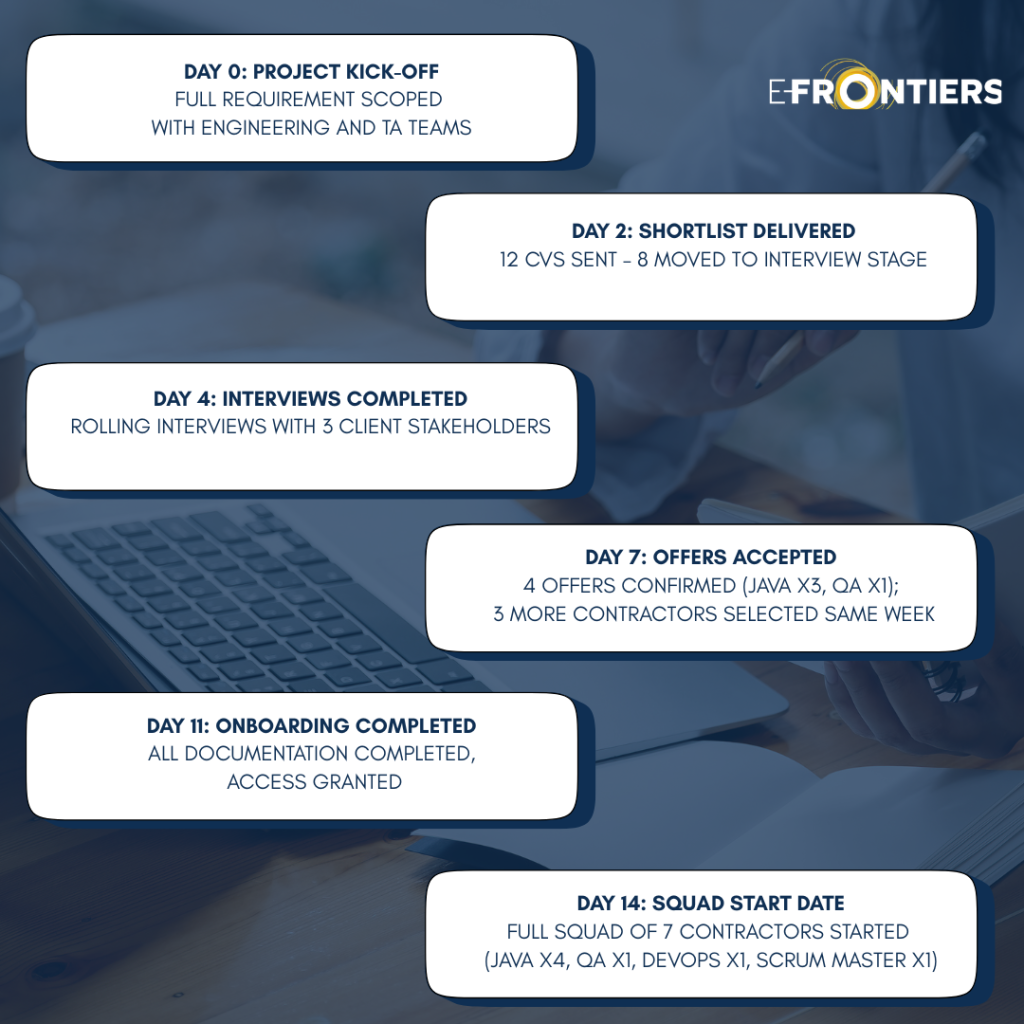
– Day 0 (Project Kick-off): Requirements gathered via live session with engineering leadership and TA partner.
– Day 1–2: Candidate pool activation via Contractor Database, network, contract market penetration.
– Day 3: 12 qualified CVs submitted.
– Day 4–6: Rolling interviews scheduled across 8 shortlisted candidates.
– Day 7: First 4 offers made and accepted.
– Day 8–9: Compliance + onboarding prep (ID verification, tax checks, background screening).
– Day 10: Equipment shipped / VPN access confirmed.
– Day 14: Full team started on-site and remote.
The Results
– 7 contractors onboarded in 14 calendar days — ahead of the client’s 3-week target.
– Zero offer rejections, 100% retention post first 3 sprints.
– Client sprint velocity achieved in week 1, contributing directly to a successful MVP delivery.
– Saved the client an estimated €80,000+ vs. typical agency time-to-hire lag (~30 days).
– Created a repeatable squad delivery model for future team builds in Q3 and Q4.
Key Takeaways
– A 14-day time-to-value is achievable with specialist contract delivery models.
– Structured shortlisting, automated outreach, and pre-qualified talent pools cut hiring timelines dramatically.
– When onboarding is managed by the recruitment partner, internal teams save dozens of hours.
Need to scale a team in weeks, not months?
Contact us to learn how our specialist contracting solutions can help you build and onboard technical squads with precision and speed.
This case study was written by Kenneth O’Connor, Head of Contracting for Ireland and the UK at E-Frontiers.
Como especialistas en selección de talento, estamos convencidos de que la diversidad no es solo una cuestión de justicia social, sino una gran herramienta de innovación para las empresas. Sin embargo, el sector tecnológico todavía enfrenta importantes retos para ser realmente inclusivo, especialmente en cuanto a la representación de mujeres, colectivo LGTBI+ y profesionales neurodivergentes.
Hoy queremos compartir algunas ideas y buenas prácticas para que las empresas puedan avanzar hacia entornos laborales más inclusivos y diversos. También os invitamos a ver (o escuchar a modo podcast) la grabación de nuestro evento del pasado 5 de Junio con Women in Tech, donde abordamos el papel de la mujer en la industria tecnológica y donde las panelistas nos hablan sobre liderazgo, iniciativas de diversidad y conciliación para atraer y retener talento femenino y referentes.

Diversidad de género: más mujeres en el sector IT
Las mujeres representan una minoría en muchos equipos tecnológicos. España, está algo por encima de la media en comparación con el resto de Europa, pero aún hay un largo camino para llegar esa paridad. Para cambiar esta realidad:
Revisa el lenguaje en las ofertas de empleo: evita sesgos de género con herramientas como Gender Decoder o Textio.
Visibilidad y liderazgo: apoya a mujeres en roles de liderazgo, dales voz en eventos y paneles. Como comentó Patricia Arboleda (Presidenta de Women in Tech Spain) en el evento, es necesario formar a las mujeres no solo en competencias técnicas, sino también en soft skills como negociación, estrategias para delegar, liderazgo, etc.
Mentoría y desarrollo: fomenta programas de mentoría y capacitación para mujeres en tech.
Conciliación real: ofrece flexibilidad horaria y teletrabajo, especialmente importante para muchas familias en etapas de crianza.
Discapacidades físicas: actualiza tu entorno
También se pueden dar casos de personas con diversas incapacidades físicas, siendo las más comunes visuales o de movimiento.
Adapta el entorno de trabajo: rampas, ascensores, espacios amplios y herramientas con tecnología accesible que permitan a las personas trabajar con normalidad.
Flexibilidad de teletrabajo y de horario: Muchas de estas personas a menudo tienen problemas para acudir a sus centros de trabajo por diversos motivos. Permitir una flexibilidad en cuanto a su ubicación daría lugar a una mayor facilidad para ellos de ejercer sus tareas diarias.
Igualdad de oportunidades: Las personas con discapacidad física deberían poder participar en procesos de selección, formación o promoción en las mismas condiciones que cualquier otra. A veces solo hace falta adaptar una entrevista o una prueba.
Inclusión de la comunidad LGTBI+
Muchas personas LGTBI+ aún temen mostrarse abiertamente en el trabajo. Las empresas pueden:
Crear espacios seguros: formar a los equipos sobre diversidad y respeto, y establecer canales de denuncia seguros.
Celebrar la diversidad: visibiliza fechas como el Orgullo y a lo largo del año, con acciones auténticas, no solo campañas estéticas.
Políticas inclusivas: asegúrate de que los beneficios de la empresa (por ejemplo, seguros médicos o permisos familiares) contemplen a todo tipo de familias y parejas.
Neurodivergencias: el valor de pensar diferente
Personas con autismo, TDAH, dislexia u otras condiciones neurodivergentes pueden aportar enfoques únicos. Para ser inclusivos:
Entrevistas adaptadas: permite formatos alternativos a la entrevista tradicional si es necesario.
Ambientes de trabajo adecuados: reduce ruidos, ajusta iluminación o da acceso a herramientas que favorezcan la concentración.
Flexibilidad en la gestión del trabajo: no todos trabajan igual, y eso puede ser una fortaleza.
¿Por dónde empezar? Guía práctica para empresas
Adoptar una cultura diversa e inclusiva requiere compromiso a largo plazo y acciones concretas. Estas son algunas claves para empezar (o avanzar) con una estrategia de diversidad real y efectiva:
Realiza un diagnóstico interno
Como con cualquier otro proyecto, antes de planificar y actuar, es fundamental conocer el punto de partida. Estas son algunas de las preguntas con las que puedes empezar:
-¿Qué nivel de diversidad hay actualmente en tu plantilla (género, identidad, orientación, neurodivergencia, etc.)?
-¿Cómo se sienten las personas en cuanto a inclusión y seguridad psicológica?
-¿Existen procesos o barreras que estén limitando la participación de ciertos colectivos?
Utiliza encuestas internas anónimas, entrevistas individuales, análisis de datos de RRHH segmentado. Incluso hay empresas externas que se dedican a hacer estos análisis y recibir directamente los datos.
Define objetivos claros y medibles
No se trata solo de “diversificar por diversificar”, sino de establecer metas que tengan impacto:
-¿Quieres aumentar el porcentaje de mujeres en roles técnicos o directivos?
-¿Buscas contratar talento neurodivergente o formar un comité de diversidad?
-¿Te interesa implementar políticas que garanticen igualdad real para personas LGTBI+?
En base a los datos obtenidos previamente, un objetivo concreto podría ser: “Aumentar un 15% la representación femenina en puestos de desarrollo en los próximos 12 meses”.
Revisa tus procesos de selección y promoción
Durante el proceso de atracción y selección de talento pueden colarse muchos sesgos incoscientes. Para evitarlo pudes utilizar estas estratégias:
-Utiliza CVs ciegos o software de análisis para identificar sesgos.
-Asegúrate de tener paneles de entrevistas diversos y de que estos estén formados en buenas prácticas durante las entrevistas (qué preguntas no hacer)
-Pregunta de forma estructurada para valorar habilidades, no afinidades personales.
-En cuanto a la promoción: Promueve la igualdad de oportunidades de promoción interna, con criterios objetivos y transparentes.
Crea espacios seguros
Muchas personas no comparten sus experiencias por miedo o desconfianza. Por ello generar confianza es clave, en este sentido puedes:
-Establecer canales seguros de comunicación (incluso anónimos).
-Crear grupos de afinidad o redes de empleados (ej. red LGTBI+, mujeres tech, etc.).
Capacita a tu equipo y liderazgo
La diversidad sin inclusión es solo es una medida superficial. Es necesario que la propia cultura empresarial lo integre. Estas son algunas estrategias que se pueden llevar a cabo para ayudar con la integración de la diversidad e inclusión:
-Forma a managers, líderes de equipo y al equipos en sesgos inconscientes, liderazgo inclusivo y lenguaje respetuoso.
-Crea espacios donde los empleados puedan aprender sobre realidades que quizás no conocen (charlas, eventos, recursos internos).
Evalúa, mejora y celebra
La diversidad es un camino continuo. Evalúa regularmente el progreso, ajusta tus estrategias y celebra los logros:
-Publica informes internos de avance.
-Reconoce el trabajo de los equipos o empleados que impulsan la inclusión.
-Aprende de los errores y adapta tus políticas con humildad y apertura.
Haz de la diversidad una parte de tu marca empleadora
Los candidatos tech cada vez valoran más los entornos diversos e inclusivos. Comunica de forma auténtica:
-Comparte historias reales de empleados.
-Muestra tu compromiso con datos, iniciativas y resultados.
-Sé coherente: la diversidad no debe ser solo parte del marketing, sino del ADN de tu cultura.
¿Necesitas apoyo?
Desde E-Frontiers, estamos aquí para ayudarte a encontrar el talento tech que no solo cumpla con las habilidades técnicas, sino que también aporte a una cultura más rica, humana y creativa.
Si quieres saber más sobre nuestros servicios o necesitas ayuda para buscar perfiles para tu equipo, ¡no dudes en contactarnos! Estamos aquí para ayudarte.
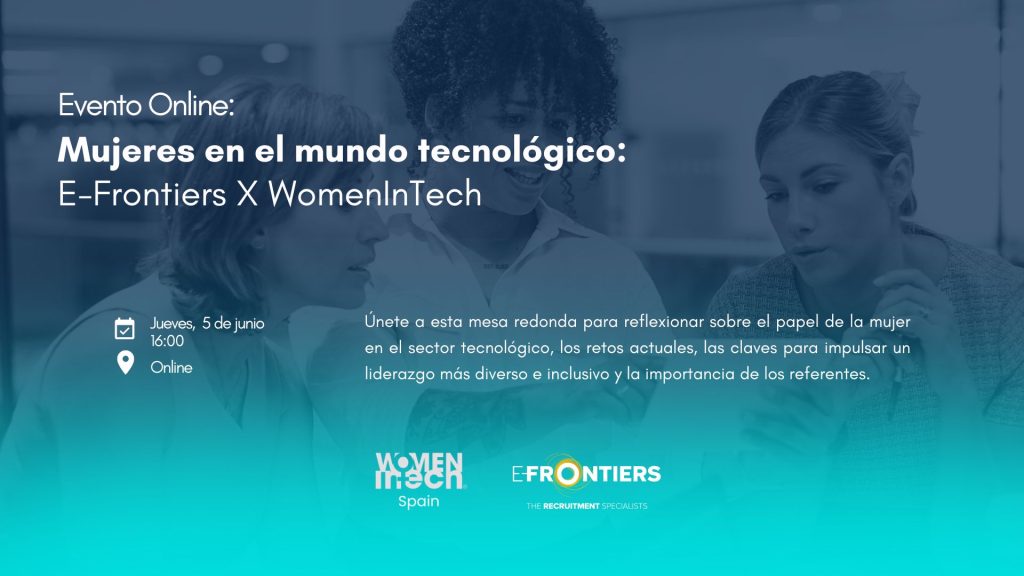
El pasado 5 de junio, tuvimos el placer de organizar una mesa redonda junto a Women in Tech® Spain, fue un evento online pensado para abrir conversaciones sobre el papel de la mujer en el sector STEM, compartir experiencias reales y avanzar hacia una industria más inclusiva y diversa. Los miembros de nuestro equipo de E-Frontiers España, Ana Martín (Senior Tech Recruiter) y Cristina Rafael (Marketing) moderaron y guiaron esta conversación tan enriquecedora.
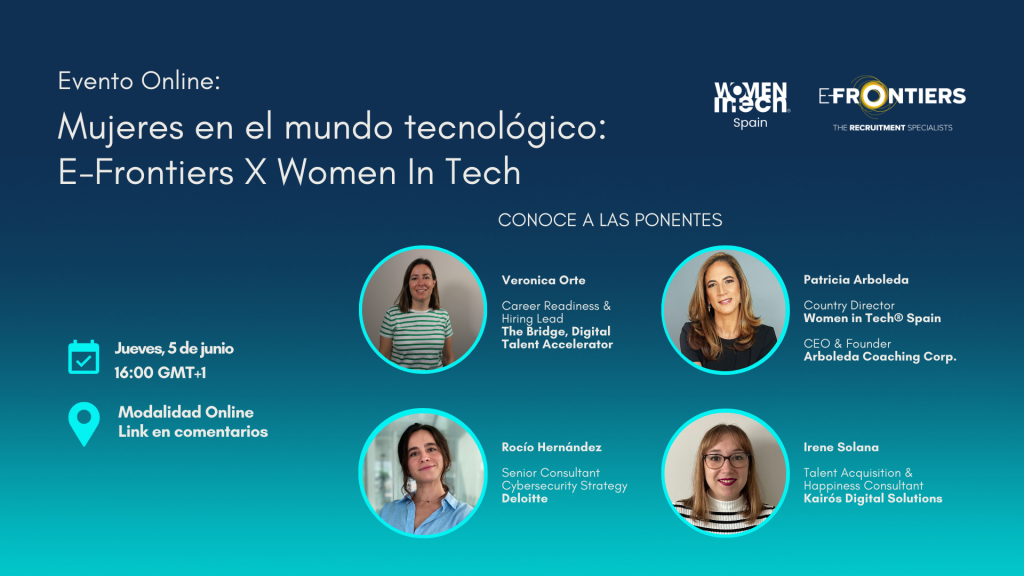
Las Panelistas
Verónica Orte Sánchez – Career Readiness & Hiring Lead @ The Bridge | Digital Talent Accelerator
Especialista en edtech, Verónica lidera iniciativas que conectan educación, empleabilidad y transformación digital, impulsando el desarrollo profesional de nuevas generaciones de talento tech.
Patricia Arboleda – Country Director @ Women in Tech® Spain | CEO @ Arboleda Coaching
Coach ejecutiva y exdirectiva de empresas Fortune 500, Patricia acompaña a líderes a crecer con propósito. Es referente en liderazgo femenino y promotora activa de ecosistemas inclusivos.
Rocío Hernández – Cybersecurity Risk Advisory Consultant @ Deloitte
Desde su posición en el área de ciberseguridad, Rocío representa a una nueva generación de mujeres expertas en IT, comprometidas con construir un entorno digital más seguro y diverso.
Irene Solana – Talent Acquisition & Happiness Consultant @ KAIROS DIGITAL SOLUTIONS
Con una sólida trayectoria en selección y talento, Irene aporta una mirada estratégica sobre cómo construir culturas organizativas inclusivas y cómo atraer y retener talento diverso en entornos tecnológicos.
Nuestros expertos abordaron temas como:
- Mujeres en el mundo tecnológico: situación actual
- Iniciativas de diversidad y atracción de talento
- Liderazgo femenino
- Importancia de los referentes
Puedes ver la grabación del evento aquí:
Como expertos en selección de talento tech, en E-Frontiers creemos firmemente que la diversidad no es solo una cuestión de justicia social, sino un motor clave de innovación, creatividad y competitividad para las empresas. Aun así, el sector tecnológico continúa enfrentando grandes desafíos para construir entornos realmente inclusivos, especialmente en lo que respecta a la representación de las mujeres.
¡Sigamos aprendiendo y creciendo juntos!
Contáctanos para saber más sobre nosotros y cómo trabajamos con clientes y candidatos.
¡Te esperamos en la edición del año que viene!
Considering Contracting in 2025? Here’s Your Essential Compliance Checklist for Ireland.
First things first: What is a contractor?
Independent contractors are professionals who offer their services or products to clients for payment but are not classified as employees. This distinction means they typically do not receive employee benefits like paid leave, sick days, or minimum wage protections. However, in exchange, contractors enjoy greater flexibility, allowing them to choose their projects, set their schedules, and work in a way that best suits their lifestyle.
Embarking on a contracting career in Ireland’s tech and project management sectors can be both exciting and rewarding. The flexibility, exposure to diverse projects, and potential for higher earnings are appealing. However, it’s crucial to stay compliant with Ireland’s regulatory and legal requirements to ensure a smooth and successful journey.
Here’s a comprehensive checklist to guide you:

1. Business Structure: Choose Wisely
Decide on the most suitable business structure for your contracting activities. This really depends on the type of person you are and your skillset. In Ireland, contractors typically choose one of the following options:
– Sole Trader: Register as self-employed, making you responsible for filing tax returns, managing pension contributions, and handling financial matters independently. This can be tricky for some and many opt to hire an accountant to assist with these responsibilities.
– Limited Company: Establishing a limited company can offer tax efficiencies and liability protection, but requires more administrative work.
– Umbrella Company: You pay an umbrella company to manage tax, pension contributions, and holiday entitlements. However, this convenience comes at a cost, often up to 15% of your salary in fees.
Each option has its implications for liability, taxation, and administrative responsibilities. Consulting with a financial advisor can help determine the best fit for you and your situation.
2. Tax Obligations: Stay Informed and Compliant
– Register with Revenue: Ensure you’re registered with the Irish Revenue Commissioners for all relevant taxes, including Income Tax, Corporation Tax (if applicable), and Value Added Tax (VAT). This is essential to avoid penalties.
– Understand Your Tax Liabilities: Familiarise yourself with the tax rates and allowable deductions for your business structure. Make sure to keep track of all legitimate business expenses so you can use these to lessen your tax burden.
– Timely Filings: Timing is very important here. You must adhere to all tax filing deadlines to avoid penalties. Hiring a professional accountant can be a huge help here.
3. Insurance: Protect Yourself and your Business
– Professional Indemnity Insurance: This covers claims arising from professional negligence or errors.
– Public Liability Insurance: Protects against claims for injury or property damage caused to third parties.
– Employer’s Liability Insurance: This one is necessary if you hire employees or subcontractors.
4. Contracts: Clarity is Key – Establish Clear Agreements
– Written Agreements: Always have a clear, written contract outlining the scope of work, payment terms, confidentiality clauses, and termination conditions. Clear agreements set expectations and work to protect both parties.
– Avoid Misclassification: ensure the client has classified you as an independent contractor and not an employee to prevent issues with Revenue.
– Review Terms Thoroughly: Understand all your contractual obligations. It is a good idea to seek legal advice if any terms are unclear.
5. Pension and Social Security: Plan for the future
– Contribute to a Pension Scheme: As a contractor, you’re responsible for your retirement planning. Setting up a personal pension plan to secure your future is crucial.
– Social Insurance (PRSI): PRSI payments are important as these are your gateway to state benefits. Ensure you’re making the appropriate Pay Related Social Insurance contributions, otherwise it may affect your entitlements.
6. Continuous Professional Development (CPD): Stay Competitive
– Invest in Learning: Stay updated with industry trends, technologies, and best practices. Regularly attending workshops, courses, and seminars can enhance your skill set and marketability.
7. Health and Safety Compliance: Prioritise Well-being
– Risk Assessments: Conduct regular risk assessments, especially if you’re working on-site or managing projects.
– Safety Statements: Prepare and maintain a safety statement as required by the Safety, Health and Welfare at Work Act.
– Training: Ensure you have the necessary health and safety training relevant to your work.
8. Data Protection: Keep Personal Information Safe
– Follow GDPR Regulations: If handling personal data, comply with GDPR rules by keeping data secure, obtaining necessary permissions, and understanding individuals’ rights regarding their information.
9. Networking: Build Your Professional Connections
– Join Professional Groups: Becoming a member of industry associations can help you meet the right people, stay updated, and enhance your credibility.
– Be Part of the Conversation: Get involved in online forums, go to industry events, and connect with others to stay in the loop and build valuable relationships.
.
Why Compliance Matters
Following the rules isn’t just about avoiding fines – it’s about setting yourself up for long-term success. Staying compliant helps you:
– Build Trust: Clients prefer to work with contractors who are professional and follow legal standards.
– Stay Financially Secure: Managing your taxes and finances properly helps you avoid surprises and ensures business stability.
– Keep Your Career on Track: Staying informed on industry regulations and best practices makes you a reliable and in-demand professional.
The Bright Side of Contracting
Once you’ve navigated the compliance landscape, contracting offers numerous benefits:
– Flexibility: Control over your schedule and choice of projects.
– Diverse Experience: Exposure to various industries, technologies, and methodologies.
– Potential for Higher Earnings: With the ability to set your rates and manage your workload, there’s potential for increased income compared to traditional employment.
By proactively addressing compliance requirements, you can pave the way for a rewarding and dynamic contracting career in Ireland’s tech and project management sectors.
For further reading and resources, consider exploring the following:
– Benefits of Contracting: Pros and Cons of Being a Contractor
– Current contract jobs – E-Frontiers
– Useful Contacts:
– E-Frontiers | Head of Contracting Ireland & UK Kenneth O’ Connor
– E-Frontiers | Contracts Manager Trish Lynch
Embarking on this path requires diligence and proactive management, but with the right approach, contracting can be a fulfilling and prosperous career choice.
