• Submit Resume
  • Submit Job
  • +353 (1)6854000
  • info@e-frontiers.ie
  • facebook-icon linkdin-icon twitter-icon twitter-icon
Back

Industry Insights

Ireland’s Economy & Jobs | A Mid-Year Update

As we reach the halfway mark of 2025, Ireland’s economy is still in relatively good shape. The latest European Commission Economic Forecast for Ireland outlines a picture of continued growth, low inflation, steady employment, and a resilient labour market. But global issues like trade tensions and tariffs could impact things in the coming months. Here’s a summary of what’s been happening and what to watch out for next. 

Strong Job Market

Ireland’s job market is in a healthy place: 

  • Unemployment stayed low at 4.3% in 2024 and 2025, with a small rise to 4.4% expected in 2026. 
  • More people are working – nearly 2.8 million people were employed in early 2025, up 3.3% from the same time last year. 
  • While job openings are starting to level off, notably in the IT and Science areas, and hiring is expected to slow a little over time, job openings still remain 8% above pre pandemic figures according to a recent report from Indeed 
MARKET INSIGHTS
Remote and Hybrid Work Is Here to Stay

Even though many companies are pushing staff on a to return to the office, remote and hybrid jobs are still popular. According to research by Indeed: 

  • By the end of 2024, 17.5% of job ads offered remote or hybrid work – over 4 times higher than before the pandemic. 

Sectors offering the most flexible jobs include: 

  • Arts & Entertainment (50%) 
  • Media & Communications (43%) 
  • Insurance (43%) 
  • Software Development (41%) 


Inflation Staying Low

Prices are staying steady, which is good news: 

  • Inflation was just 1.3% in 2024 and is expected to stay low – 1.6% in 2025 and 1.4% in 2026. 
  • Falling prices for energy and goods are helping, even though food and services have gone up. 


Economy Growing, But Slowing Down Slightly

Ireland’s economy grew by 1.2% in 2024 and is expected to grow by 3.4% in 2025, slowing slightly to 2.5% in 2026. 

  • Growth is being driven by strong exports, especially in pharma and tech. 
  • However, global trade issues – like new tariffs – could slow things down. 
Trade Tensions Could Cause Problems

Ireland’s economy depends heavily on exports, especially to the U.S. That means changes to trade rules or tariffs can have a big impact. 

  • With U.S.–EU trade talks showing signs of strain and the possibility of 30% tariffs on EU goods back on the table, Ireland could face serious economic headwinds. If tariffs in the range of 10–20% are implemented, Ireland’s growth may slow to around 2%, and between 25,000 and 80,000 jobs could be at risk – particularly across tech, pharma, and manufacturing. Listen to more here 
  • The outcome of these trade negotiations could have real consequences for business confidence. If talks break down, we may see companies pulling back on hiring and investment due to increased uncertainty and cost pressures.


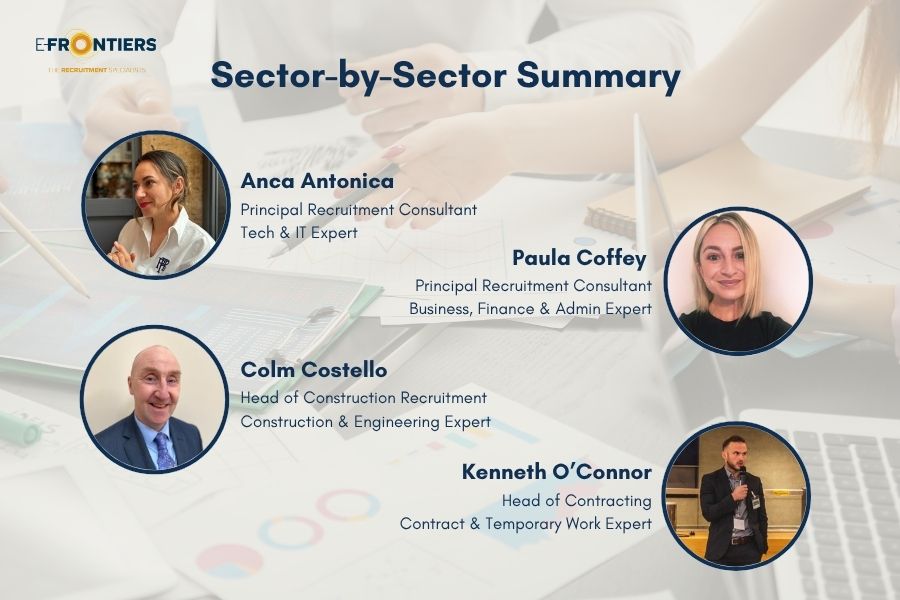
Sector-by-Sector Summary 

Tech & IT 

The tech job market is strong, with unemployment at 4.3%. 

There’s growing demand for skills in AI, machine learning, cybersecurity, and cloud computing. 

A recent survey by Nucamp showed machine learning skills are up 383% in demand. 

Outlook: Positive, but global trade issues could slow growth. 

Our Principal Recruitment Consultant in IT, Anca Antonica, celebrates 10 years at E-Frontiers this month. She is sharing her insights based on what she’s observed this first half of the year:  

“The first half of 2025 showed more resilience than many expected.” She noted that while some sectors remained cautious, especially early in Q1, we saw a steady increase in hiring confidence across tech roles – particularly in fintech, public sector digital transformation, and contract positions. There’s been strong demand for developers (Java, .NET, Full Stack), DevOps specialists, and integration experts with platforms like Celigo or Workday. Clients are balancing the need to control costs with the urgency to deliver on strategic tech projects, especially cloud migrations and AI/automation initiatives. 

From her experience during Q1 and Q2 2025, candidates are increasingly focused on flexibility – hybrid or remote-first options are still top of mind. Many also ask about team structure, company values, and stability, showing a shift from just chasing salary. Regarding companies, those that stand out are offering clear progression paths, strong onboarding processes, and involvement in high-impact projects. A growing number are also highlighting upskilling opportunities (AI/ML, cloud certs), which resonates well with more tech-driven talent. 

Focusing on the near future, she thinks the sector will face some challenges: skills shortages are becoming more acute in specific areas like AI, advanced cloud engineering, and data governance. Some companies are still navigating the return-to-office debate, which can limit their candidate pool. There’s also increasing competition from remote-first international employers offering Dublin-level salaries without the commute, so local companies need to sharpen their employer branding.

Her core insight for clients: “Speed of engagement is everything. The best candidates are often off the market in under two weeks. Clients who streamline interviews, offer clarity on projects and progression, and move decisively are consistently winning the top talent. That agility, combined with a clear EVP (Employee Value Proposition), is what makes all the difference right now.” 

Outlook: Cautiously optimistic. Demand for mid-to-senior IT professionals – especially in cloud, cybersecurity, and ERP (SAP, Dynamics 365) – is expected to stay strong. Contract roles will grow, with private sector hiring likely to pick up in Q4 if economic conditions remain stable. 

Construction & Engineering 

According to a recent report from Research and Markets.com Irish Construction shows strong signs of growth: 

  • The industry is expected to grow by 3.3% in 2025, and by 4.8% annually from 2026 to 2029. 
  • Planning permissions increased by 2.2% in 2024, after a drop of 7.4% in 2023, showing renewed momentum. 
  • Major public investment is planned: 
  • €713 million allocated for roads in 2025. 
  • €600 million in loans from Bank of Ireland to help build 4,000 homes by 2028. 
  • The government housing targets include: 
  • 41,000 homes in 2025 
  • 43,000 in 2026 
  • 303,000 homes by 2030 

Outlook: Positive, but persistent labour shortages and supply issues remain a challenge. 

This is echoed by our Head of Recruitment for Construction, Colm Costello, who shared his experience of the first half of the year and expectations for the months ahead: 

H1 2025 Performance: Colm noted that the first half of 2025 went well overall, particularly considering that our Construction desk is still relatively new. Demand for talent was strong, and a solid pipeline of roles was built. That said, sourcing suitable candidates continues to be the main challenge – a familiar theme across the sector. 

Outlook for H2 2025: Looking ahead to the second half of the year, Colm is optimistic. While the summer months may bring a brief slowdown, Q3 is traditionally the busiest time for construction recruitment, and expectations are high for similar momentum this year. Although a dip is typically seen in Q4, the team is already forward-planning to minimise any disruption.` 

Candidate Priorities & What Employers Need to Offer: When it comes to candidate preferences, hybrid working has become a standard expectation – especially among Quantity Surveyors and Estimators. Candidates already enjoying hybrid setups are reluctant to consider new roles that don’t offer similar flexibility. Still, it’s salary that remains the number one motivator when candidates consider a move. 

Sector Risks on the Horizon: Colm also flagged a few emerging risks. The sector is currently driven by residential, pharmaceutical, and data centre projects. The housing shortage will likely keep residential activity high, but potential changes in U.S. foreign policy – such as new tariffs – could lead American companies to scale back investment in Ireland’s Pharma and Data Centre space. Another ongoing challenge is the highly competitive recruitment market, with many agencies chasing a limited talent pool. 

His key takeaway for clients? “Flexibility and competitive salaries are absolutely essential if you want to attract – and more importantly, retain – the best candidates in today’s tight construction market.” 

Recruitment experts

Business, Finance & Admin 

Key Trends: 

Roles such as fundraisers, compliance managers, and learning specialists are in high demand. 

Growth is being fuelled by regulatory change, new technologies, and a focus on learning and development. 

Hiring remains steady despite broader market uncertainty. 

Flexibility and company culture are major decision-making factors for candidates. 

AI is reshaping traditional business support roles, creating a need for continuous upskilling. 

Our Principal Consultant in Sales & Marketing, Paula Coffey, shared her observations on the first half of the year and her expectations for what lies ahead: 

She noted that H1 2025 didn’t quite meet expectations. Activity was slower than hoped, with fewer open roles and longer decision-making cycles across the board. That said, Paula remains cautiously optimistic about the second half of the year – “Summer tends to bring a boost in business support recruitment, and I’m already seeing early signs of renewed momentum”. 

Candidates continue to prioritise flexibility and workplace culture above all else. Hybrid working is now considered the baseline, and companies that can offer more than just remote options -such as strong internal values and employee wellbeing initiatives – stand out the most. 

Looking ahead, one of the key risks is the ongoing disruption caused by AI. Many traditional support roles are evolving, and candidates must be proactive in keeping up with trends and technology to stay relevant. 

Paula’s key message to clients is simple: “top candidates are being lost to slow hiring processes.” In a competitive market, she believes clear communication and fast decision-making are essential to securing the best talent. 

Outlook: Demand is expected to remain steady, especially for roles connected to regulatory functions, learning and development, and business transformation. 

Contract & Temporary Work 

  • Contract roles remain in demand, supported by: 
  • Strong immigration numbers 
  • Continued hybrid working 
  • Sector-specific growth in tech, finance, and construction 
  • While forecasts don’t separate contract roles, all signs point to continued need. 
  • Outlook: Optimistic. Contracting should grow, especially in busy sectors. Risks remain if business confidence is affected by global trade issues. 

Our Head of Contracting, Kenneth O’Connor, shared his observations on the first half of the year and what he thinks about the rest of 2025: 

He noted that we had a good start to the year and the market, in the contracting industry, has exceeded his expectations. This has been across sectors for us, but activity is continuing to increase. 

At the moment, both companies and candidates are seeing that more flexibility is key for agreements to be made on both sides. 

When it comes to risks and challenges on the horizon, he points to the usual suspects – Artificial Intelligence, potential tariffs, and broader market uncertainty. However, he believes that with uncertainty comes opportunity, as companies increasingly explore shorter-term, flexible solutions to meet their resource needs.

Kenny’s key message for his clients is that engaging contractors for short-term solutions provides a lot of value. 

Outlook: He remains optimistic and expects continued growth. While some uncertainty still lingers, many clients are turning to the contractor model as a flexible hiring solution in the current climate. “We anticipate a slow but steady rise in activity across the contracting sector,” he says.

Final Thoughts 

Ireland’s economy continues to show strength, with growth projected across key sectors. While hiring may ease slightly, demand remains healthy -particularly in tech, construction, and contracting. 

Flexible work is no longer a perk but a priority, and companies offering hybrid or remote-first models continue to attract top talent. 

Contracting and infrastructure investment present exciting opportunities, especially as businesses seek agile solutions in an evolving landscape. 

However, global trade uncertainties – including tariffs and geopolitical shifts – pose risks, particularly for export-driven industries. 

Across the board, our consultants agree: challenges lie ahead, but so do opportunities. The key will be adaptability, speed, and a strong value proposition for both clients and candidates. 

We’d love to hear from you— How did Q1 and Q2 go for your business? What challenges or opportunities do you see on the horizon? What are your expectations for the rest of 2025? 

For further recruitment insights, please check out our Industry insights section on our website.

author avatar
Cristina Rafael

More Insights All Posts

View our industry experts opinion on all things recruitment, salaries, working from home and everything in between.